

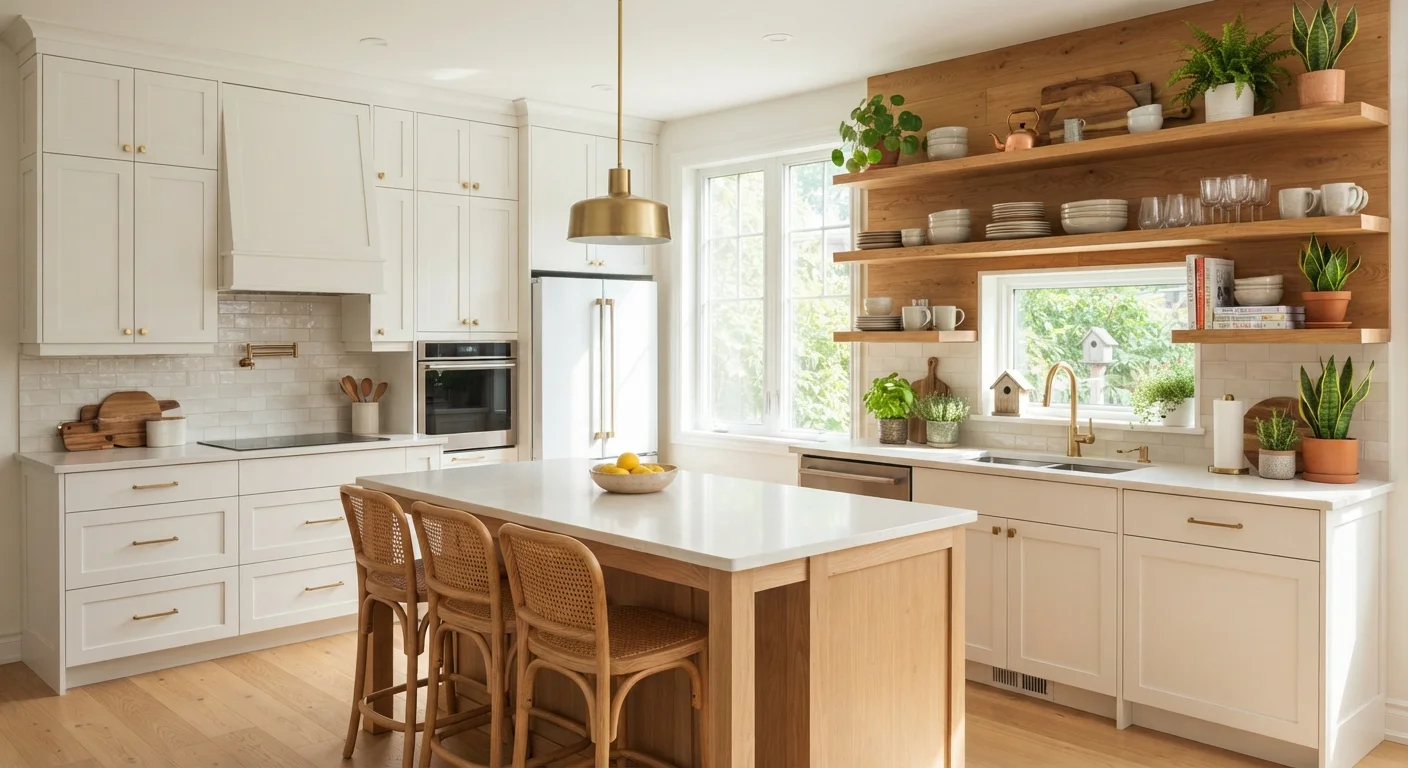
Key Takeaways
Option A
Open Shelving
The airy, display-forward approach.
Best for: Homeowners who keep tidy counters, love curating a visual display, and want a kitchen that feels more open and connected.
Option B
Closed Cabinets
The practical, clutter-concealing classic.
Best for: Households with busy lifestyles, varied cookware collections, or anyone who prefers a clean, uniform look without daily maintenance.
If you prefer a low-maintenance, clutter-free kitchen
Closed Cabinets
Closed cabinets hide everyday messes behind uniform doors, requiring far less daily tidying and protecting stored items from cooking grease and airborne dust.
If you want to make a small kitchen feel larger and more airy
Open Shelving
Removing upper cabinet doors visually opens up wall space and reduces visual weight, which can make compact kitchens feel less boxed-in.
If you enjoy displaying curated dishware or collectibles
Open Shelving
Open shelves turn everyday objects into intentional décor, rewarding homeowners who take pleasure in arranging and maintaining a cohesive display.
If you have a large, varied collection of pots, appliances, and pantry items
Closed Cabinets
Closed storage accommodates mismatched, bulky, or utilitarian items that would look visually chaotic if left exposed on open shelves.
If you want flexibility without committing fully to one approach
Open Shelving
Adding a few open shelves to an existing cabinet layout is a relatively simple project that introduces openness while keeping the bulk of your storage hidden.
What Each Approach Actually Involves
Open shelving replaces upper cabinet boxes - and often their doors - with simple floating shelves or bracket-mounted boards. Everything stored on them is fully visible at all times. Closed cabinets, the longtime kitchen standard, use doors (typically hinged or sliding) to enclose storage completely. Both can be installed at any budget level and in virtually any kitchen layout.
Before choosing, it helps to honestly evaluate how your kitchen functions today. Assessing what your space actually needs before making changes is a crucial first step - what looks inspiring in a design magazine may create daily friction in a real working kitchen.
| Criterion | Open Shelving | Closed Cabinets |
|---|---|---|
| Visual effect | Airy, open, display-forward | Uniform, contained, calm |
| Maintenance demand | High - frequent dusting and tidying | Lower - wipe exterior surfaces |
| Grease/dust protection | None - contents fully exposed | Strong - doors seal out residue |
| Installation complexity | Simple - floating shelves, brackets | Moderate to complex - full cabinet units |
| Storage flexibility | Limited - must look presentable | High - accommodates any items |
| Cost range | Often lower upfront | Wider range; higher for custom |
| Reversibility | Moderate - shelves can be removed | High - doors can be added or changed |
The Real Trade-Offs: Maintenance, Dust, and Daily Life
Open shelving's most underappreciated demand is maintenance. Because items are exposed, they accumulate kitchen grease, steam residue, and dust much faster than items stored behind doors. Plates, glasses, and decorative objects on open shelves typically need wiping down every one to two weeks in an active kitchen - more often near the stove.
Closed cabinets, by contrast, protect contents almost entirely. Items stored inside can go months between cleanings. The exterior surfaces of cabinet doors do collect grease and fingerprints, but a single wipe-down covers far more storage area in far less time.
A Note on Rental Kitchens
If you're renting, confirm with your landlord before removing cabinet doors or mounting floating shelves. Many landlords permit temporary changes if original hardware is stored and restored. Freestanding shelving units are a fully reversible alternative that adds open storage without any wall modification.
For households with young children, pets, or anyone who cooks frequently, closed cabinets also reduce the risk of items being knocked off shelves. Open shelves placed too low become a hands-on temptation for curious kids.
Visual Impact and Design Considerations
Open shelves genuinely do make kitchens feel more spacious - particularly when installed above the counter on a single wall rather than wrapping the entire room. Removing upper cabinet doors is one of the most common DIY moves for homeowners trying to brighten a darker kitchen. The tradeoff is that what you store becomes part of the room's visual design. Mismatched storage containers, half-used cereal boxes, or a crowded shelf can make the room feel more chaotic rather than more open.
Closed cabinets deliver visual consistency. A uniform row of cabinet doors - whether shaker-style, flat-panel, or traditional raised-panel - reads as calm and organized even when the insides are anything but. This is why the most persistent decorating myths often involve surface-level tidiness standing in for genuine design intentionality.
Lighting also plays a role in how either choice reads. Under-cabinet lighting installed beneath closed upper cabinets adds warmth and task illumination; for open shelves, ambient and accent lighting from other sources becomes more critical. See how recessed and track lighting compare if you're rethinking your kitchen's overall lighting alongside its storage.
When a Hybrid Layout Makes the Most Sense
For most American kitchens, the most practical answer is neither all open nor all closed - it's a deliberate mix. A common approach: keep lower cabinets fully enclosed for bulky pots, pans, and cleaning supplies, and use one or two open shelf runs above the counter for everyday dishes, glasses, and a few plants or decorative objects.
This arrangement lets you enjoy the visual lightness of open display without sacrificing the functional concealment that busy households genuinely need. If you're weighing whether to upgrade your existing cabinet boxes at the same time, cabinet refacing versus full replacement is worth understanding before committing to a project scope.
~30%
Kitchens using open shelving in new builds
Design industry surveys have noted open shelving appearing in roughly a quarter to a third of new kitchen installations, reflecting growing interest in the look among homeowners.
2-4x
More frequent cleaning needed for open vs. closed storage
Interior designers and kitchen specialists generally note that open shelving in active cooking environments requires cleaning several times more often than items stored behind cabinet doors.
The hybrid approach also makes the transition lower-risk. Removing a few upper cabinet doors - or replacing a short cabinet run with floating shelves - is a reversible experiment. If the open display turns out to require more upkeep than expected, reinstalling doors is straightforward.