
Accredited vs. Non-Accredited Online Programs: What Employers and Schools Actually Check

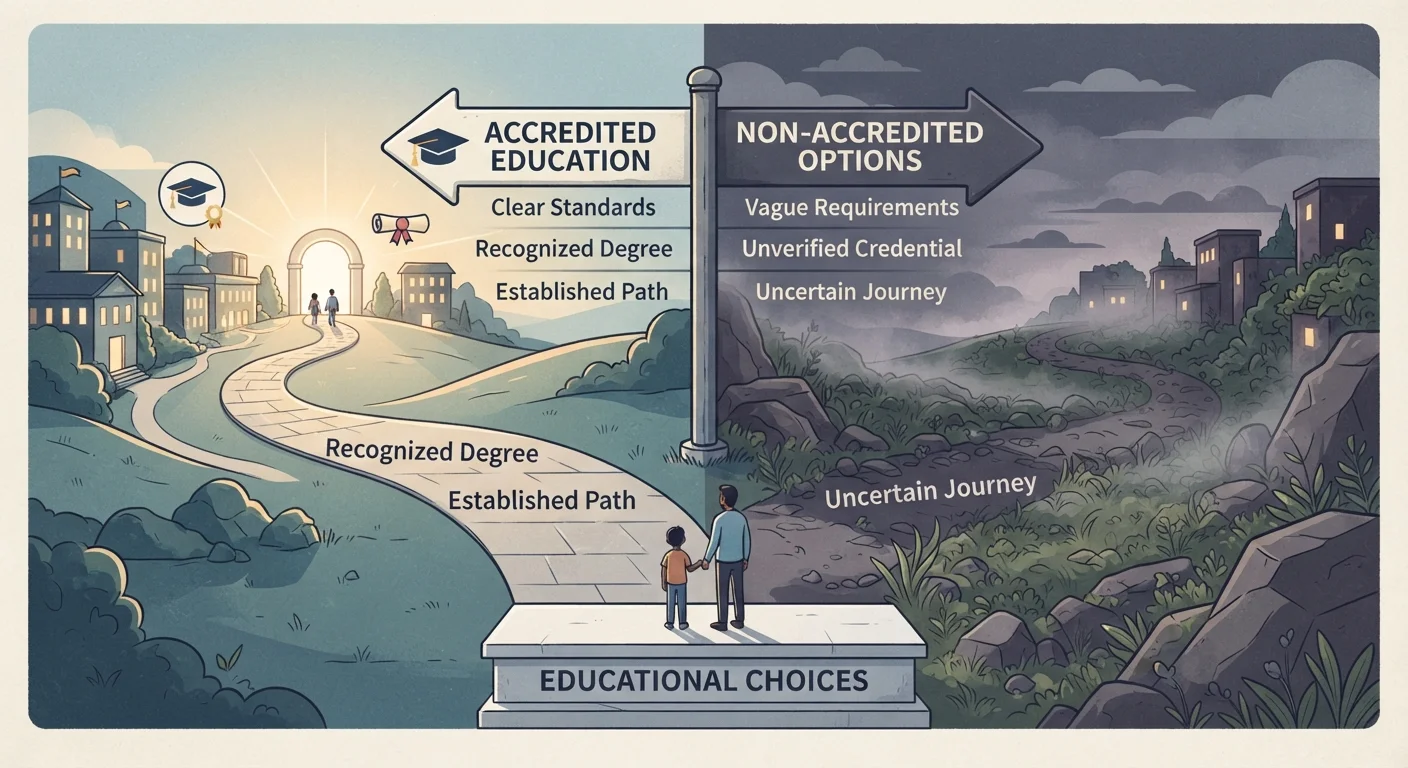
Key Takeaways
Option A
Accredited Online Programs
The credential backed by formal institutional review.
Best for: Learners who need transferable credits, federal financial aid eligibility, or a degree recognized by employers and graduate schools.
Option B
Non-Accredited Online Programs
The flexible, often skills-focused alternative.
Best for: Professionals seeking to upskill quickly in fields where demonstrated competency matters more than institutional credentials.
If you plan to transfer credits or pursue a graduate degree
Accredited Online Programs
Graduate schools and most four-year universities only accept transfer credits from regionally accredited institutions. Without this, your coursework may not count toward future degrees.
If you need federal financial aid to cover tuition
Accredited Online Programs
Federal grants and loans are available only at institutions accredited by a Department of Education-recognized body. Non-accredited programs offer no access to this funding.
If you want to enter a licensed or regulated profession
Accredited Online Programs
Fields like nursing, teaching, social work, and accounting typically require degrees from accredited programs for licensure. Regulators and licensing boards check accreditation status directly.
If you're upskilling in tech, design, or a portfolio-driven field
Non-Accredited Online Programs
In many technology and creative roles, hiring managers focus on demonstrated skills and portfolio quality. A well-structured non-accredited course can provide practical expertise efficiently.
If your employer requires a verifiable degree for promotion or hiring
Accredited Online Programs
HR departments at mid-to-large employers often use third-party verification services that flag non-accredited credentials. An accredited degree avoids this barrier entirely.
What Accreditation Actually Means
Accreditation is a quality-review process in which an independent organization evaluates whether a college, university, or program meets established educational standards. In the United States, accreditors must themselves be recognized by the U.S. Department of Education (ED) or the Council for Higher Education Accreditation (CHEA) to carry weight in federal and institutional decisions.
There are two main tiers of institutional accreditation relevant to most learners:
- Regional accreditation - historically the most rigorous and widely accepted type, granted by bodies like the Higher Learning Commission (HLC) or SACSCOC. Most nonprofit colleges and universities hold regional accreditation.
- National accreditation - typically applied to for-profit, vocational, or career-focused schools. Generally less portable when it comes to credit transfers.
Programs can also hold programmatic accreditation - a separate review of a specific field of study, such as ABET for engineering programs or ACEN for nursing. Employers and licensing boards in those fields may require this in addition to institutional accreditation.
Crucially, a school cannot accredit itself. Claiming to be accredited without recognition from an ED- or CHEA-recognized body is a sign of a diploma mill. Always verify status through the ED's official database before enrolling. For a deeper look at the topic, see Accreditation Demystified.
| Criterion | Accredited Online Programs | Non-Accredited Online Programs |
|---|---|---|
| Federal financial aid eligibility | Yes - Pell Grants, federal loans available | No - must pay out of pocket or find alternatives |
| Credit transferability | Generally accepted (especially regional accreditation) | Rarely accepted by accredited institutions |
| Employer recognition | Broadly recognized, especially in regulated fields | Varies widely by industry and employer |
| Graduate school admission | Meets baseline requirements at most programs | Often disqualifying without separate accredited degree |
| Licensure eligibility | Required in most regulated professions | Generally insufficient for licensed professions |
| Curriculum flexibility | More structured; must meet accreditor standards | Often more current and industry-responsive |
| Cost range | Varies widely; often higher tuition | Often lower cost or subscription-based |
How Employers and Graduate Schools Check Credentials
When you submit a resume or graduate school application, the review process for your degree is often more systematic than a simple glance at the institution name.
What Employers Check
Large employers - particularly in government contracting, healthcare, finance, and education - commonly use third-party credential verification services. These services compare your stated degree against institutional records and accreditation status. A degree from a non-accredited school may be flagged or simply excluded from consideration in these systems.
In contrast, many technology companies, startups, and creative agencies place greater weight on demonstrated skills, GitHub profiles, design portfolios, or completed projects. In these contexts, a certificate from a reputable non-accredited program may be respected - or even preferred - when paired with visible work.
What Graduate Schools Check
Graduate admissions offices are generally explicit: most require an undergraduate degree from a regionally accredited institution as a baseline condition for consideration. National accreditation alone is often insufficient. Applicants whose undergraduate credentials don't meet this threshold are frequently screened out before a human reviewer evaluates their application.
Understanding how your specific field treats credentials is essential. Online learning platforms differ structurally - and so does the credential weight they carry.
~7,000
U.S. institutions with ED-recognized accreditation
The U.S. Department of Education maintains a searchable database of all institutions holding recognized accreditation status.
40%+
of college students receive federal Pell Grant aid
According to the National Center for Education Statistics, federal grant aid is available only at accredited institutions, making accreditation a gateway to funding for millions of learners.
Regional vs. National
Key accreditation distinction for credit transfer
CHEA research consistently shows that regional accreditation remains the standard most accepted for credit transfer between institutions.
When Non-Accredited Programs Still Deliver Real Value
Non-accredited does not automatically mean low-quality. Bootcamps, professional development platforms, and industry-led training programs often deliver rigorous, current, and job-relevant instruction - particularly in fields that move faster than traditional accreditation cycles can accommodate.
Consider these scenarios where non-accredited programs have demonstrated practical value:
- Software development and data science - Coding bootcamps have placed graduates in professional roles, especially when combined with a strong portfolio and demonstrated problem-solving ability.
- Digital marketing and content creation - Industry-recognized certificates from platform providers are often cited by practitioners as more current than equivalent university coursework.
- Entrepreneurship and business skills - Short, intensive programs focused on lean startup methodology or financial modeling can supplement formal education effectively.
The key variable is whether your target employer or licensing body cares about accreditation for the specific role you're pursuing. Research job postings in your field before investing in any program. Before you enroll, ask the right questions to verify a program's legitimacy regardless of its accreditation status.
For a broader view of how credentials compare across education routes, vocational and trade credentials offer a useful comparison point.