

Key Takeaways
Start here
Why Insulation Matters
Learn the language
Understanding R-Values
Explore your options
Common Insulation Types
Plan your project
Where to Insulate in Your Home
Make your decision
DIY vs. Hiring a Professional
Why Insulation Matters
Insulation is one of the most effective ways to make a home more comfortable and energy-efficient, yet it's one of the least visible improvements you can make. Without adequate insulation, conditioned air - the warm or cool air your HVAC system works hard to produce - leaks out through walls, ceilings, and floors, forcing your system to run longer and work harder.
The result is higher utility bills, uneven temperatures between rooms, and a home that feels drafty in winter or stuffy in summer. Improving insulation addresses all three problems at once. It also helps with noise reduction and can protect against moisture-related damage when installed correctly.
Start With an Energy Audit
Before investing in insulation, consider scheduling a home energy audit. Many utility companies offer these at low or no cost, and auditors use tools like blower door tests and thermal cameras to pinpoint exactly where your home is losing energy. This takes the guesswork out of where to focus first.
Understanding R-Values
Before shopping for insulation or hiring a contractor, it helps to understand one core concept: the R-value. R-value is a measure of thermal resistance - how well a material slows the movement of heat. The higher the R-value, the better the insulating performance.
R-values are additive. If you install two layers of R-19 insulation, you get roughly R-38. The specific R-value you need depends on your climate zone, the part of your home you're insulating, and local building codes. The U.S. Department of Energy publishes recommended R-values by climate zone, which is a helpful starting point before consulting a local professional.
R-value
A number that measures how well insulation resists heat flow. Higher R-values mean better insulating performance.
Thermal bridging
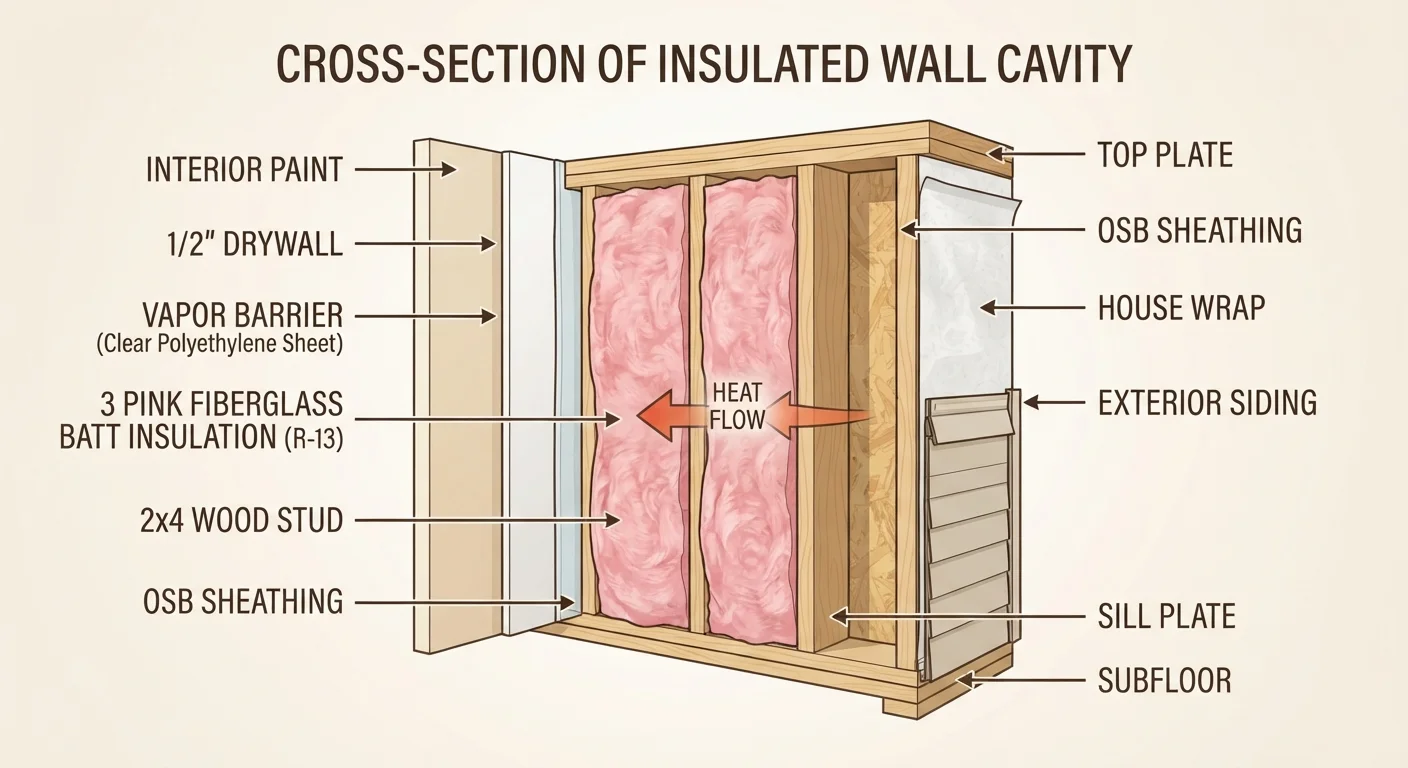
When heat bypasses insulation by traveling through a more conductive material, like a wood stud or metal framing, reducing overall efficiency.
Vapor retarder
A material that slows the movement of moisture through walls and ceilings, helping prevent condensation and mold inside the building assembly.
Air sealing
The process of closing gaps, cracks, and penetrations in a home's envelope to stop unwanted airflow, which works hand-in-hand with insulation.
Closed-cell foam
A dense type of spray foam insulation with a high R-value per inch that also resists moisture and can act as a vapor barrier.
Rim joist
The horizontal framing member that sits on top of your foundation wall, connecting the floor framing. It's a common source of air leaks and heat loss.
Common Insulation Types
Insulation comes in several forms, each suited to different locations and installation methods:
- Fiberglass batts: Pre-cut blankets of spun glass fibers that fit between standard wall studs and attic joists. These are widely available, relatively affordable, and manageable for experienced DIYers in accessible spaces.
- Blown-in (loose-fill): Shredded cellulose or fiberglass blown into attics or enclosed cavities using a machine. Excellent for filling irregular spaces and topping up existing attic insulation.
- Spray foam: A two-component liquid that expands into a solid foam. It insulates and air-seals simultaneously. Closed-cell spray foam also acts as a vapor barrier. Professional installation is strongly recommended for most applications.
- Rigid foam boards: Dense panels used on basement walls, exterior sheathing, and under slabs. They offer high R-value per inch of thickness.
- Mineral wool (rock wool): Made from volcanic rock or steel slag, it is fire-resistant and moisture-tolerant, making it a good fit for basements and areas with higher humidity.
Where to Insulate in Your Home
Not every part of your home loses heat equally. Prioritizing strategically gives you the most benefit for your investment:
- Attic: Heat rises, so the attic is where most homes lose the most energy. It's usually the first place to address.
- Exterior walls: Walls between conditioned living space and the outdoors should be well insulated. Older homes often have little to none inside the cavities.
- Basement and crawl space: Uninsulated foundations allow cold to creep into floors above. Insulating the rim joist (where the foundation meets the framing) is especially impactful.
- Floors over unconditioned spaces: Floors above garages or vented crawl spaces benefit from insulation between the joists.
Air sealing - caulking or foam-sealing gaps around pipes, wires, and fixtures - should accompany any insulation upgrade. Insulation slows heat transfer, but air sealing stops the drafts that carry heat directly out of the home.
Watch for Asbestos in Older Homes
Homes built before the mid-1980s may contain asbestos-based insulation materials, particularly vermiculite in attics or wrap-style insulation on older pipes. Do not disturb suspected asbestos-containing materials. Have a licensed asbestos inspector test and, if necessary, professionally abate the material before beginning any insulation work.
DIY vs. Hiring a Professional
Some insulation work is within reach of a motivated homeowner. Adding blown-in insulation to an open attic floor, for example, is a common DIY project - many home improvement stores rent the blowing equipment when you purchase enough material. Installing fiberglass batts in an accessible, unfinished basement ceiling is similarly manageable.
Other work is best left to licensed professionals. Spray foam installation, insulating enclosed wall cavities in finished rooms, and any project involving asbestos abatement (a concern in homes built before the 1980s) all warrant professional expertise. When in doubt, a professional energy audit - offered by many utility companies and weatherization programs - can tell you exactly where your home is losing energy and what solutions make the most sense for your situation.
Always check with your local building department about permit requirements before beginning any insulation project. Requirements vary by municipality and project scope.