

Why Decorating Style Labels Actually Matter
Decorating style names aren't just jargon - they're a shared vocabulary that helps you communicate what you want, identify what you're drawn to, and avoid costly trial-and-error purchases. When you can name a style, you can research it, replicate it intentionally, and avoid mixing elements that will clash rather than complement. Before adding anything new to a room, it helps to know where you're headed. See our room-by-room décor audit for a structured way to assess what you already have.
The styles below represent the most widely used in American homes today. Many overlap, and real rooms rarely fit a single category perfectly - which is part of what makes interior design so personal. Use these definitions as a reference, not a rulebook.
The Major American Decorating Styles, Defined
Traditional
Rooted in 18th- and 19th-century European design, traditional style emphasizes symmetry, rich wood tones, upholstered furniture with curved lines, and layered textiles. Color palettes tend toward warm neutrals, burgundy, navy, and forest green. Details like crown molding, wingback chairs, and oil paintings are hallmarks. It reads as formal and polished without being cold.
Transitional
Transitional is the most widely chosen style in American homes because it bridges traditional and contemporary. It pairs classic silhouettes with cleaner lines, mixes upholstered pieces with metal accents, and keeps color palettes neutral. Nothing is too ornate or too stark. It's the style people often describe as "timeless."
Modern
True modern design refers specifically to the Modernist movement of the early-to-mid 20th century - flat surfaces, minimal ornamentation, and a "form follows function" philosophy. Materials like steel, glass, and concrete are common. It's often confused with contemporary, which simply means design current to the present moment.
Mid-Century Modern
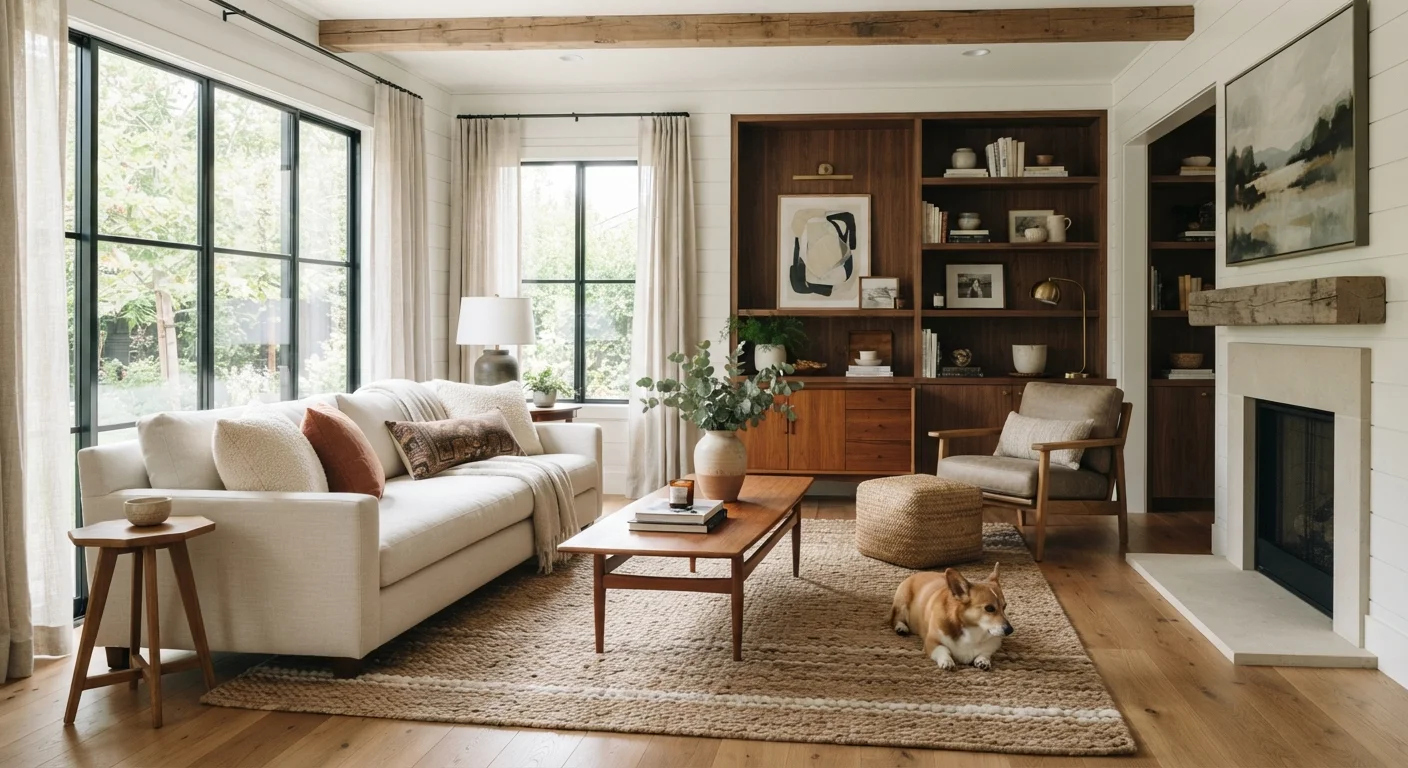
Mid-century modern draws from American and Scandinavian design of roughly the 1940s through 1960s. Recognizable features include tapered legs on furniture, organic curves, teak and walnut wood, and a palette of olive, mustard, and rust alongside muted neutrals. It emphasizes clean lines while remaining warm and livable.
Farmhouse
Farmhouse style takes its cues from rural American working homes - shiplap walls, barn doors, apron-front sinks, and distressed wood. Modern farmhouse softens this with white palettes, linen textiles, and open shelving. It feels casual, unpretentious, and family-friendly. Common decorating misconceptions can make farmhouse rooms look unfinished if the mix of rustic and refined isn't handled thoughtfully.
Coastal
Coastal style channels relaxed seaside living through light colors (white, sand, soft blue), natural textures like rattan, jute, and linen, and an emphasis on open, airy layouts. It doesn't require literal nautical décor - the feeling is breezy and informal rather than themed.
Scandinavian (Scandi)
Scandinavian design prioritizes function, simplicity, and warmth in cold-climate living. Expect pale wood, minimal ornamentation, cozy textiles (known as hygge), and a restrained palette of whites, grays, and natural tones. It overlaps significantly with modern and minimalist styles but always retains a sense of comfort.
Industrial
Industrial style borrows from converted loft and warehouse spaces - exposed brick, concrete floors, metal pipe shelving, and Edison bulbs. Furniture tends to be raw-edged, chunky, and utilitarian. The palette runs dark: black, charcoal, and deep brown, often warmed with leather and aged wood.
Bohemian (Boho)
Bohemian interiors layer patterns, global textiles, vintage finds, and abundant plants with little regard for matching sets. Color is embraced, and curated clutter is part of the appeal. It's intentionally eclectic - for guidance on pulling that off, see our article on mixing old and new in eclectic interiors.
Minimalist
Minimalism applies a strict less-is-more philosophy: only what's necessary remains. Surfaces are clear, storage is concealed, and every piece is deliberate. Palettes are typically monochromatic or near-neutral. The goal is calm through absence rather than addition.
Biophilic
Biophilic design is less a decorating style and more a design principle - it prioritizes connection to nature through living plants, natural materials, abundant daylight, and organic forms. It can be layered onto virtually any other style. Learn how it works in practice through our guide on biophilic design in everyday homes.
Transitional Style
A decorating approach that blends traditional and contemporary elements, balancing classic silhouettes with cleaner lines and neutral palettes. It avoids extremes of either formality or starkness.
Biophilic Design
A design philosophy centered on connecting interior spaces to the natural world through plants, natural materials, daylight, and organic forms. It can be applied within virtually any decorating style.
Mid-Century Modern
An American and Scandinavian-influenced design movement from roughly the 1940s-1960s, characterized by tapered furniture legs, organic curves, warm wood tones, and a restrained but warm color palette.
Hygge
A Danish and Norwegian concept describing a quality of coziness, warmth, and comfortable togetherness. In Scandinavian interior design, it manifests through soft textiles, warm lighting, and natural materials.
Minimalism
A design philosophy that removes everything non-essential, leaving only deliberate, functional pieces. The goal is visual calm achieved through restraint and concealed storage rather than decoration.
Industrial Style
An interior aesthetic inspired by converted loft and factory spaces, featuring exposed structural materials like brick and concrete alongside raw metal, leather, and aged wood.
How to Identify Your Own Style
Most people are drawn to two or three styles simultaneously - and that's normal. Transitional, for example, exists precisely because pure traditional felt too formal and pure modern felt too cold for everyday American living. The useful exercise is identifying which elements within a style appeal to you rather than committing wholesale to a label.
Consider the materials, colors, and furniture silhouettes that consistently appear in spaces you find appealing. If you gravitate toward warm wood, layered textiles, and soft neutrals regardless of the labeled style, those preferences are your real design language. A paint sheen choice can reinforce or undercut a style's mood just as much as furniture - our guide to interior paint finishes explains how sheen interacts with light and atmosphere.
Style labels are most useful as a starting point and a communication tool - not as rules you're obligated to follow.