

Key Takeaways
Why the South Rewards Slow Driving
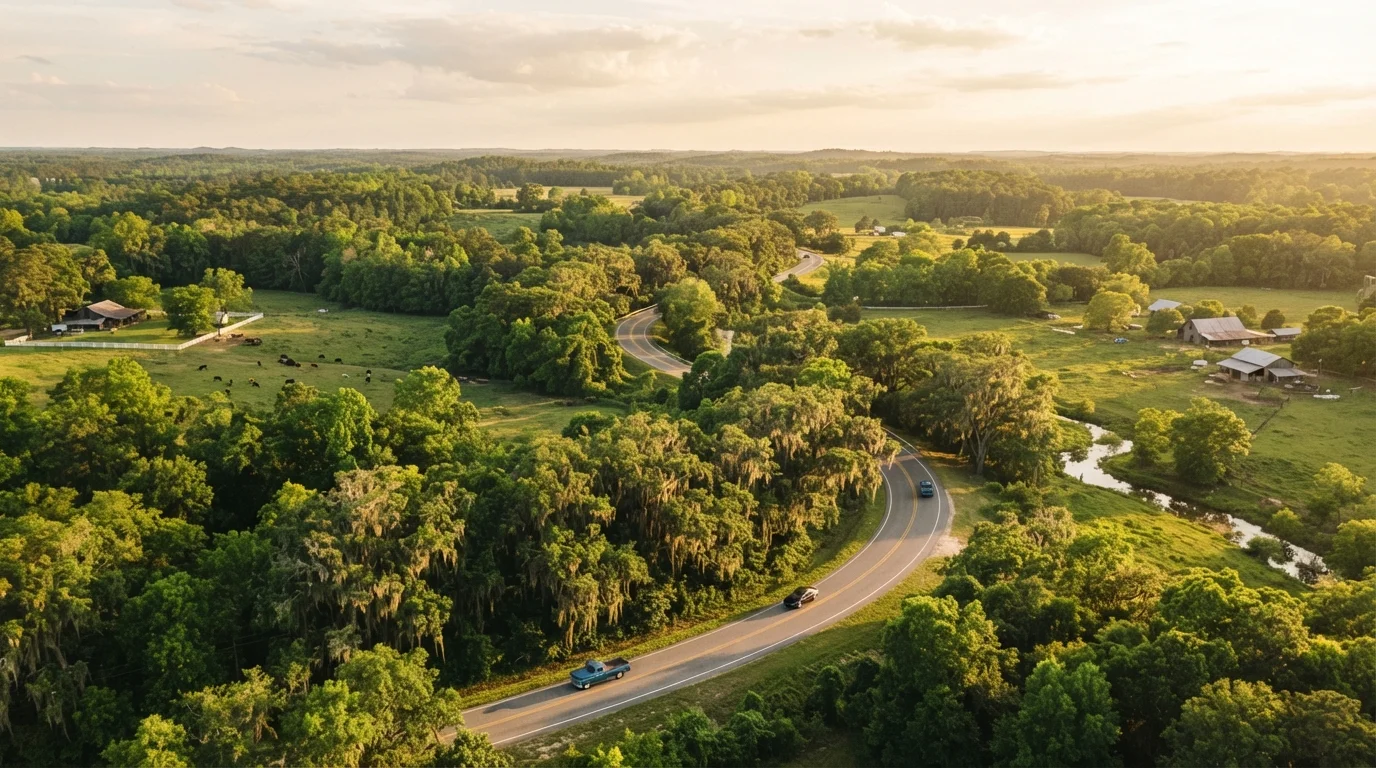
Few regions in the United States repay patience behind the wheel the way the American South does. Unlike a Western road trip defined by dramatic vistas at predictable overlooks, Southern driving is textured and layered — a roadside church built in 1887 beside a pecan grove, a blues juke joint that opens only on Saturday nights, a ferry crossing a blackwater river with no bridge in sight. The reward is rarely visible from the interstate.
That distinction matters enormously when planning. Drivers who attempt to cover the South at highway speed tend to miss its essence entirely, passing through without landing anywhere meaningful. If you're new to longer drives, see our step-by-step guide to first long-distance road trips for a solid framework before you map a Southern route.
The South is also more varied than its stereotype suggests. Within roughly 1,000 miles of driving, you move from mountain hollows in western North Carolina to tidal marshes on the Georgia coast, from the cotton-field flatlands of the Delta to the cypress swamps of Louisiana. Each sub-region has its own cuisine, dialect, architectural vernacular, and pace of life.
Download offline maps for each state you're entering before you leave cell coverage — rural Delta and Sea Island roads are notorious dead zones where data service disappears entirely.
Cell coverage in rural Southern counties, particularly in the Mississippi Delta and coastal Georgia, remains inconsistent. Offline maps eliminate the single biggest navigation failure point on backroad trips.
When choosing between a state highway and a US highway on the map, default to the state highway — they tend to pass through more town centers and offer far more character than the numbered US routes.
State highways in the South were often built before the US highway system and follow older settlement patterns, routing through courthouse squares, historic downtowns, and agricultural communities that US routes bypass.
Building Your Route: Four Core Corridors
Rather than attempting to do everything at once, most Southern road trips work best when organized around one or two of the region's four natural corridors.
The Mississippi Delta Corridor
Running roughly from Memphis, Tennessee, south to Natchez, Mississippi, this route follows the flatlands where American blues music was born. Highway 61 — the so-called Blues Highway — is the spine. Small towns like Clarksdale, Cleveland, and Indianola each hold museums, performance venues, and landmarks tied directly to the Delta's musical heritage. For those considering extending the drive north or south along the river, the Great River Road scenic byway covers the Mississippi's full length across ten states.
The Appalachian Foothills Corridor
The Blue Ridge Parkway and its connecting state roads thread through western North Carolina, northern Georgia, and into Tennessee. This is fall foliage country in September and October, cooler and greener than the lowland South. Towns like Asheville, NC, and Dahlonega, GA, serve as natural anchors.
The Gulf Coast Corridor
From Pensacola, Florida, west through Biloxi and Gulfport, Mississippi, to New Orleans, Louisiana, the coast road traces white-sand beaches, antebellum port towns, and one of America's great culinary cities at its western terminus. US-90 largely parallels the coast and carries far more local flavor than I-10.
The Georgia Lowcountry and Sea Islands
South Georgia and coastal South Carolina offer a quieter, otherworldly version of the South — tabby ruins, Gullah Geechee culture, salt marshes, and barrier islands accessible only by causeway or ferry. US-17 through this stretch is one of the most underrated scenic byways in the country.
444 miles
Length of the Natchez Trace Parkway
The Natchez Trace Parkway, managed by the National Park Service, runs from Natchez, MS, to Nashville, TN, with no commercial traffic permitted.
10 states
States along the Great River Road
The Great River Road National Scenic Byway follows the Mississippi River across ten states, from Minnesota to the Gulf of Mexico.
~2,000 miles
Driving distance, Memphis to New Orleans via backroads
A leisurely Southern loop connecting Memphis, the Delta, New Orleans, the Gulf Coast, and back covers roughly 1,800–2,200 miles depending on detours.
History on Every Horizon
The South carries American history in concentrated form — and much of it is physically present in the landscape. Civil War battlefields, Civil Rights movement landmarks, antebellum architecture, and Indigenous heritage sites are often within a short drive of one another, sometimes in the same county.
Serious history travelers should plan stops around the National Park Service's African American Civil Rights Network sites, which span multiple Southern states and include locations connected to the Montgomery Bus Boycott, the Selma to Montgomery Marches, and the Freedom Riders movement. Many of these sites are free to enter and provide context that no highway billboard can offer.
The Natchez Trace Parkway — a federally designated road following an ancient travel corridor from Natchez, Mississippi, to Nashville, Tennessee — is among the most historically layered drives in the country. No commercial vehicles or billboards are permitted on the Parkway, which makes it feel genuinely removed from modern roadside America.
Practical Logistics for a Southern Road Trip
Planning the nuts and bolts of a Southern road trip involves a few considerations that differ from other American regions.
Season and Climate
Spring (March through May) and fall (September through November) are generally the most comfortable seasons for driving. Summer heat and humidity across the Deep South can be intense, and the Gulf Coast and lowcountry face meaningful hurricane risk from June through November. If summer travel is unavoidable, plan to drive in the morning and seek air-conditioned stops during midday hours.
Distances Between Services
While the South is more densely settled than the desert West, rural stretches — particularly in the Delta and along the Georgia coast — can have significant gaps between gas stations and medical facilities. Some backroads that appear navigable on a map can be seasonal or poorly maintained. Our guide to roads that catch first-time travelers off guard covers this dynamic in detail.
Accommodation
Larger cities like New Orleans, Nashville, and Savannah have abundant lodging. Smaller towns in the Delta or rural Georgia may offer only a handful of options, and some historic inns book up months in advance during festival weekends. Research small-town accommodation early — options are genuinely limited in some areas.
Book Small-Town Lodging Early
In popular Southern festival towns like Oxford, MS, or Beaufort, SC, lodging can sell out weeks in advance around annual events. Check local tourism calendars when finalizing your dates. A single festival weekend can double nightly rates and eliminate availability across an entire county.
Food, Culture, and the Art of the Detour
Arguably the most compelling reason to drive the South rather than fly through it is the food. The region is home to some of the most regionally distinct American cuisines — Gulf Coast seafood, Delta tamales (a genuinely surprising regional specialty with deep historical roots), Nashville hot chicken, Low Country boil, and New Orleans Creole cooking, to name only a few. Following a food thread — planning stops around a specific culinary tradition — is a legitimate and rewarding way to structure a Southern route.
Music functions similarly. The Delta corridor is inseparable from blues history. Nashville anchors country and Americana. New Orleans has its own brass band and jazz traditions that spill into the streets on any given evening. Checking local event calendars before finalizing an itinerary can reveal small festivals and live music nights that aren't widely publicized.
Families driving with children will find that the South offers an unusually varied mix of outdoor spaces, living history sites, and hands-on museums. The practical guide to road trips with kids has useful strategies for managing long driving days with younger travelers.
Safety, Weather, and Road Conditions
Southern driving is generally straightforward, but a few safety considerations deserve attention. Rural two-lane roads can narrow significantly, carry farm equipment in agricultural areas, and lack shoulders. Deer are common in wooded corridors, particularly at dawn and dusk. Drive to conditions — not just to the speed limit.
Summer thunderstorms across the region can be severe and move quickly. If dark clouds build rapidly while you're driving, pull over safely at a gas station or rest area rather than pushing through heavy rain. Flash flooding is a genuine risk in low-lying areas, particularly around river deltas and coastal marshes. Never attempt to drive through standing water of unknown depth.
For all Southern road trips, keeping your vehicle properly maintained before departure is non-negotiable. Review our safe driving tips for a practical pre-trip checklist. If you're curious how the South's humid, flat-to-hilly terrain compares with other demanding American drives, the guide to desert driving in the Southwest offers a useful contrast in terrain and preparation needs.
Above all, give yourself time. The South is not a region to rush. Its character reveals itself on mile 200 of a small state highway, at a table shared with strangers, or at a roadside marker that stops you cold. That's the trip worth planning for.