

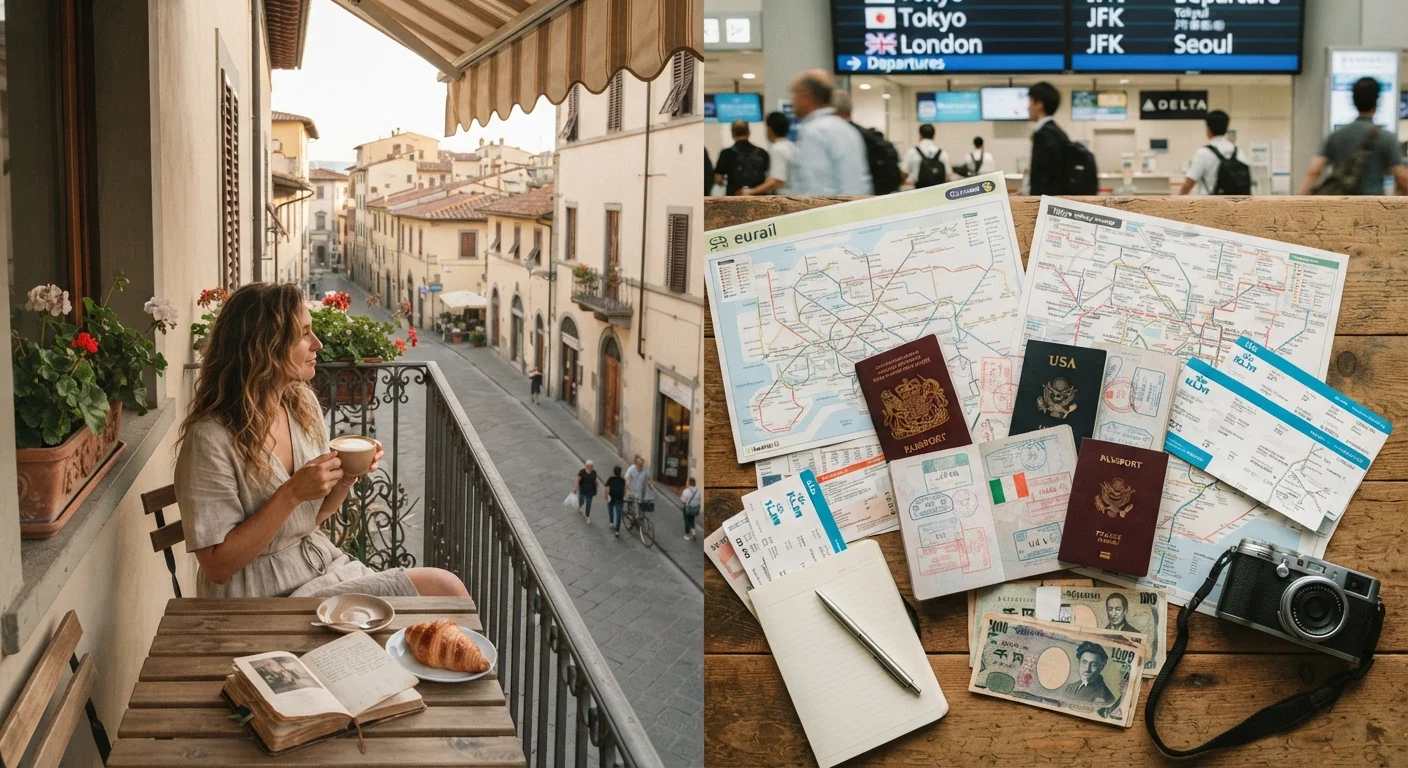
Key Takeaways
Option A
Slow Travel
The deep-dive, budget-stretching approach.
Best for: Travelers who want to immerse themselves in a region, reduce transit costs, and unlock weekly accommodation discounts.
Option B
Country-Hopping
The variety-first, experience-rich approach.
Best for: Travelers on a fixed window who want to tick multiple destinations and are comfortable managing frequent transport logistics.
If you have a month or more and want to minimize daily spend
Slow Travel
Extended stays unlock monthly rental rates, grocery routines, and lower-cost local habits that dramatically cut your daily average.
If you have two weeks and want to see multiple countries
Country-Hopping
A tight itinerary across neighboring countries can be worthwhile if you plan transport in advance and keep accommodation simple.
If you're traveling with family or a group
Slow Travel
Renting a single apartment for a week or two is almost always cheaper per head than booking multiple hotel rooms across several cities. See our slow travel with kids guide for more.
If you're doing a US-based road trip rather than international travel
Country-Hopping
Domestic road trips benefit from varied stops; fuel and campsite costs stay manageable without international transit fees complicating the budget.
If maximizing new experiences per dollar is your priority
Slow Travel
Deeper stays surface free or low-cost local activities - markets, parks, neighborhood events - that fast itineraries simply don't allow time to find.
Where the Money Actually Goes
Every traveler's budget breaks down into roughly the same categories: accommodation, transport, food, activities, and incidentals. What changes dramatically between slow travel and country-hopping is the weight each category carries.
With slow travel, accommodation and food dominate - but both can be aggressively managed. A traveler who stays in one city for three weeks can negotiate weekly rates on an apartment, shop at local markets, and develop a mental map of which streets offer the best value. Compare that with country-hopping across five nations in the same period: you're paying for five sets of arrival transfers, five "orientation nights" where you inevitably overspend because you don't know the area yet, and likely multiple flights or long-distance trains.
For budget-minded travelers exploring European cities, our European budget travel resource breaks down rail passes, free museum days, and seasonal pricing in detail. And if high-cost cities are unavoidable on your route, strategies for keeping spending contained can offset the premium.
| Criterion | Slow Travel | Country-Hopping |
|---|---|---|
| Accommodation cost | Lower - weekly/monthly discounts common | Higher - nightly rates, no loyalty savings |
| Transport spend | Low - minimal transit once settled | High - repeated flights, trains, transfers |
| Food costs | Lower - grocery routines, local knowledge | Higher - tourist-area dining by default |
| Visa/entry fees | One-time or minimal | Multiple fees across borders |
| Arrival overhead costs | Paid once | Repeated at each new destination |
| Destinations covered | One or two regions, deeply explored | Multiple countries or cities |
| Flexibility | High within one area | High across geography, less per place |
| Best trip length | 3+ weeks | 1-2 weeks |
The Hidden Costs of Moving Around
Transit costs are where country-hopping budgets quietly spiral. A budget flight between European capitals might advertise a low fare, but add baggage fees, airport transfers, and the time cost of a 5 a.m. departure and the economics shift. Multiply that across four or five border crossings and you can easily spend $400-$600 on movement alone in a two-week trip - money that a slow traveler might redirect entirely into experiences.
Country-hopping also carries what travel planners sometimes call arrival tax: the cluster of small but inevitable expenses that hit every time you land somewhere new. A taxi from an unfamiliar station, a meal grabbed near the tourist drag because you haven't found the local spots yet, a data SIM card, a rushed laundry service. These costs rarely show up in pre-trip budget spreadsheets, but they accumulate reliably.
30-50%
Potential accommodation saving with monthly rentals
Short-term rental platforms typically show this discount range when switching from nightly to monthly bookings in popular slow-travel destinations.
$80-$120
Average arrival overhead cost per new destination
Estimates based on common traveler-reported expenses covering airport transfers, first-night meals, and incidentals when arriving somewhere unfamiliar.
3-5 moves
Average country-hopper relocations in a two-week trip
Common itinerary patterns suggest most multi-destination travelers move accommodations every two to four nights on a standard two-week international trip.
Slow travelers aren't immune to high costs, of course. Staying long in one expensive city can dwarf the transport savings. The key variable is destination selection - a month in a lower-cost country can be dramatically cheaper than two weeks bouncing between premium capitals. Traveling in shoulder season compounds these savings further, as both accommodation and transport prices soften outside peak windows.
Accommodation and Food: Where Slow Travel Wins
The accommodation math strongly favors slow travelers. A private apartment rented for a month in cities like Lisbon, Chiang Mai, or Medellín frequently costs less per night than a mid-range hotel room - sometimes less than a hostel dorm when the weekly discount kicks in. Comparing hostel and budget hotel costs is a worthwhile exercise for anyone still building their accommodation strategy.
Food tells a similar story. Slow travelers gain neighborhood knowledge: they find the Tuesday market, the lunch-only spot that charges half the dinner price, the grocery store with the best produce. Country-hoppers eat more meals near train stations and tourist centers by necessity. For anyone country-hopping who wants to eat well without defaulting to expensive restaurants, finding local food spots abroad is an essential read.
When Country-Hopping Makes Financial Sense
Country-hopping isn't always the more expensive choice. Three scenarios tip the balance in its favor. First, when neighboring destinations are close enough to reach by overland transport - a bus or short train ride rather than a flight - movement costs stay modest. Second, when you're traveling in a lower-cost region where accommodation prices are consistently low regardless of which city you're in. Third, when a fixed vacation window of ten to fourteen days makes a single-destination stay feel limiting; here, a well-planned multi-stop trip can deliver strong value if you book transport early.
Domestic road trips occupy their own category entirely. Hopping between US cities or national parks by car spreads fuel costs across a fluid itinerary without international fees, visa costs, or airline baggage charges. Structuring a two-week US road trip budget walks through the logistics of keeping those costs in check, and comparing national parks routes to city-to-city drives helps clarify which domestic style fits your priorities.
A Hybrid Approach Worth Considering
Many experienced travelers find the most financially efficient strategy is a hybrid: slow down in one region for two to three weeks, then hop to a second destination rather than returning directly home. This approach captures the accommodation discounts and food savings of slow travel while still delivering variety. It also keeps transport costs predictable - typically one inbound flight, one inter-region move, and one outbound flight rather than a string of short hops.