

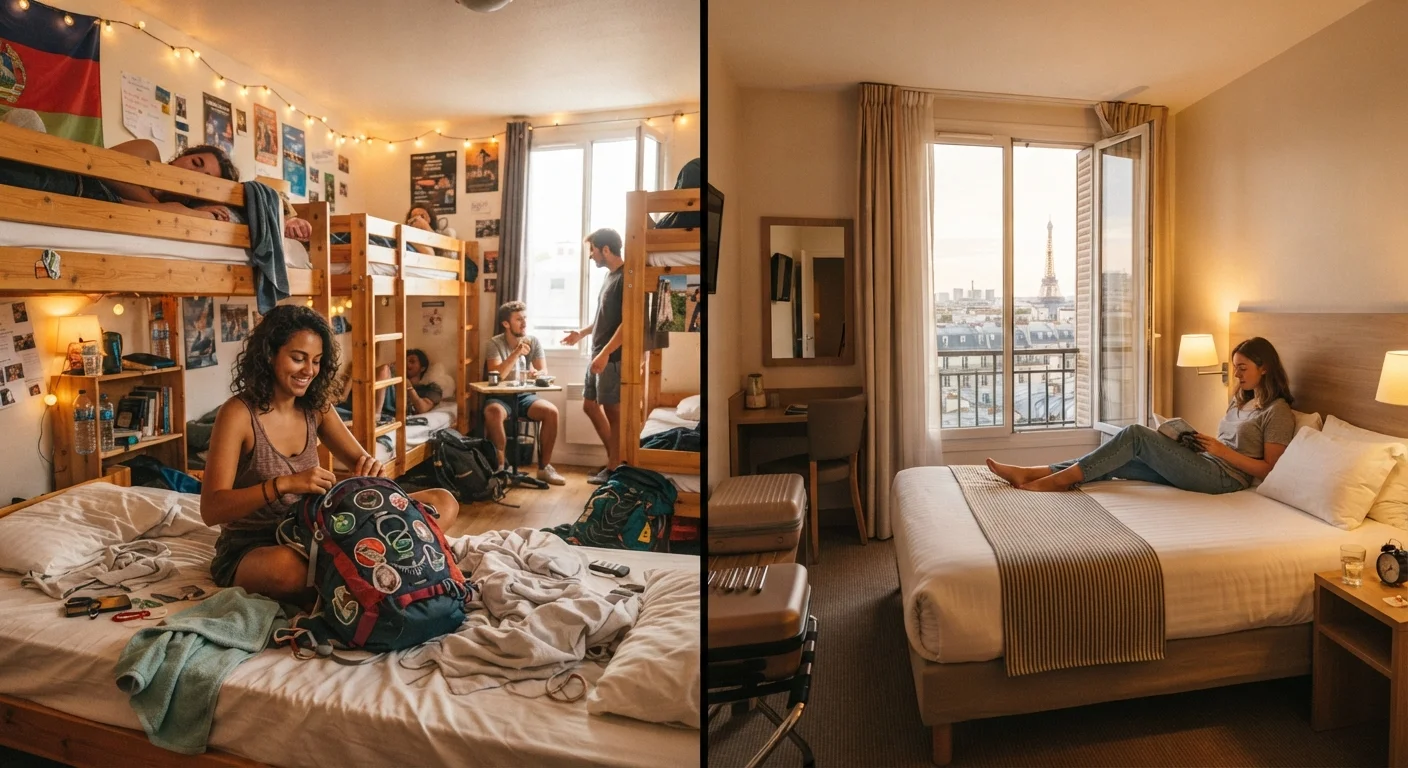
Key Takeaways
Option A
Dormitory Hostels
The social, ultra-affordable choice for flexible travelers.
Best for: Solo travelers, backpackers, and anyone who wants to stretch their budget as far as possible and connect with fellow travelers.
Option B
Budget Hotels
The private, predictable option without the luxury price tag.
Best for: Couples, light business travelers, and anyone who values a private room and guaranteed personal space without breaking the bank.
If you're a solo traveler on a tight daily budget
Dormitory Hostels
Dorm beds can cost a fraction of a private room, and communal kitchens let you save further on meals. The trade-off in privacy is often worth it.
If you're traveling as a couple or with a friend
Budget Hotels
Splitting a private budget hotel room between two people often brings the per-person cost close to a hostel dorm bed, with far more comfort and privacy.
If you want to meet other travelers and build a social trip
Dormitory Hostels
Hostels with common rooms, organized events, and shared spaces create organic opportunities to connect that budget hotels simply don't replicate.
If sleep quality and a predictable routine matter to you
Budget Hotels
Shared dorms come with roommates on different schedules, light, and noise. A private room removes those variables entirely.
If you're on a long trip and want to control food costs
Dormitory Hostels
Access to a shared kitchen lets you cook your own meals, which can meaningfully reduce daily spend on multi-week journeys.
The Real Cost Gap Between Hostels and Budget Hotels
The price difference between a hostel dorm bed and a budget hotel room isn't uniform - it depends heavily on the city and country you're visiting. In many popular European and Southeast Asian destinations, a dorm bed can run anywhere from $10 to $30 per night, while a basic private budget hotel room in the same city might start at $50 to $90. In pricier US cities, that gap often narrows, but dorm beds still tend to undercut private rooms significantly.
The math shifts when you're not traveling solo. Two people splitting a budget hotel room can sometimes pay per-person rates comparable to hostel dorms - without sacrificing privacy. Understanding how accommodation fits into your broader spending plan is worth a look at our guide to fixed vs. variable travel expenses, which explains why lodging behaves differently from other travel costs.
| Criterion | Dormitory Hostels | Budget Hotels |
|---|---|---|
| Typical nightly cost (solo) | $10-$35 per dorm bed | $50-$100 per private room |
| Privacy | Shared room, limited privacy | Private room, full privacy |
| Social atmosphere | High - communal by design | Low - mostly independent |
| Kitchen access | Usually included | Rarely available |
| Sleep predictability | Variable - depends on roommates | High - controlled environment |
| Best traveler fit | Solo backpackers, social travelers | Couples, routine-focused travelers |
| Value for two people | Two dorm beds add up quickly | Splitting one room often competitive |
It's also worth factoring in what's included. Many hostels provide free breakfast, communal kitchens, and organized activities. Budget hotels may offer free parking or simpler included amenities. Neither is inherently better - it depends on what you'll actually use.
Privacy, Safety, and What the Trade-Off Actually Feels Like
The biggest practical difference between a hostel dorm and a budget hotel room is privacy - and it touches more than just sleep. In a dorm, you're sharing a space with strangers: their schedules, their light, and their noise. Lockers are standard in reputable hostels for securing valuables, but the communal environment requires a different mindset than a private room.
Safety in both categories is primarily a function of the individual property, not the type. Reading recent traveler reviews, checking whether lockers are available (and whether padlocks are provided or required), and looking at the hostel's check-in process all matter more than the category label. Budget hotels with poor maintenance or in poorly lit areas can raise just as many concerns as a chaotic hostel dorm.
~40%
Average nightly savings: dorm vs. private room
Industry estimates consistently place hostel dorm beds at roughly 40-60% less than the cheapest private rooms in the same city, though this varies widely by destination.
70%+
Solo travelers who choose hostels for social reasons
Surveys of backpacker travelers regularly find that social connection - not just cost - is a primary motivator for choosing hostel accommodation over private rooms.
That said, couples or travelers who are light sleepers or have early flights frequently find that a budget hotel removes a meaningful layer of uncertainty. There's no risk of a 3 a.m. roommate returning loudly from a night out. For longer trips where fatigue accumulates, that predictability has real value - something our piece on hidden costs that quietly inflate travel budgets touches on when it covers how poor sleep can lead to costly impulse decisions.
Choosing the Right Fit for Your Travel Style
The honest answer is that neither option is universally better - they suit different travelers and different trips. Solo backpackers doing a multi-country circuit often find hostels invaluable, not just for cost savings but for the built-in community. Shared kitchens can dramatically cut food costs on longer journeys, and hostel social boards frequently surface free or low-cost local experiences. If that style of travel appeals to you, pairing a hostel-heavy approach with a strategy like slow travel can stretch your budget even further.
Budget hotels make more sense when privacy is non-negotiable - whether because you're traveling with a partner, carrying equipment you can't easily lock up, or simply value uninterrupted rest. They also tend to work better for travelers visiting a single destination for several days rather than moving frequently, since the per-night cost is easier to justify when you're maximizing time in one place.
Before booking either, consider the real trade-offs of strict travel budgeting. Cutting accommodation costs aggressively makes sense in some destinations, but in others - particularly where safety infrastructure is thinner - spending a little more for a vetted private room is a reasonable call that won't derail your overall budget.
Whatever you choose, book through established platforms with verified reviews, confirm cancellation policies in advance, and always verify entry requirements and local conditions through official government travel advisories before your trip.