

Key Takeaways
Layered Lighting
Layered lighting is the practice of combining three distinct types of light - ambient, task, and accent - in a single room to serve different purposes simultaneously. Instead of relying on one overhead fixture to do everything, this approach treats lighting as a design tool with multiple functions. The result is a room that feels balanced, adaptable, and more visually interesting.
Interior designers often refer to these three layers using the terms 'general,' 'task,' and 'decorative' lighting - different vocabulary for the same functional framework used in residential and commercial design.
Why One Overhead Light Is Never Enough
Walk into most American living rooms and you'll find the same setup: a ceiling fixture centered on the ceiling, switched on when people enter, switched off when they leave. It works, in the most basic sense - the room is technically lit. But a single source, especially one positioned directly overhead, creates harsh shadows, flattens surfaces, and gives a room a waiting-room quality that no amount of furniture arrangement can fully fix.
The issue isn't the fixture itself - it's the expectation that one light can do everything. In practice, rooms serve multiple functions at different times of day: relaxing, reading, entertaining, working, or simply moving through. A single overhead bulb can't adapt to all of those roles. That's the core argument for layered lighting, and it's less about aesthetics than it is about function.
If your room feels dim in some areas and glaring in others, or if you find yourself reaching for a lamp even when the ceiling light is on, you're already experiencing the limitation. Understanding the three layers gives you a practical vocabulary for fixing it - and most solutions don't require rewiring.
The Three Layers, Defined
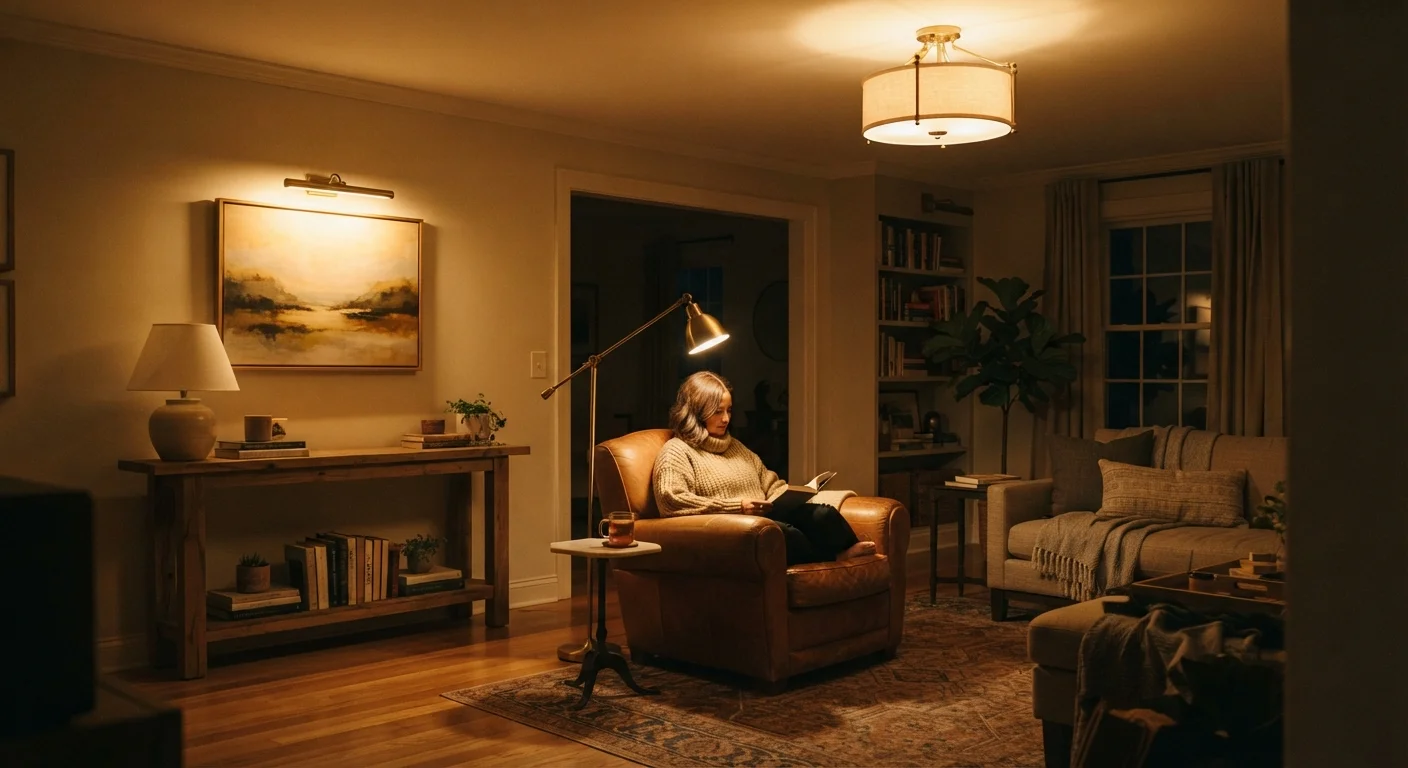
Ambient lighting is the base layer - the general, overall illumination that lets people move safely through a room. Ceiling fixtures, recessed lights, and flush-mount pendants typically provide ambient light. Think of it as the foundation everything else builds on. If you want to understand how different fixture types contribute to this layer, our guide on recessed vs. track lighting covers the practical trade-offs.
Task lighting targets a specific activity zone. A pendant above a kitchen island, a desk lamp over a workspace, a reading light beside an armchair - these all serve task lighting's purpose. The defining quality of task light is that it's brighter and more directional than ambient light, positioned close to where work actually happens. Without it, people lean toward whatever light is available and often end up straining their eyes.
Accent lighting is the finishing layer. Its job is visual interest: drawing attention to a piece of art, grazing texture across a stone wall, or illuminating shelving displays. Accent light typically operates at about one-third the brightness of ambient light. Picture lights, directional track heads, and small uplights are common tools. It's the layer most rooms skip - and often the one that makes the biggest visual difference once added.
~10%
Of residential energy use from lighting
According to the U.S. Energy Information Administration, lighting accounts for roughly 10% of household electricity consumption - making thoughtful fixture choices relevant to both design and energy efficiency.
2700K-3000K
Warm white range for living spaces
Lighting designers generally recommend bulbs in this color temperature range for ambient and accent layers in bedrooms and living areas, where warm, relaxing tones are preferred over cooler, more clinical light.
3x
Accent light intensity ratio
A widely cited rule in residential lighting design suggests accent lighting should be approximately three times brighter than the ambient light in the same zone to create noticeable visual contrast without glare.
Applying the Framework in Real Rooms
In a living room, ambient light might come from a ceiling fixture or recessed lights on a dimmer. Task light arrives via a floor lamp beside a reading chair or a table lamp on the sofa's end table. Accent lighting could be a small directional fixture highlighting a gallery wall, or uplights behind large plants. The key is that each layer operates independently - dimmers let you dial down the ambient and rely on the accent layer alone for a relaxed evening setting.
In a kitchen, under-cabinet lights handle task lighting over prep areas, while a pendant above an island does double duty as ambient and accent. In a bedroom, bedside table lamps provide task light for reading while a dimmed overhead fixture handles ambient. A strip of warm lights behind a headboard or inside a wardrobe can serve as accent.
The color temperature you choose for each layer matters here. Warm tones (around 2700K) work well for ambient and accent layers in relaxing spaces; slightly cooler tones in task zones keep the eye alert and reduce fatigue.
Start With a Dimmer Switch
If you can only make one change to your room's lighting, adding a dimmer switch to your main overhead fixture is the highest-value first step. It won't add a new layer on its own, but it allows your ambient light to step back when your task or accent sources are doing the work. Consult a licensed electrician for any switch installation.
Making It Work Without Starting From Scratch
Most homeowners don't need a full renovation to achieve layered lighting. Start by auditing what you already have - something our room-by-room décor audit framework walks through in detail. Identify which layer is missing, then address that gap with the simplest possible solution first.
If you have no task lighting, add a plug-in lamp where you actually read or work. If accent lighting is absent, a clip-on picture light or a plug-in uplight behind a plant costs very little and adds immediate depth. Dimmers are one of the highest-value changes you can make - a licensed electrician can add a dimmer switch to an existing circuit, and it transforms how a single fixture behaves across different times of day.
The goal isn't complexity - it's intentionality. Rooms that feel well-designed typically have lighting that responds to how people actually use the space. Three layers, each doing one job well, achieves that far more reliably than one fixture trying to do everything.
For further design context, common decorating misconceptions often extend to lighting - including the assumption that brighter always means better.