

Key Takeaways
Stopping Distance
Stopping distance is the total distance a vehicle travels from the moment a driver perceives a hazard to the moment the car comes to a complete stop. It has two components: the distance covered during the driver's reaction time, and the distance covered while the brakes are actively slowing the vehicle. Both parts are affected by speed, road conditions, and vehicle condition.
Braking distance increases with the square of speed - meaning doubling your speed roughly quadruples the distance needed to stop, not merely doubles it.
Two Phases, One Number
Most drivers think of stopping as a single action - press the brake, car stops. In reality, total stopping distance is the sum of two distinct phases that happen in sequence.
Reaction distance is how far your vehicle travels between the moment you perceive a hazard and the moment your foot actually depresses the brake pedal. The average alert driver takes roughly 1.5 seconds to react. At 60 mph, that alone accounts for about 130 feet of travel - before any braking starts.
Braking distance is everything that happens after the brakes engage: the friction between tires and road surface working to bleed off kinetic energy until the vehicle halts. The key physics principle here is that kinetic energy increases with the square of speed. Doubling your speed doesn't double braking distance - it roughly quadruples it. Going from 30 mph to 60 mph doesn't mean you need twice the room; you need about four times as much.
Understanding this two-phase structure helps explain why small increases in speed carry outsized consequences, and why speed limits are a ceiling, not a target is genuinely sound advice rather than overcaution.
What Makes Stopping Distance Longer
Several variables compound stopping distance beyond the basics of speed alone.
~4x
Braking distance multiplier when speed doubles
Because kinetic energy increases with the square of speed, doubling vehicle speed roughly quadruples the braking distance required on the same surface.
88 ft/sec
Distance traveled at 60 mph per second
At highway speed, every second of reaction delay adds roughly 88 feet to total stopping distance before braking even begins.
~50%+
Increase in stopping distance on wet roads
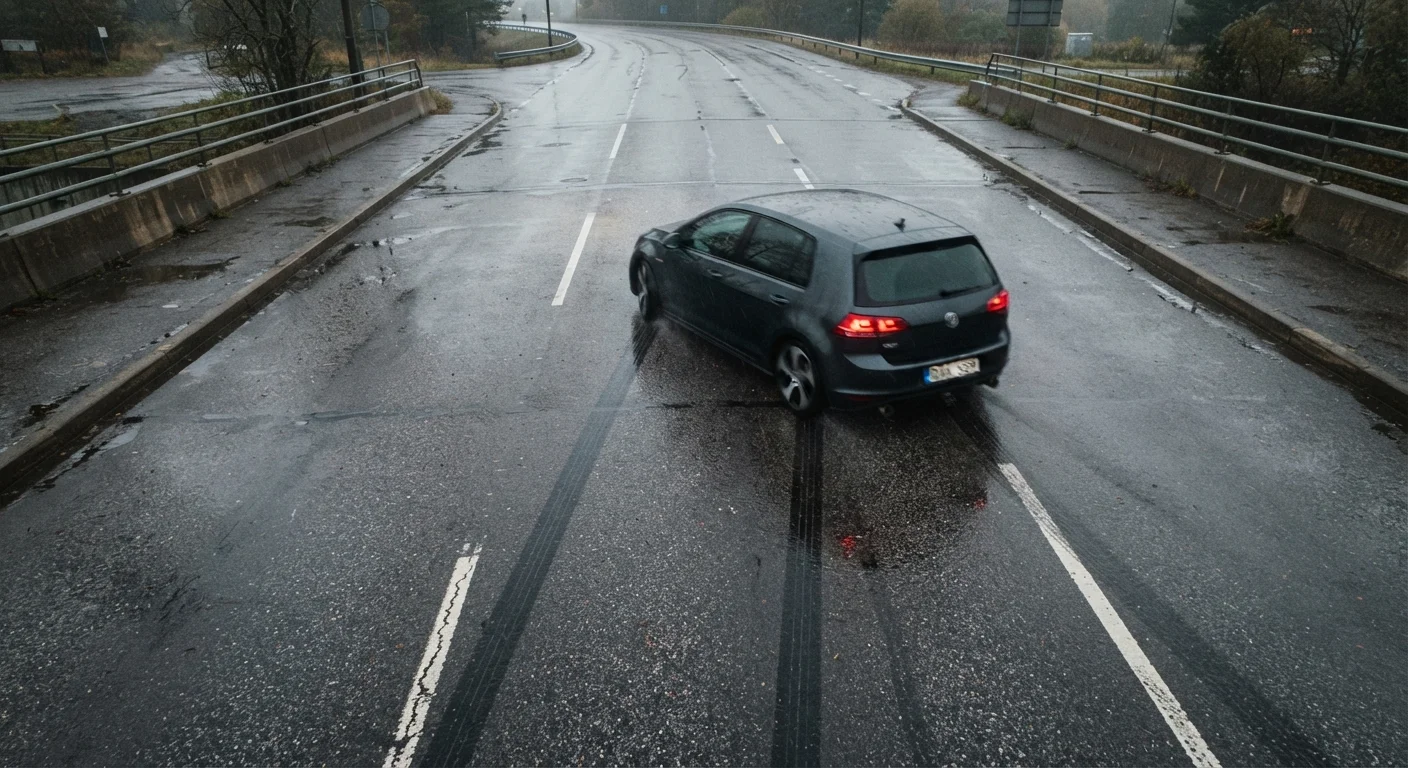
Safety authorities generally estimate that wet pavement can extend total stopping distance by at least 50% compared to dry conditions, though real-world results vary.
Road Surface Conditions
Dry asphalt provides the highest friction. Wet pavement - even light rain - reduces tire grip significantly. Ice or compacted snow can extend stopping distance by several times compared to dry conditions. Loose gravel behaves unpredictably because the surface itself shifts underfoot. For a closer look at how these hazards differ by environment, see our guide on highway versus city driving safety habits.
Tire and Brake Condition
A tire worn to its wear indicators has dramatically less grip than new rubber. Similarly, brake pads that are thin or glazed can't generate the same stopping force as properly maintained brakes. Neither deficiency is obvious to the driver until an emergency makes it apparent - which is why routine inspection by a qualified mechanic matters.
Driver State
Fatigue, distraction, and impairment all slow reaction time, directly adding to the reaction distance portion of total stopping distance. A driver who is fatigued may have a reaction time closer to 2-3 seconds rather than the alert baseline of around 1.5 seconds - adding dozens of extra feet at highway speeds.
Following Distance: The Practical Application
Understanding stopping distance is most useful when applied to the gap you maintain behind other vehicles. If the car ahead stops suddenly, you need enough space to perceive the hazard, react, and bring your vehicle to a halt - all before reaching that car's bumper.
Use a Fixed Landmark to Check Your Gap
To apply the three-second rule, watch for a road sign, overpass, or painted marking. When the vehicle ahead passes it, count 'one one-thousand, two one-thousand, three one-thousand.' If you reach the same point before finishing, increase your following distance. In adverse conditions, extend the count to four or five seconds.
The three-second rule is the practical standard: pick a fixed reference point on the road, and count the seconds between when the vehicle ahead passes it and when you do. If less than three seconds elapse, you're following too closely. Increase that buffer to at least four seconds in rain or fog, and even more on ice or snow.
Following too closely eliminates that buffer almost entirely. Tailgating is more dangerous than most drivers realize precisely because it removes the stopping distance margin that physics demands.
Stopping distance also feeds directly into broader defensive driving habits - anticipating hazards before they become emergencies is only possible when you've given yourself room to act.