
Highway Driving vs. City Driving: The Safety Habits That Differ Between Them

Key Takeaways
Option A
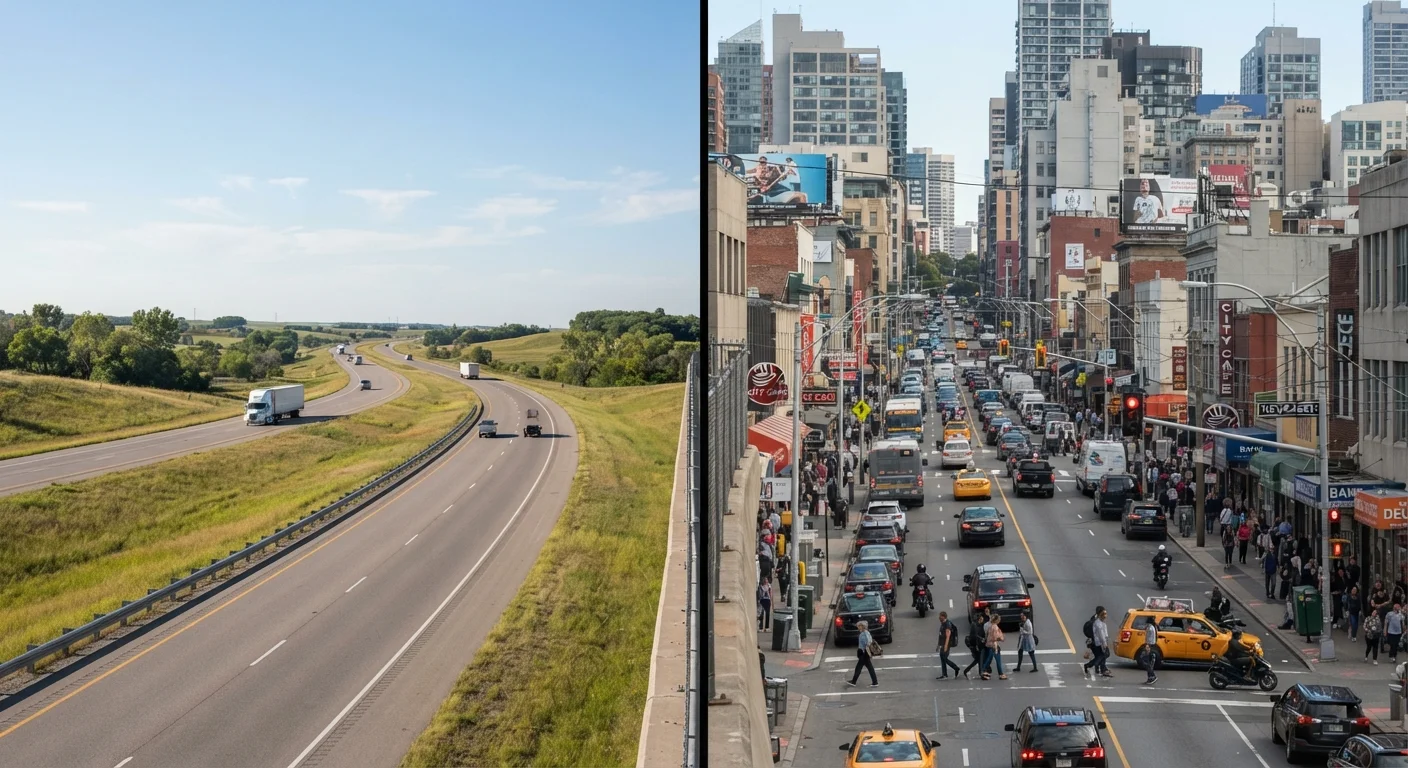
Highway Driving
High-speed, sustained-attention environments.
Best for: Covering long distances efficiently, with fewer intersections but higher consequences for errors.
Option B
City Driving
Low-speed, high-complexity urban navigation.
Best for: Short-distance trips with frequent stops, turns, pedestrians, and unpredictable interactions.
If you drive mostly on interstates and rural highways
Highway Driving habits
Focus on following distance, fatigue management, and early hazard identification at high speed - skills that matter most when closing distances happen fast.
If you commute or travel primarily through urban areas
City Driving habits
Prioritize intersection awareness, pedestrian scanning, and anticipating unpredictable movements from all directions at close range.
If you regularly switch between both environments
Both sets of habits
Consciously resetting your mindset each time you transition - from highway to city or vice versa - is itself a critical safety habit.
Why the Same Driver Needs Two Different Mindsets
Most Americans drive in both environments regularly - a city commute in the morning, an interstate stretch on the weekend. The instinct is to treat driving as one unified skill set. In practice, highway and city driving call for different priorities, different attention patterns, and different reflexes.
The risks aren't just different in degree - they differ in kind. Understanding that distinction is the first step toward becoming a genuinely defensive driver in both settings.
| Criterion | Highway Driving | City Driving |
|---|---|---|
| Typical speed range | 55-80 mph | 15-45 mph |
| Primary crash risk | Rear-end, lane departure | Intersection, pedestrian |
| Following distance rule | 3-4+ seconds | 2-3 seconds |
| Top attention demand | Sustained alertness, fatigue | Constant close-range scanning |
| Distraction risk | Moderate (monotony-driven) | High (multiple simultaneous inputs) |
| Lane change complexity | High speed, larger gaps needed | Lower speed, shorter sight lines |
| Pedestrian/cyclist exposure | Very low | Very high |
Highway Driving: The Safety Habits That Matter Most
Following distance scales with speed. At 65 mph, your vehicle travels roughly 95 feet per second. The traditional two-second following rule becomes a three- to four-second rule at highway speeds, and longer still in adverse conditions. Most drivers underestimate this because high-speed gaps feel larger than they are.
Lane discipline reduces unpredictability. On multi-lane highways, staying in your lane until you're ready to pass - and signaling well in advance - reduces the surprise factor for drivers around you. See our guide to merging and lane changes for a deeper look at where this goes wrong.
Fatigue is the underrated threat. Highway monotony suppresses alertness faster than most drivers expect. Taking breaks every 100 miles or two hours is a widely recommended guideline - not a suggestion for weak drivers, but a physiological reality for all of them.
Speed and stopping distance. Posted speed limits are a ceiling, not a target. On highways, the gap between your speed and your stopping distance grows exponentially - a detail that matters most when traffic suddenly slows ahead.
~56%
Fatal crashes occurring on non-interstate roads
According to NHTSA data, the majority of fatal crashes in the U.S. occur on non-interstate roads, including urban streets and local roads - not highways.
95 ft/sec
Distance traveled per second at 65 mph
At highway speeds, a vehicle covers roughly 95 feet every second, meaning a two-second gap translates to nearly 200 feet of stopping space.
~40%
Of all U.S. traffic fatalities involving intersections
The Federal Highway Administration has estimated that roughly 40 percent of all traffic crashes in the U.S. are intersection-related, reflecting the density of conflict points in urban driving.
City Driving: The Safety Habits That Matter Most
Intersection awareness is your primary job. The majority of urban crashes happen at or near intersections. A green light authorizes entry - it doesn't guarantee that cross traffic has stopped. Scanning left, center, and right before proceeding is a habit worth building deliberately.
Pedestrians and cyclists require active scanning. Urban environments are shared spaces. Assuming a sidewalk is empty before turning right, or that a bike lane is clear, is the kind of gap in attention that causes serious crashes. Checking mirrors and blind spots before any turn or lane shift is non-negotiable.
Speed management works differently in cities. Lower posted limits exist because stopping distances, pedestrian exposure, and crossing density are all higher. Even at 25 mph, a vehicle striking a pedestrian carries significant injury risk. Treating city speed limits as the floor - not just a ceiling - reflects how densely packed the hazards are.
Distraction risk peaks in cities. Navigation prompts, delivery vehicles double-parking, unexpected pedestrian movements, and traffic signals all compete for attention simultaneously. This is where phone use behind the wheel becomes most consequential. New drivers in particular face compounded risk in urban environments - for more on building foundational habits, see how early driving habits form.
The Transition Moment: Switching Between Environments
One underappreciated risk is the transition itself. Drivers exiting a highway and entering city streets after sustained high-speed travel often perceive their speed as lower than it actually is - a well-documented perceptual effect. This makes the first few minutes in an urban environment particularly hazardous.
Equally, drivers accustomed to stop-and-go city traffic may carry habitual caution - short following distances, frequent braking - onto the highway, where that pattern becomes its own danger.
The practical fix is deliberate: when you change road types, consciously reassess your speed, your following distance, and your scanning habits. Conditions like rain or reduced visibility amplify these transition risks further. For a full breakdown, driving in poor weather conditions adds an additional layer of complexity to both environments.
Safe driving in either setting isn't a fixed behavior - it's an ongoing calibration. Building the habit of resetting your mindset at each environmental shift is itself one of the most practical safety gains available to everyday drivers.