
Speed Limits Are a Ceiling, Not a Target: Understanding Safe Speed in Context

Key Takeaways
Safe Speed in Context
A safe speed is the velocity at which a driver can maintain full control of their vehicle given the actual conditions present at that moment - including road surface, visibility, traffic density, and weather. The posted speed limit represents the legal maximum under ideal conditions, not a recommended target for all situations. Driving at or below the limit does not automatically mean driving safely.
Traffic engineers set speed limits based on the 85th-percentile speed of free-flowing traffic under favorable conditions, a method known as the '85th percentile rule.' This means limits are designed as a ceiling, not a floor, and conditions can require speeds well below that ceiling.
What Speed Limits Actually Tell You
A posted speed limit communicates one thing clearly: the legal maximum a driver may travel on that road under normal, favorable conditions. What it does not communicate is the appropriate speed for rain, fog, school zones during dismissal, or a tight curve on a rural road at night.
Speed limits are established through traffic engineering studies - factoring in road geometry, land use, and historical traffic patterns. They are not recalculated in real time based on weather or an unexpected hazard ahead. That calculation falls entirely to the driver.
Understanding this distinction is a foundational piece of defensive driving - the ability to read your environment and adjust your behavior before a problem develops, rather than reacting after it does.
Conditions That Demand a Lower Speed
Several common driving conditions call for speed reductions that many drivers routinely skip:
- Wet or icy roads: Water reduces tire grip, and ice can cut traction to near zero. Braking distances stretch dramatically when the road surface changes. See our explanation of stopping distance physics for the mechanics behind this.
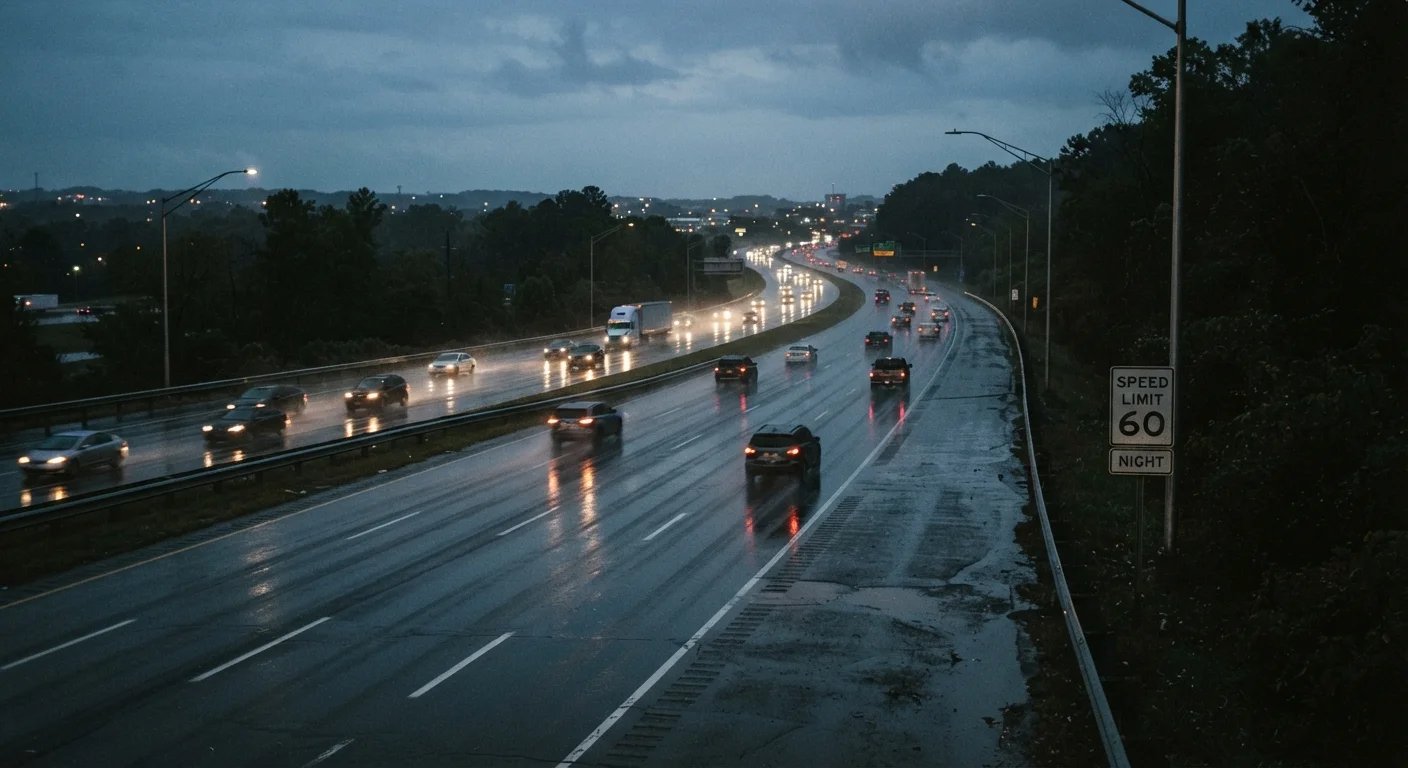
- Reduced visibility: Fog, heavy rain, glare, and darkness all shorten how far ahead you can see - and therefore how far ahead you can react. Your speed should never outpace your sight line. Night driving adds fatigue and glare to this equation.
- Heavy traffic: Shorter gaps between vehicles mean shorter reaction windows. Higher density also means one driver's error cascades faster. This is directly related to why tailgating is so hazardous at any speed.
- Work zones and school zones: These areas are posted with reduced limits for a reason, but they also frequently contain unpredictable movement - workers on foot, children crossing mid-block - that demands active attention beyond just slowing down.
- Unfamiliar roads: Curves, grade changes, and intersections you haven't seen before require extra buffer time to process and respond.
Use the 'Sight Distance' Rule
A practical way to check your speed: if you cannot stop your vehicle within the distance you can clearly see ahead, you are going too fast for conditions. This applies in fog, at night with low-beam headlights, or on roads with blind curves. Adjusting speed to match your sight line is one of the simplest and most effective safety habits a driver can build.
The Physics of Why Speed Matters More Than It Feels
Speed feels linear behind the wheel - 60 mph feels roughly twice as fast as 30 mph. But the physics of kinetic energy and stopping distance do not work that way. Kinetic energy increases with the square of velocity. Double your speed, and you quadruple the energy your brakes and tires must absorb to stop your vehicle.
At 30 mph, a typical passenger car in good condition might stop in around 75 feet after the driver reacts. At 60 mph, that same car may need 300 feet or more. Add a wet road surface, worn tires, or a distracted moment, and those numbers grow further.
~31%
Of traffic fatalities involving speeding
According to the National Highway Traffic Safety Administration (NHTSA), speeding is a contributing factor in roughly 29-32% of all motor vehicle traffic fatalities annually.
4×
Stopping distance increase from 30 to 60 mph
Because kinetic energy scales with the square of velocity, doubling speed from 30 to 60 mph requires approximately four times the stopping distance under similar road conditions.
~10-15 mph
Suggested speed reduction in heavy rain
Traffic safety organizations generally advise reducing speed by at least 10-15 mph on wet roads, with greater reductions needed in heavy rain or standing water.
The gap between where you can stop and where you need to stop is where crashes happen. Reducing speed by even 5-10 mph compresses that gap meaningfully - not just in distance, but in the severity of any impact that does occur.
Speed also shapes the difference between highway and city driving risk. On a highway, the speeds are higher but traffic is more predictable and pedestrian-free. Urban environments bring intersections, cyclists, and pedestrians into the equation at speeds where reaction time is already compressed.
Finding the Right Speed: A Practical Framework
There is no formula that spits out a precise safe speed for every situation. What experienced drivers develop is a habit of continuous assessment - checking a short list of factors each time conditions change:
- What is my sight distance? Can you see far enough ahead to stop if something unexpected appears?
- What is the road surface doing? Dry, wet, loose gravel, and ice each behave differently under braking.
- What is traffic density? More vehicles nearby means less room for error in any direction.
- Am I in a high-pedestrian or high-cyclist area? Schools, parks, neighborhoods, and commercial strips all raise the stakes for any speed-related error.
- Am I tired, distracted, or unfamiliar with this road? Cognitive load affects reaction time, which affects safe speed.
The goal is not anxiety - it is calibration. Each assessment takes seconds and becomes automatic with practice. A speed that felt appropriate when you entered the highway may not be appropriate when rain starts or traffic backs up ahead.
This article provides general educational information about safe driving practices. Always follow applicable traffic laws and use your own judgment based on actual road conditions. For legal questions about traffic regulations in your area, consult the relevant state or local authority.