

Key Takeaways
Why Habitat Design Matters More Than Most Owners Expect
Birds are among the most cognitively complex pets kept in American homes, yet their housing is frequently underestimated. A cage that is merely functional - large enough to hold the bird, with food and water dishes - falls well short of what avian welfare requires. Poor habitat design contributes to feather-destructive behavior, chronic stress, nutritional problems, and respiratory illness.
The good news is that setting up a genuinely bird-friendly environment is straightforward once you understand what each element is designed to accomplish. Unlike housing for mammals, bird habitats require attention to vertical space, air quality, light cycles, and acoustic environment - factors that are easy to overlook but meaningful to your bird's long-term health.
Before you finalize any setup, it's worth reviewing common household hazards for small pets, since many dangers - from scented candles to certain houseplants - apply directly to birds.
What you will need
Step-by-Step: Building Your Bird's Habitat
Follow these steps in order. Each decision builds on the previous one, so working through the process sequentially will save time and help you avoid costly reversals.
Select the Correct Cage Size and Bar Spacing
Cage dimensions should allow your bird to fully extend both wings simultaneously without touching the sides - this is the minimum acceptable width, not a comfort upgrade. Height matters for species that climb, while horizontal space matters more for flighted birds. Research the specific requirements for your species: a budgie, a cockatiel, and an African grey have dramatically different needs.
Bar spacing is a safety-critical measurement. Bars spaced too widely allow a bird's head to pass through, risking strangulation. As a general guideline, small birds such as finches and budgies need spacing no wider than half an inch; medium birds like cockatiels need roughly five-eighths of an inch; larger parrots vary but typically require three-quarters to one inch. Verify the manufacturer's species recommendations before purchasing.
Choose and Position Perches Thoughtfully
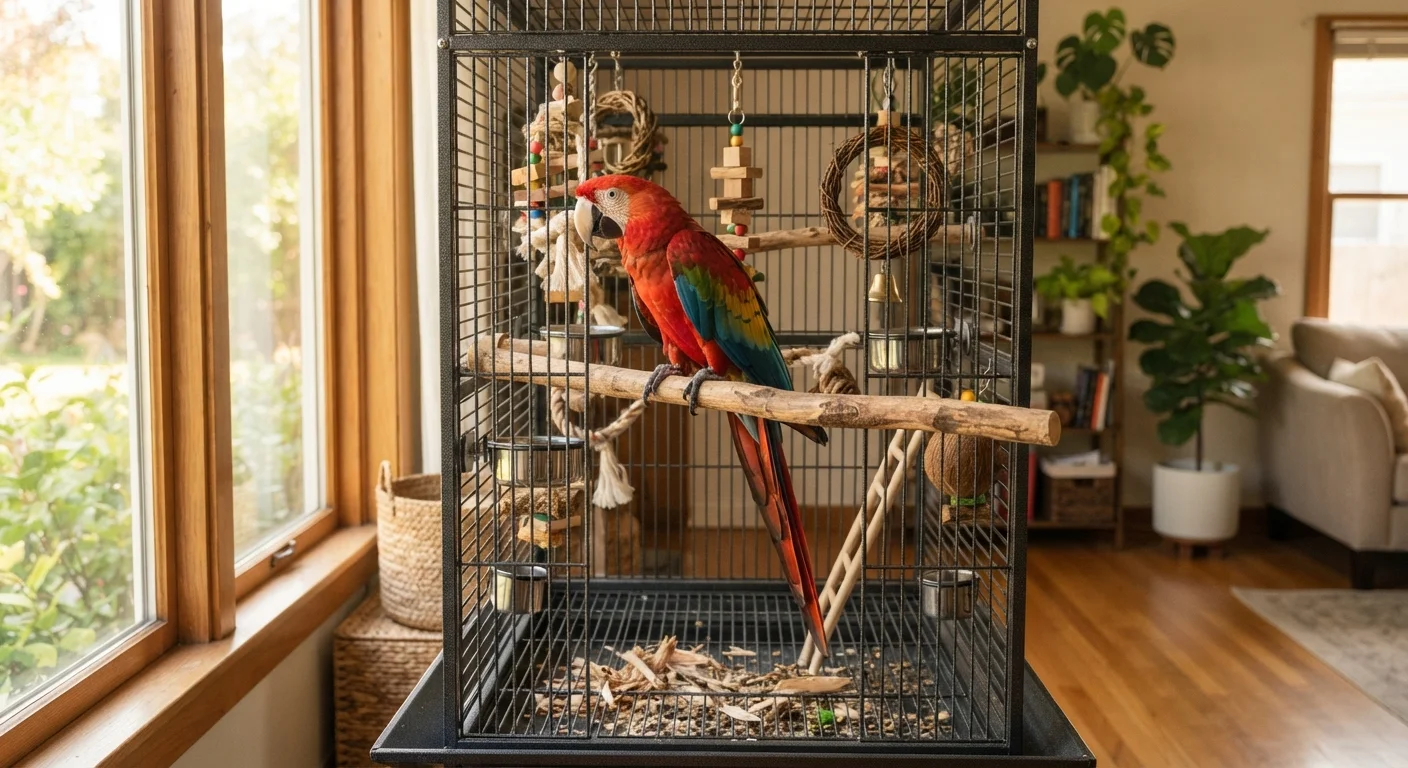
Provide a minimum of three perches at varying heights and diameters. Different diameters exercise different muscle groups in the foot and help prevent pressure sores. Natural wood branches - from bird-safe species such as manzanita, java wood, or untreated apple - are preferable to uniform dowel rods. Rope perches add textural variety and are appropriate for many species, though inspect them regularly for fraying that could entangle toes.
Position the highest perch below the cage ceiling so the bird is not forced to hunch. Place at least one perch near the food and water dishes at a comfortable feeding height. Avoid positioning perches directly above dishes, as droppings contaminate food and water quickly.
Establish Safe Placement in the Home
Place the cage in a room where the family spends significant time - birds are social and need visual engagement. Avoid the kitchen: cooking fumes, especially from overheated non-stick (PTFE-coated) cookware, are acutely toxic to birds and can cause rapid respiratory failure even in small concentrations. Bathrooms and laundry rooms, which accumulate moisture and chemical fumes, are also unsuitable.
Position the cage against one wall or in a corner rather than in the center of a room. This gives the bird a sense of security - in the wild, exposed positions in open space are associated with predation risk. The cage should not be placed in direct sunlight for extended periods, which can cause dangerous overheating, but access to indirect natural light is beneficial.
Manage Light Cycles and Ambient Temperature
Birds require a consistent photoperiod - typically 10 to 12 hours of light and 12 to 14 hours of darkness - to regulate their hormonal rhythms, sleep quality, and behavior. Use a cage cover or a room with controllable lighting to achieve consistent darkness at night. Irregular or excessive light exposure is associated with chronic egg-laying in female birds and behavioral dysregulation in both sexes.
Most companion bird species are comfortable in the temperature range typical of a human household - roughly 65 to 80°F (18 to 27°C). Rapid temperature swings are more dangerous than gradual seasonal changes. If your home experiences significant temperature variation, monitor the area around the cage rather than relying on a general room thermostat.
Add Toys and Foraging Opportunities
Toys are not optional accessories - they are enrichment tools that address documented behavioral and psychological needs. Provide a mix of chewable items (untreated wood blocks, cork, safe palm fibers), manipulable items (foot toys, rings, bells), and foraging structures (shreddable materials with hidden food).
Do not overcrowd the cage. Too many items restrict movement and can cause frustration rather than enrichment. A rotation of four to six items at a time, refreshed regularly, is more effective than a permanently cluttered space. For a broader look at species-appropriate enrichment approaches, see enrichment strategies for small pets.
Quarantine New Birds Before Full Integration
If you are adding a bird to a home that already has one, keep the new bird in a separate room for a minimum of 30 days. This quarantine period allows you to identify illness before it spreads. Even birds that appear healthy can carry transmissible pathogens. An avian vet exam during quarantine is strongly recommended.
Enrichment, Routine, and Long-Term Wellbeing
A well-constructed habitat is only the foundation. Birds require consistent daily interaction, mental challenge, and environmental variety to thrive. Foraging-based feeding - hiding food in paper cups, puzzle feeders, or wrapped in safe paper - engages natural problem-solving instincts that go largely unused when food is simply placed in a dish.
Rotate toys on a weekly or biweekly schedule rather than leaving the same items in place indefinitely. Novel objects engage curiosity; stale environments contribute to boredom-related behaviors. For deeper enrichment strategies suited to different small species, see enrichment ideas for small pets.
Maintain a predictable daily routine for lighting, feeding, and out-of-cage time. Birds are highly attuned to schedule, and irregular patterns can elevate baseline stress. If your bird will be housed near other pets, evaluate separation and supervision carefully - even well-intentioned contact between a bird and a cat or dog can result in serious injury.
This article provides general educational information about bird habitat setup and is not a substitute for guidance from a qualified avian veterinarian. If you have concerns about your bird's health or behavior, consult a vet experienced with avian species.