

Key Takeaways
Why Enrichment Matters for Small Pets
Small animals - rabbits, guinea pigs, hamsters, gerbils, pet birds, and rats - are often assumed to need little beyond food, water, and a clean cage. That assumption leads to preventable suffering. As our guide to the real demands of small pet care explains, these animals have complex behavioral needs rooted in the survival strategies of their wild counterparts.
Without adequate stimulation, small pets can develop stereotypies - repetitive, purposeless behaviors like bar-chewing, pacing, or over-grooming - which signal chronic stress. Obesity, muscle atrophy, and immune suppression are also linked to sedentary, unstimulating environments. Enrichment addresses all of these risks simultaneously, engaging an animal's body and mind in ways that mirror natural activity.
The good news is that effective enrichment rarely requires expensive equipment. What it does require is an understanding of species-specific instincts and a commitment to providing variety and novelty over time.
Start Simple, Then Build Complexity
If your pet is new to enrichment, introduce one new item or activity at a time rather than overhauling the entire habitat at once. Sudden major changes can temporarily stress animals accustomed to their existing environment. Allow each new item to become familiar before adding the next layer of complexity.
Seven Enrichment Strategies That Work Across Species
Foraging and scatter feeding
In the wild, most small animals spend a significant portion of their day searching for food. Replicating this through foraging enrichment - hiding pellets in hay, burying treats under bedding, or placing food inside paper rolls - engages natural seeking behavior and extends mealtime from seconds to minutes. For rabbits and guinea pigs, this also encourages movement throughout the enclosure. Birds benefit from food hidden in shreddable toys or woven into foraging skewers.
Foraging enrichment turns every meal into a mentally engaging activity rather than a passive event.
Species-appropriate tunnels and hides
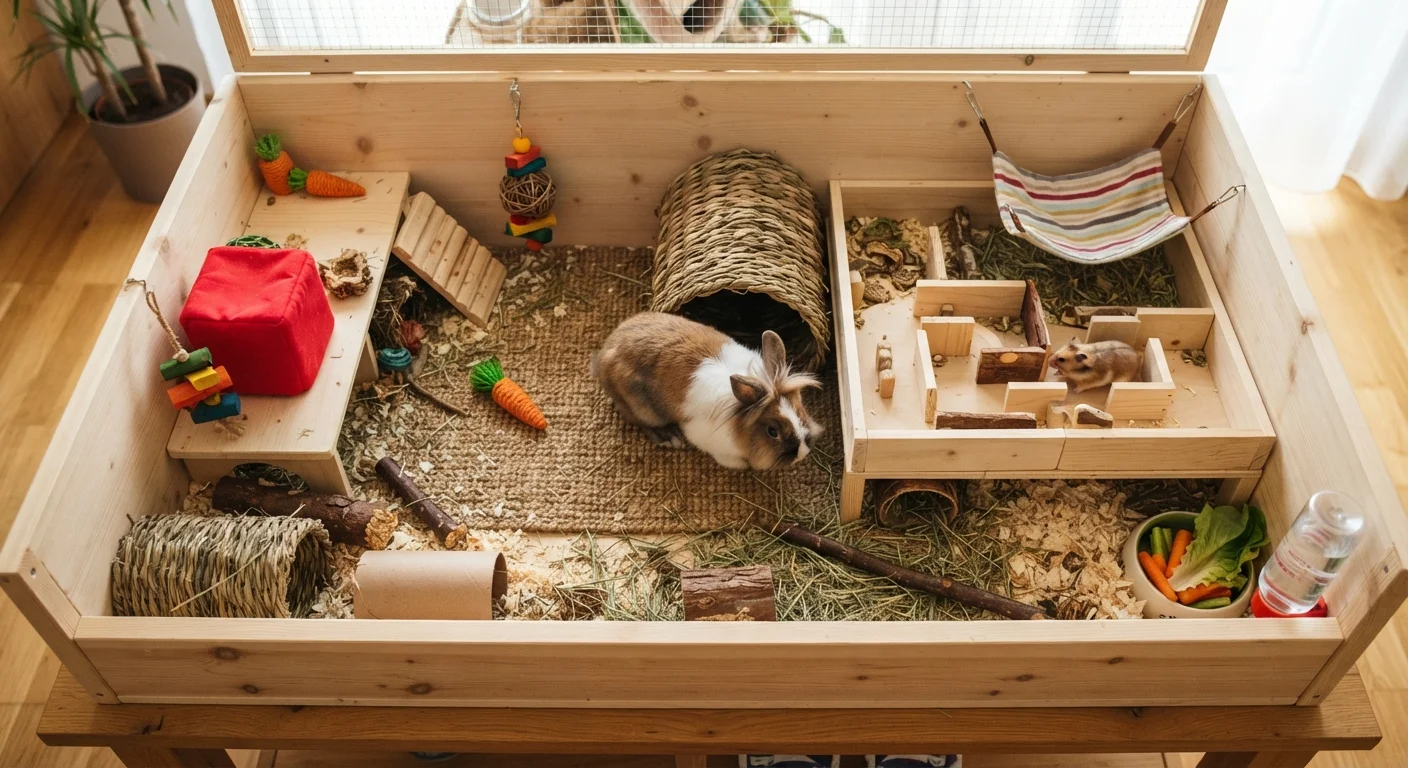
Prey animals are hardwired to seek shelter. Providing tunnels, hides, and enclosed resting spaces isn't just comfort - it satisfies a fundamental psychological need for security. Hamsters and gerbils thrive with multiple tunnel networks and nesting chambers. Rabbits benefit from cardboard box hides they can also chew. Even confident, social animals like rats use hides to regulate arousal between active play sessions. Rotate hide placement periodically to reintroduce novelty.
For prey animals, access to hides and tunnels is a psychological need, not a luxury.
Chew items and destructible objects
Rodents and rabbits have continuously growing teeth that require constant wear. Appropriate chewing enrichment - untreated wooden blocks, willow balls, dried grass mats, cardboard tubes - addresses this biological need while simultaneously providing mental engagement. The act of destruction is itself rewarding to these animals. Avoid items treated with dyes, adhesives, or finishes, and check that any wood species used is non-toxic before offering it.
Chewing isn't misbehavior - it's a biological necessity that enrichment items can redirect constructively.
Digging substrates and burrowing opportunities
Many small mammals are natural burrowers. Hamsters in particular are motivated to dig extensively, and studies on captive hamster welfare have noted that insufficient substrate depth is a significant stressor. Providing a deep bedding layer - ideally several inches - in at least part of the enclosure allows animals to construct burrows, cache food, and express natural locomotion patterns. For rabbits, a digging box filled with soil or shredded paper offers a safe outlet for the same instinct.
Substrate depth matters: shallow bedding denies burrowing animals one of their core behavioral outlets.
Supervised free-roam and exploration time
Enclosure space alone rarely meets the activity needs of species like rabbits, guinea pigs, and rats. Regular, supervised time outside the cage in a pet-proofed space dramatically increases daily movement and exposes animals to novel sensory input. This is especially valuable for social species that benefit from proximity to their owners. Build a consistent free-roam routine rather than offering access sporadically - predictability reduces stress and helps animals anticipate and look forward to the experience.
A consistent free-roam routine provides far more than exercise - it offers novelty, owner interaction, and autonomy.
Cognitive puzzle and problem-solving tasks
Rats, parrots, and rabbits demonstrate genuine problem-solving capacity that can be engaged through puzzle feeders, latch-based containers, or training sessions using positive reinforcement. Teaching a rabbit to nose-target an object or a rat to navigate a tabletop obstacle course builds trust with the owner while exercising working memory and adaptability. For birds, puzzle toys that require manipulating pieces to access a food reward are particularly well-suited to their dexterous, curious nature. Our guide to bird habitat setup covers how to integrate these elements into a bird's daily environment.
Training small animals with positive reinforcement is enrichment and bonding practice in a single activity.
Social interaction and handling
For social species - guinea pigs, rats, ferrets, and many parrot species - regular, gentle interaction with their owner is itself a form of enrichment. Handling should be calm, consistent, and respectful of the animal's body language. Guinea pigs kept in pairs or small groups gain continuous social enrichment from conspecifics (members of the same species), but owner contact still provides additional novelty and stimulation. For naturally solitary species like Syrian hamsters, owner interaction should be timed around natural activity periods - typically dusk and evening - to avoid disrupting rest cycles.
Social species benefit from both same-species companionship and regular, respectful human interaction.
Enrichment Needs Vary by Species and Individual
The strategies listed here are widely applicable, but individual animals within a species can vary in temperament and preference. A rabbit that ignores a tunnel may be highly motivated by a foraging box, and vice versa. Observing how your specific animal interacts with enrichment items will tell you more than any general guideline. When in doubt about your pet's behavioral health, consult a veterinarian with exotic or small animal experience.
Building a Richer Routine
Enrichment isn't a one-time habitat upgrade - it's an ongoing practice. Rotating toys and foraging setups every week or two prevents animals from habituating to familiar objects and stops engagement from plateauing. Even something as simple as rearranging tunnels or introducing a new food-stuffed item can reignite exploratory behavior.
It's also worth remembering that enrichment and nutrition are closely linked. Scatter feeding or puzzle-based food delivery slows eating and extends mental engagement around mealtimes. For species-appropriate dietary foundations to build those feeding strategies around, see our nutrition guide for small animals.
Finally, before expanding your pet's enrichment footprint - especially during free-roam periods - review your home environment for hazards. Our article on hidden home hazards for small pets covers what to audit before giving animals access to new spaces. A stimulating environment is only beneficial when it's also a safe one.