

Key Takeaways
Rabbit Housing
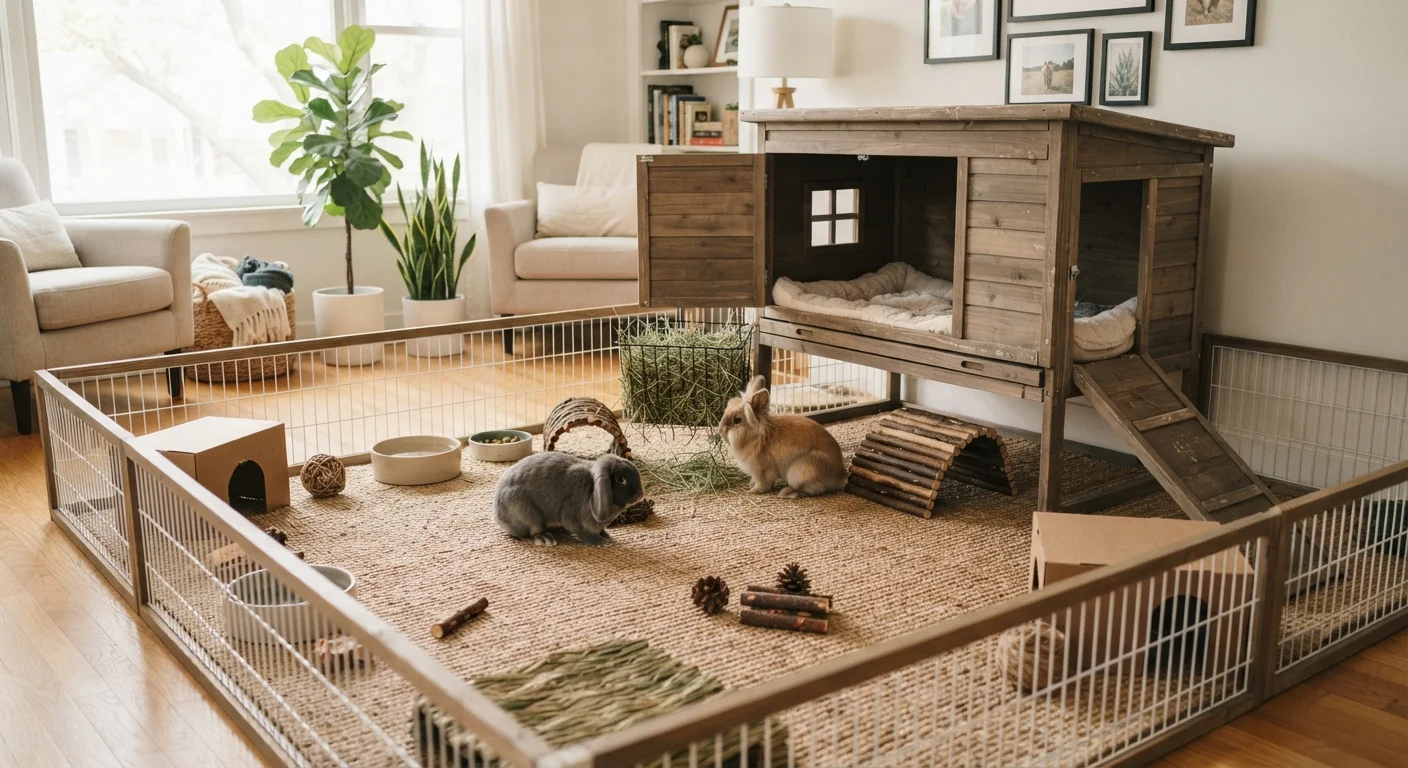
Rabbit housing refers to the full environment a domestic rabbit lives in - including its enclosure, exercise area, bedding, flooring, and enrichment. A proper rabbit habitat is not simply a small cage but a thoughtfully designed space that meets the animal's physical and behavioral needs. Rabbits are active, intelligent animals that require room to move, explore, and rest comfortably throughout the day.
Rabbits are classified as obligate nasal breathers and highly susceptible to heat stress; housing placement relative to temperature, humidity, and airflow is a veterinary welfare consideration, not just a comfort preference.
Why 'Cage' Is the Wrong Mental Model
When most people picture a rabbit's home, they imagine a small wire cage - the kind sold in pet stores alongside hamster wheels and bird feeders. That image is outdated and, for rabbit welfare, genuinely harmful. Domestic rabbits are not small creatures content to sit quietly in a corner. In the wild, their relatives travel several miles per day, forage across open terrain, and maintain complex social structures.
A cage, as traditionally understood, fails to support any of those behavioral drives. The shift needed is from containment to habitat - a space designed around what rabbits actually need rather than around what's easy to stack in a store. As explored in our guide to small pet care realities, the idea that rabbits are low-effort pets leads directly to environments that cause them unnecessary suffering.
Enclosure Size: The Baseline That Matters Most
The single most common housing mistake rabbit owners make is keeping their rabbit in an enclosure that is far too small. A rabbit should be able to take at least three consecutive hops in any direction within its enclosure - and stand fully upright on its hind legs without its ears touching the ceiling. For most medium-sized breeds, this translates to a minimum enclosure footprint of roughly 8 square feet, though larger breeds need considerably more.
Beyond the enclosure itself, rabbits require daily, supervised free-roaming time in a larger rabbit-proofed area. A minimum of three to four hours per day is widely cited by rabbit welfare organizations, though more time is better. Exercise pens that expand the enclosure into a connected play zone are a practical solution for many owners.
8+ sq ft
Minimum recommended enclosure size
Rabbit welfare organizations including the House Rabbit Society recommend at least 8 square feet of enclosure space, with significantly more for larger breeds.
3-4 hrs
Daily free-roaming exercise time needed
Most rabbit welfare guidelines specify a minimum of three to four hours of supervised exercise outside the enclosure each day.
60-72°F
Safe ambient temperature range for rabbits
Rabbits are highly susceptible to heat stress; sustained temperatures above 80°F can be life-threatening without immediate veterinary attention.
For context on how rabbit space needs compare to other small pets, see our rabbit vs. guinea pig comparison.
Flooring, Bedding, and Surface Safety
The floor of a rabbit's enclosure is one of the most overlooked welfare factors. Wire-bottom cages - still common in retail - cause a condition called sore hocks (ulcerative pododermatitis), where the skin on the hind feet breaks down under sustained pressure and friction. Left untreated, sore hocks can become severely infected and require veterinary intervention.
Safe flooring options include solid plastic bases lined with absorbent bedding (such as paper-based litter), fleece mats, or natural wood surfaces. Avoid cedar and pine shavings, which release aromatic oils that can irritate a rabbit's respiratory tract. Bedding should be spot-cleaned daily and replaced fully at least once a week to control ammonia buildup from urine.
Test Your Rabbit's Floor Surface
Place your rabbit on the proposed flooring surface and observe how it moves. If your rabbit shuffles, slips, or avoids moving, the surface is likely unsuitable. Rabbits do best on flooring that provides grip without abrasion - fleece mats and paper-based bedding over solid bases are widely used and well-tolerated.
Enrichment: Meeting the Behavioral Needs of an Active Mind
Rabbits are curious, intelligent animals. A habitat that lacks enrichment doesn't just bore them - it actively harms them. Chronic under-stimulation in rabbits is associated with repetitive behaviors (such as bar-chewing and circling), aggression, and self-directed overgrooming. These are not personality quirks; they are signs of an inadequate environment.
Effective enrichment includes tunnels and hide boxes that mimic burrow-like spaces, untreated wooden chews to support healthy tooth wear, cardboard structures that can be destroyed and rearranged, and foraging opportunities such as hay scattered across the enclosure rather than provided only in one spot. Hay, in particular, should always be available within the habitat - both as a dietary necessity and as a behavioral outlet. Learn more about the role hay plays in your rabbit's overall health in our guide to building a balanced rabbit diet.
Placement, Temperature, and Environmental Safety
Where you position a rabbit's habitat inside your home matters significantly. Rabbits are sensitive to temperature extremes - particularly heat. Temperatures above 80°F can trigger heat stroke, which is a veterinary emergency. Enclosures should be kept away from direct sunlight, heating vents, and drafts. A consistently temperate, well-ventilated room is ideal.
Household hazards also extend into any free-roaming area. Electrical cords must be concealed or covered, toxic houseplants removed, and gaps behind furniture blocked - rabbits explore by chewing, and many common items in a home are dangerous if ingested. This level of environmental management is part of what distinguishes a properly designed rabbit habitat from simple cage ownership.
This article is for general informational purposes only and does not constitute veterinary advice. Always consult a licensed veterinarian for guidance specific to your rabbit's health and housing needs.