

Key Takeaways
Start here
Before Pickup Day: What to Have Ready
Next
Week One: Survival Mode (and That's Normal)
Then
Weeks Two and Three: Building the Routine
As you settle in
Week Four: Signs You're on the Right Track
Always know
When to Call the Vet
Before Pickup Day: What to Have Ready
The calmer and more prepared your home is when your puppy arrives, the smoother that first day will go. You don't need to buy everything at once, but a few essentials must be in place beforehand.
The non-negotiables:
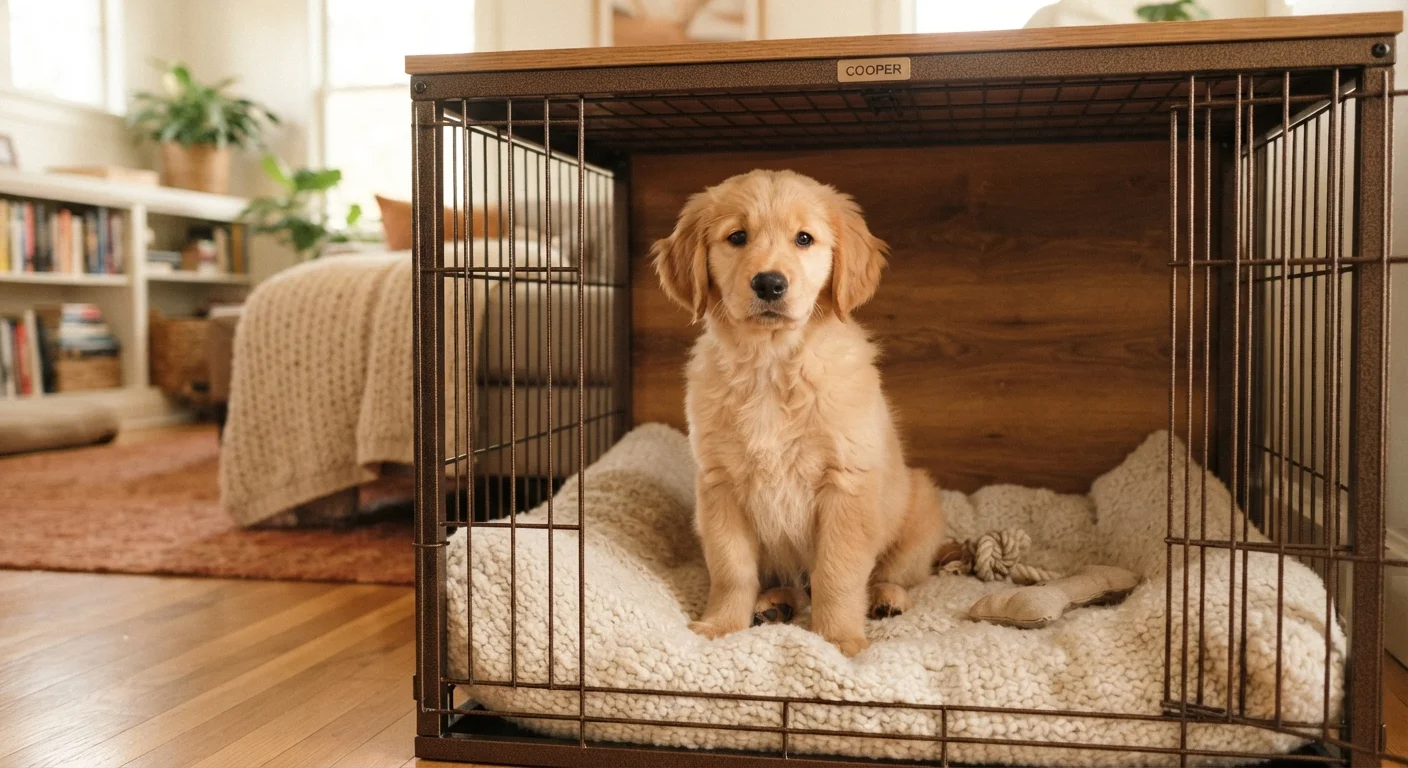
- A properly sized crate - snug enough that the puppy can't use one corner as a bathroom
- Puppy-safe food and water bowls at floor level
- A collar with ID tag and a four- to six-foot leash
- Enzymatic cleaner for inevitable accidents
- A vet appointment booked within 72 hours of arrival
Puppy-proofing matters too. Get electrical cords off the floor, secure cabinet doors, and remove toxic houseplants. Think of it like baby-proofing at ankle height. If you're weighing confinement options, our guide to crate training vs. free-roaming can help you decide what structure suits your home and lifestyle before day one.
Socialization window
The period roughly between 3 and 14 weeks of age when puppies are most receptive to new experiences. Positive exposure during this time shapes their long-term behavior and confidence.
Crate training
A method of teaching a dog to view a crate as a safe, comfortable resting space. Done gradually and positively, it supports house training and gives the dog a secure retreat.
Enzymatic cleaner
A cleaning product that uses enzymes to break down the proteins in pet urine and feces, eliminating odor at the source and reducing the chance a puppy re-marks the same spot.
Resource guarding
When a dog becomes tense, stiff, or growls to protect food, toys, or space. It is a normal canine behavior that can become problematic if not addressed early with professional guidance.
Core vaccines
A standard set of vaccinations recommended for all puppies regardless of lifestyle, covering serious diseases like parvovirus and distemper. Your vet determines the appropriate schedule.
Week One: Survival Mode (and That's Normal)
Expect the first week to feel harder than anticipated. Your puppy is grieving the loss of their mother and littermates while processing an entirely new environment. They may whine at night, refuse food, have multiple accidents per day, and alternate between frenetic energy and deep sleep. All of this is developmentally normal.
What actually helps in week one:
- Keep the household calm and limit visitors - every new person is a stressor
- Begin taking the puppy outside every one to two hours while awake and immediately after eating or sleeping
- Use the crate for naps and overnight sleep, placing it in your bedroom so the puppy can sense you nearby
- Say nothing, do nothing, and return calmly when the puppy has an accident indoors - punishment makes house training slower, not faster
Puppies need 16 to 18 hours of sleep per day. An overtired puppy bites harder, ignores cues, and escalates quickly. Watch for yawning, slow blinking, and loss of coordination - those are wind-down signals. Put them in the crate before meltdown happens.
Set an Alarm for Overnight Potty Trips
Rather than waiting for your puppy to cry and wake you up - which reinforces the crying - set an alarm for midway through the night and take them out proactively. This way, you control the schedule rather than the puppy. Most puppies between 8 and 12 weeks can hold it for about four hours at night with practice.
Weeks Two and Three: Building the Routine
By day eight or nine, most puppies have begun reading the rhythms of your household. This is your window to layer in structure. A consistent daily schedule - same wake time, same meal times, same outdoor intervals - is the most powerful housetraining tool available, more effective than any product or punishment.
A practical framework for weeks two and three:
- Morning: Outside immediately upon waking, then breakfast, then outside again within 20 minutes
- Midday: Active play (10-15 minutes maximum), outside, crate nap
- Afternoon: Repeat midday pattern; begin two-to-three-minute training sessions using sit and name recognition
- Evening: Calm interaction, dinner, outside, and a wind-down period before crate
- Overnight: Most eight-to-ten-week-old puppies need at least one middle-of-the-night potty trip
Week three is also the time to begin deliberate socialization - carefully exposing your puppy to different surfaces, sounds, people, and environments in low-stress ways. The window between 3 and 14 weeks is when puppies form their foundational associations with the world. Missing it has lasting behavioral consequences. Note that socialization should happen in safe, low-disease-risk environments until your puppy is fully vaccinated; your vet can advise on timing.
Week Four: Signs You're on the Right Track
By day 30, you should see measurable progress even if you don't yet feel it. Realistic benchmarks for a four-week-old home life include:
- Fewer overnight wake-ups (or none at all for older puppies)
- Fewer indoor accidents, with most happening when the schedule slipped
- Willingness to enter the crate without prolonged protest
- A brief response to their name
- Beginning to settle after a cue like 'place' or 'bed'
If you're not seeing any of these improvements, that's important information - not a reason for frustration, but a signal that something in the routine may need adjusting or that a professional trainer's input would be worthwhile.
It's also worth knowing that some behaviors that look alarming - resource guarding, growling at strangers, fear of certain sounds - may be early signals worth addressing with a veterinary behaviorist or certified trainer before they become entrenched. Early intervention is consistently more effective than later remediation. For challenges that persist or intensify, our overview of separation anxiety in dogs covers signs and vet-recommended approaches.
ASPCA Puppy Care Overview
The ASPCA publishes vet-reviewed guidance on puppy nutrition, vaccinations, behavior, and health milestones - a reliable reference for new owners navigating the first months.
American Veterinary Society of Animal Behavior (AVSAB)
AVSAB publishes position statements on puppy socialization, training methods, and behavior that reflect current scientific consensus - useful for evaluating advice you encounter online.
Certified Professional Dog Trainer Finder (CCPDT)
The Certification Council for Professional Dog Trainers maintains a searchable directory to help owners find credentialed trainers who use evidence-based, humane methods in their area.
When to Call the Vet
Beyond the initial wellness visit, contact your veterinarian if your puppy shows any of the following during the first 30 days:
- Lethargy that lasts more than a few hours
- Vomiting more than once or diarrhea that persists beyond 24 hours
- Refusal to eat for more than 12 hours
- Bloated or painful abdomen
- Coughing, labored breathing, or nasal discharge
- Pale, white, or blue-tinged gums
Puppies can decline quickly. When in doubt, err on the side of calling. Your vet would rather reassure you than miss something. New puppy ownership looks different than adopting other small animals - if you're curious how the commitment compares, our guide to small pet ownership day to day offers an honest side-by-side perspective.
This article is for general informational and educational purposes only and is not a substitute for professional veterinary advice. Always consult a licensed veterinarian regarding your pet's health, vaccinations, behavior, and care needs.