

Key Takeaways
Option A
Crate Training
The structured, den-like approach to managing a dog's space.
Best for: Puppies, dogs still learning house manners, and anxious dogs who benefit from a defined safe zone.
Option B
Free-Roaming
The hands-off approach that grants dogs full household access.
Best for: Well-trained adult dogs with a proven track record of calm, reliable behavior when unsupervised.
If you have a new puppy under 6 months old
Crate Training
Young puppies lack the bladder control and impulse regulation needed to roam safely. A crate supports housebreaking and prevents dangerous chewing or ingestion of household items.
If your dog is a calm, fully house-trained adult with no destructive history
Free-Roaming
Dogs that have consistently demonstrated reliable behavior when unsupervised can thrive with full household access, which supports their mental and physical comfort.
If your dog shows signs of separation anxiety
Crate Training
For some anxious dogs, a crate provides a predictable den space that reduces environmental triggers - though severe anxiety cases warrant veterinary or behaviorist input.
If you have a senior dog with established good habits
Free-Roaming
Older dogs with arthritis or mobility issues may find crating uncomfortable. Free-roaming with appropriate dog-proofing is often more suitable for their physical needs.
If you're rehabbing a rescue dog with unknown history
Crate Training
Starting with a crate gives you time to observe behavior patterns before granting independence, protecting both the dog and your home during the adjustment period.
What Each Approach Actually Involves
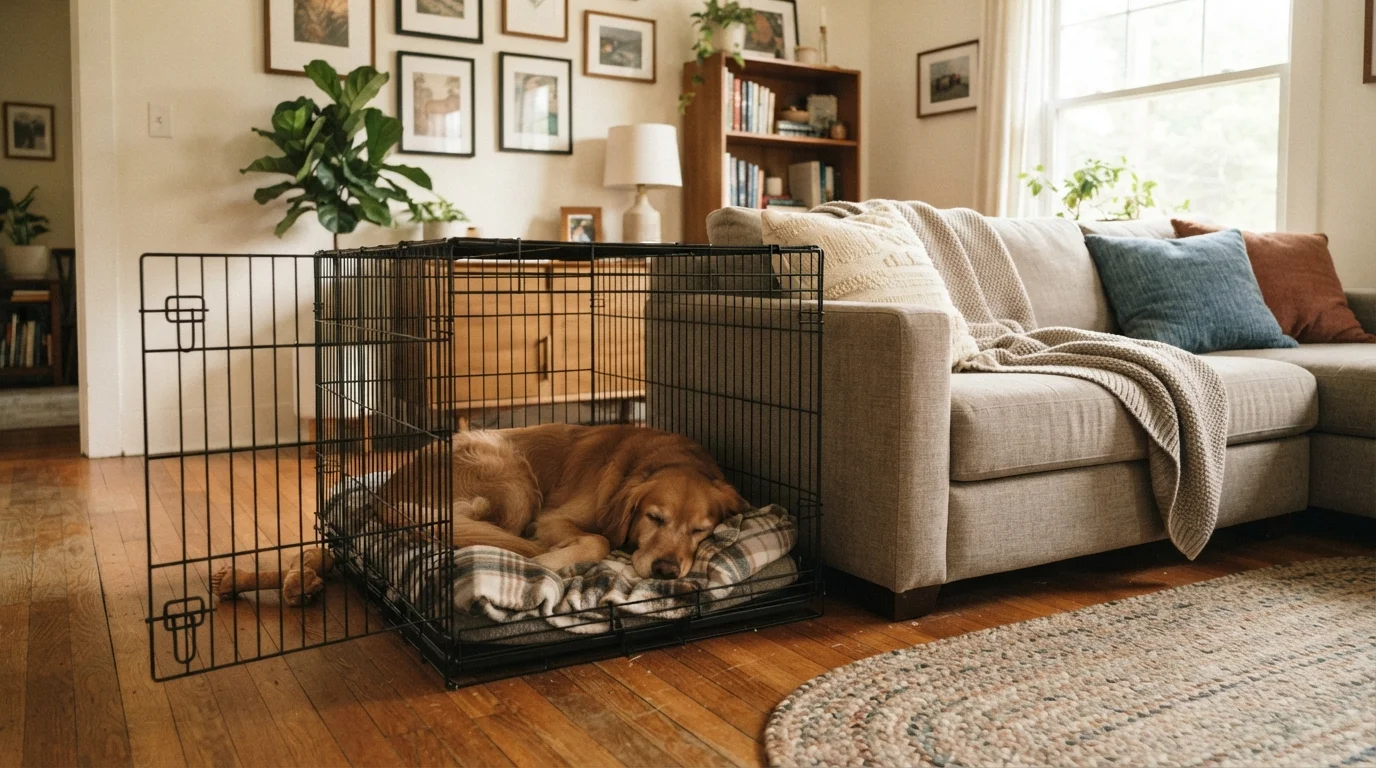
Crate training means providing your dog with a dedicated enclosed space - typically a wire, plastic, or soft-sided crate - where they rest, sleep, and stay during unsupervised periods. Done correctly, crating is not punishment. It mimics the den instinct many dogs naturally possess, giving them a low-stimulation zone they come to associate with safety and calm.
Free-roaming, by contrast, means allowing your dog unrestricted or broadly unrestricted access to your home when you're away or asleep. This approach works well for dogs who have graduated from the learning phase of ownership and demonstrated consistent, reliable behavior without supervision.
The key distinction isn't which method is kinder - both can be humane and enriching when applied appropriately. The real question is whether your specific dog, at their current life stage and behavioral baseline, is ready for the responsibility that free-roaming entails. If you're settling a new puppy into your home, starting with a crate is almost always the safer foundation to build from.
| Criterion | Crate Training | Free-Roaming |
|---|---|---|
| Best life stage | Puppies, adolescents, new rescues | Mature, fully trained adult dogs |
| Housebreaking support | Strongly supports bladder control | Requires prior housebreaking completion |
| Safety when unsupervised | High - limits access to hazards | Depends on dog-proofing and training |
| Mental stimulation | Limited during crated periods | Higher environmental enrichment |
| Anxiety management | Helpful for some anxious dogs | Can increase anxiety in reactive dogs |
| Physical comfort (seniors) | May be uncomfortable for arthritic dogs | More accommodating for mobility issues |
| Training prerequisites | Crate must be introduced positively | Solid obedience and impulse control required |
Age, Breed, and Temperament: The Variables That Matter Most
Age is the most reliable starting point. Puppies under six months simply cannot hold their bladder long enough to be left loose safely, and their exploratory behavior puts them at real risk of chewing electrical cords, ingesting toxins, or injuring themselves. Even well-meaning owners often overestimate how much unsupervised freedom a young dog can handle.
Breed tendencies matter too, though they're not deterministic. High-energy working breeds - herding dogs, terriers, sporting dogs - often need more structure before earning free-roaming privileges because boredom drives destructive behavior. Understanding how much exercise your specific dog actually needs is part of making this judgment accurately.
Temperament is the third pillar. Dogs who are naturally anxious, reactive, or prone to resource-guarding may find free-roaming overstimulating, not liberating. For these dogs, a crate can function as a de-escalation tool - a space where they aren't constantly scanning their environment for threats. Conversely, a confident, laid-back dog who has never shown destructive tendencies might find extended crating unnecessarily restrictive once they've matured.
~28%
Dogs affected by separation-related behaviors
Research published in veterinary behavioral literature estimates that roughly a quarter to a third of dogs exhibit some form of separation-related behavior, which can influence which management approach is appropriate.
12-18 months
Typical age range for canine adolescence to peak
Veterinary behaviorists generally place canine adolescence between 6 and 18 months, a period when impulse control is still developing and unsupervised freedom carries higher risk.
Making the Transition: From Crate to Free-Roaming
The transition should be earned and gradual, not calendar-based. A common mistake is assuming that a dog who turns one year old is automatically ready for full household access. Developmental maturity varies considerably by breed - giant breeds, for instance, can remain in extended adolescence well past 18 months.
A practical approach: begin by granting access to a single, dog-proofed room while you're home but in another area of the house. Observe behavior. If your dog settles calmly, escalate to short absences of 15-30 minutes. Use a camera if needed. Only expand access after consistent success at each stage.
Watch for early warning signs that the dog isn't ready: chewed furniture, counter-surfing, garbage raiding, or accidents. These aren't signs of spite - they indicate the dog needs more structure and training before independence is extended. Dogs showing distress when alone may be signaling separation anxiety rather than simple mischief, which warrants a different response entirely.
For senior dogs with established good behavior, revisiting the crate decision makes sense as mobility and comfort needs shift with age.
This article provides general educational information about dog management approaches and is not a substitute for individualized advice from a licensed veterinarian or certified animal behaviorist. If your dog is displaying anxiety, aggression, or persistent behavioral problems, consult a qualified professional.