

Key Takeaways
Object Displacement Behavior
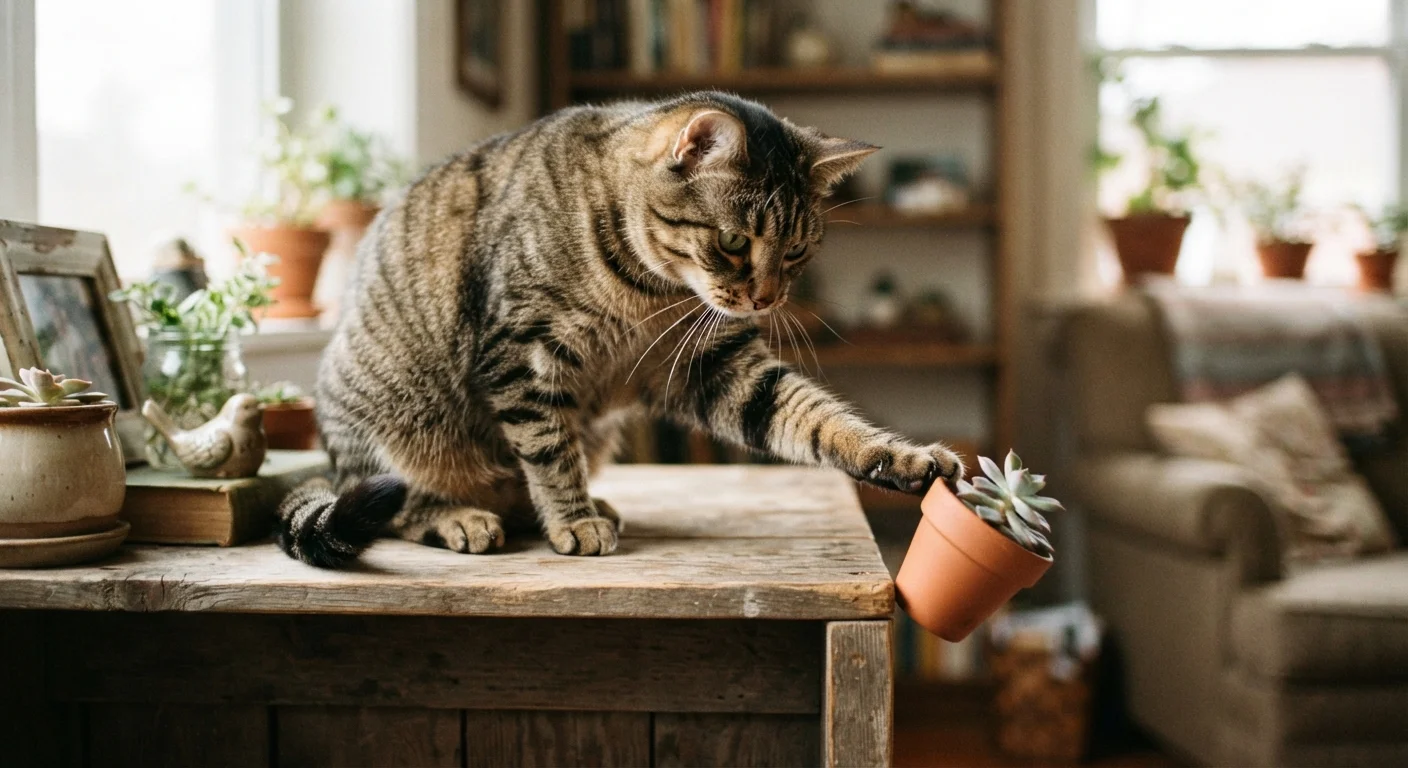
When a cat repeatedly pushes objects off elevated surfaces, it's engaging in what behaviorists call object displacement behavior. Far from random mischief, this action reflects a combination of predatory instinct, environmental curiosity, and learned social communication. Cats may do it once out of novelty, or repeatedly because it reliably produces a rewarding result.
Feline predatory motor sequences - including the swipe and bat motions used in hunting - are triggered not only by prey but by any small, movable object, explaining why the behavior persists even in well-fed indoor cats.
The Instinct Behind the Swipe
Watch a cat bat at a pen on the edge of a desk and you're watching millions of years of predatory evolution in miniature. Cats are obligate carnivores whose survival historically depended on detecting, testing, and disabling small prey. The paw-tap motion - used to check whether something is alive or safe before committing to a full bite - is hardwired into feline motor behavior.
Small objects sitting near surface edges closely mimic the visual and tactile profile of prey. They're compact, they move when touched, and they produce an immediate, satisfying response when pushed. Even cats that have never had to hunt for food retain this behavioral circuitry, which is why a fully fed indoor cat will still enthusiastically send a lip balm cap sailing across the floor.
This doesn't mean a cat is broken, badly behaved, or acting out. It means the cat is being a cat - expressing a deeply embedded behavioral repertoire in the environment available to it. Understanding this distinction matters, because it shapes how you respond.
~63%
U.S. households with at least one cat
According to the American Pet Products Association's National Pet Owners Survey, cats remain one of the most commonly kept companion animals in the country.
15-20 min
Recommended daily interactive play per cat
Many veterinary behaviorists suggest this minimum as a general benchmark for addressing predatory energy in indoor-only cats, though individual needs vary.
2-5x
Daily predatory sequences in wild cat relatives
Studies of feral and wild felid behavior suggest cats are motivated to perform multiple full hunt cycles per day, a drive that doesn't disappear in domestic settings.
When Curiosity Becomes a Habit
The first time a kitten pushes something off a surface, it's almost certainly curiosity. Does this object respond to pressure? What happens when it falls? The answers - yes, dramatically - are immediately engaging. Gravity delivers instant feedback, and cats are highly attuned to movement and consequence.
The behavior becomes habitual when it's reinforced. And here's where many owners unknowingly train the very behavior they'd prefer to stop: reacting. Whether a person rushes over, says the cat's name, issues a scolding, or simply makes eye contact, the cat registers that pushing that object produced an outcome. In a quiet apartment where little happens, any response is worth repeating.
This is why object-knocking is so often classified as attention-seeking behavior - not because cats are calculating manipulators, but because they learn, through trial and error, what reliably gets a response. Boredom and understimulation are frequently the underlying fuel. A cat with adequate outlets for predatory energy and social interaction is generally less motivated to resort to shelf-clearing.
What You Can Actually Do About It
The most effective approach addresses both the instinct and the reinforcement loop. On the instinct side, structured play is the primary tool. Sessions using wand toys, feather lures, or laser pointers give the predatory swipe-and-chase sequence a legitimate target. Fifteen to twenty minutes of interactive play daily can noticeably reduce displaced behaviors - though outcomes vary by individual cat.
On the reinforcement side, the key is not reacting when the behavior occurs. This is harder than it sounds, but any consistent reaction - even negative attention - signals that the strategy worked. Redirecting calmly before the object gets pushed (offering a toy instead) is more effective than responding after the fact.
Environmental adjustments also help. Storing objects that matter in closed spaces, providing dedicated climbing structures and window perches, and rotating enrichment items all reduce the appeal of improvised entertainment. Puzzle feeders are particularly useful because they engage the predatory sequence in a controlled way.
It's also worth noting that many common beliefs about cat behavior - including the idea that cats act out of spite - don't hold up to scrutiny. Cats that knock things over are communicating through available means, not plotting revenge. Responding to that communication thoughtfully, rather than reactively, tends to produce better results for everyone in the household.
Try Ignoring the Behavior Completely
If your cat knocks something over and you immediately look up, call its name, or pick up the object with visible frustration, you've just rewarded the behavior. Try standing up calmly, leaving the room briefly, and returning without acknowledgment. Consistency over several weeks is usually required before a reinforced habit begins to fade.