

Key Takeaways
Why the Home Environment Matters as Much as the Classroom
Teachers spend roughly six hours a day with a child. Parents and caregivers have the remaining eighteen. That math matters. Research in educational psychology consistently shows that the home learning environment - the physical space, the emotional tone, and the daily routines a family maintains - shapes how effectively children absorb and retain what they learn at school.
This isn't about transforming your home into a second classroom. It's about making intentional, modest choices that remove friction from learning and replace it with support. Whether your child attends a traditional school, is being homeschooled, or falls somewhere in between (see our guide on weighing the trade-offs between homeschooling and traditional school), the home environment plays a foundational role.
Establish a predictable homework and reading block each day at the same time.
Routine reduces the daily negotiation around when schoolwork happens, lowering resistance and cognitive load for both parent and child. Children who follow consistent after-school routines show higher homework completion rates in multiple longitudinal studies of family learning environments.
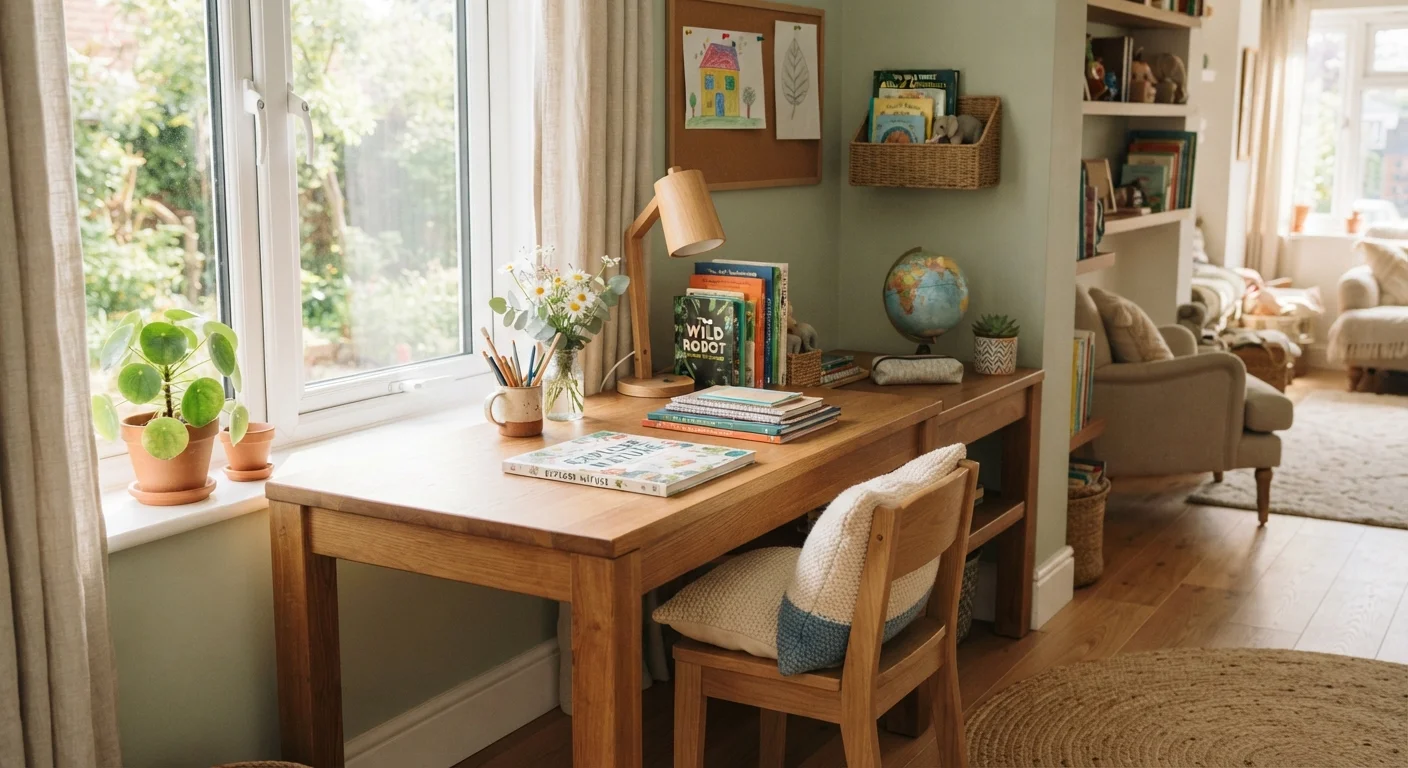
Create a designated, low-distraction physical space for schoolwork - even a small corner will do.
A consistent workspace cues the brain that focused work is expected there, much like how an office desk triggers a different mindset than a couch. Clutter and background noise compete for the same cognitive resources that reading and problem-solving require.
Read aloud with your child regularly, regardless of their independent reading level.
Shared reading builds vocabulary, comprehension, and a positive association with books in ways that independent silent reading alone does not. Hearing fluent, expressive reading models language patterns children then internalize.
Respond to academic mistakes with curiosity rather than disappointment.
How adults react to errors shapes whether children perceive effort as worthwhile. Shame or frustration in response to mistakes causes children to avoid challenge; curious, problem-focused responses sustain motivation over time.
Limit passive screen time during homework hours and model focused attention yourself.
Children's attention and habits are shaped heavily by what they observe adults doing. A parent who is visibly reading or working while a child does homework sends a stronger message than a rule posted on the refrigerator.
Talk with your child about what they're learning - not just whether they finished their work.
Conversation about content deepens comprehension through retrieval practice, one of the most evidence-supported memory strategies in cognitive science. It also signals that learning itself is interesting, not just obligatory.
Routines, Spaces, and Habits That Support Learning
The most effective home learning environments aren't elaborate - they're consistent. Small, repeatable habits signal to a child's developing brain that learning is a normal, expected part of daily life rather than a chore imposed at random.
Physical space matters more than many parents realize. Children benefit from a designated spot for schoolwork - not necessarily a separate room, but a consistent location with minimal visual clutter and good lighting. Natural light in particular has been associated with better alertness and mood in learning contexts. Our related article on biophilic design principles for everyday homes explores how simple environmental tweaks can shift the feel of any room.
If you suspect your child needs more structured support beyond the home, finding a tutor who genuinely fits your child can be a meaningful complement to what you build at home.
Emotional Climate: The Often-Overlooked Foundation
Academic engagement doesn't happen in an emotional vacuum. Children who feel psychologically safe at home - where mistakes are treated as learning opportunities rather than failures - are more willing to tackle difficult material and ask for help when they're stuck. This is sometimes called a growth mindset environment, a concept grounded in the work of developmental psychologists studying motivation and resilience.
Practically, this means how a parent responds to a failed quiz or a confusing assignment carries real weight. Curiosity-forward responses - "What part was tricky?" or "What would you try differently?" - sustain effort better than outcome-focused pressure. If a child shows persistent signs of disengagement or anxiety around schoolwork, recognizing when a child may need extra academic support is a useful next step.
Every Child's Needs Are Different
These practices reflect general patterns from educational research and are not prescriptions for individual children. Some children thrive with longer focused blocks; others need more frequent breaks. If your child shows signs of persistent frustration, avoidance, or anxiety around schoolwork, those signals may point to a need for professional evaluation rather than a change in home routine alone. A school counselor, learning specialist, or pediatrician can help clarify next steps.
Parent-teacher communication also reinforces the home environment. The insights a teacher shares can help you calibrate the support you're offering at home. Our guide on getting more from parent-teacher conferences gives you focused questions to make those short meetings count.