

Key Takeaways
Option A
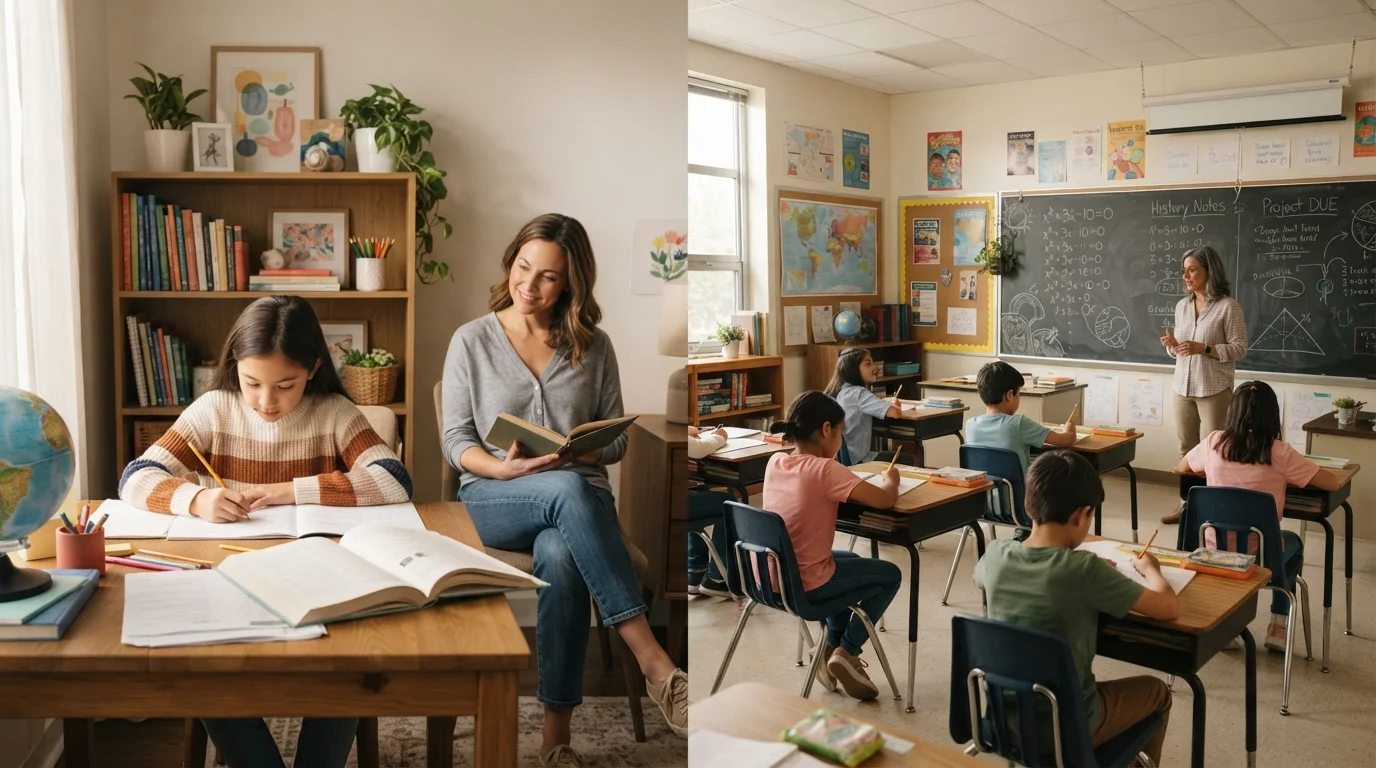
Homeschooling
The flexible, family-directed approach to education.
Best for: Families who want to customize curriculum, pace, and schedule around a child's individual needs and learning style.
Option B
Traditional School
The structured, institution-based educational pathway.
Best for: Families who value peer socialization, credentialed instruction, and a consistent daily structure outside the home.
If your child has specialized learning needs or a non-traditional pace
Homeschooling
Homeschooling allows instruction to be tailored to a child's exact level and learning style, removing the pressure of lockstep grade progression.
If peer interaction and team-based activities are a high priority
Traditional School
Traditional schools provide daily, structured social environments and broad extracurricular offerings that are difficult to replicate at home.
If your family has a single income or limited discretionary budget
Traditional School
Public traditional schooling has no direct tuition cost and does not require a parent to reduce or leave paid employment to manage instruction.
If your child is a self-motivated learner whose schedule requires unusual flexibility
Homeschooling
Homeschooling can accommodate travel, competitive training, or health-related scheduling constraints in ways a fixed school calendar cannot.
If you want access to certified specialists across multiple subjects
Traditional School
Schools employ credentialed teachers for every subject area, providing expert instruction that most individual parents are not positioned to replicate across all disciplines.
How the Two Approaches Are Structured
Homeschooling places the parent - or a hired tutor - at the center of instruction. Families select their own curriculum, set their own hours, and pace learning according to the child's demonstrated mastery rather than a school calendar. This autonomy is the defining feature, and the defining responsibility, of the model.
Traditional schooling operates within an institutional framework: a fixed daily schedule, credentialed teachers, state-approved curriculum standards, and a shared physical space with peers. Public schools are tuition-free and governed by local and state education agencies; private schools charge tuition and may have religious or philosophical affiliations.
A meaningful middle ground has also grown significantly in recent years. Virtual K-12 schooling blends home-based delivery with school-issued curriculum and, often, state oversight - a useful reference point when comparing the two primary models here.
| Criterion | Homeschooling | Traditional School |
|---|---|---|
| Curriculum control | Fully customizable by family | State-approved standards |
| Socialization | Requires deliberate planning | Built-in daily peer interaction |
| Direct tuition cost | Variable ($0-several thousand/year) | Free (public); tuition for private |
| Teacher credentials | Usually parent-led; varies | State-certified instructors |
| Schedule flexibility | High; family sets the calendar | Fixed school-year calendar |
| Extracurricular access | Requires outside enrollment | Broadly available on-site |
| Parental time commitment | Very high | Low to moderate |
| State regulatory oversight | Varies widely by state | Consistent; publicly accountable |
Socialization and Community
Socialization is the most frequently raised concern about homeschooling, and it deserves an honest look. Traditional schools provide daily, unscripted interaction with a wide range of peers - a feature that supports social skill development in naturalistic settings. Extracurricular activities, team sports, and clubs are built into the structure.
Homeschooled children are not isolated by definition, but social opportunities require deliberate planning. Many families join co-ops, enroll children in community sports leagues, or participate in religious and civic groups. Research on homeschooled students' social outcomes is mixed and context-dependent, meaning the quality of a child's social life in either setting hinges substantially on what families actively pursue. If social enrichment at home concerns you, after-school programs and learning centers can supplement either pathway.
3.3M+
Homeschooled students in the U.S.
According to the U.S. Census Bureau's 2021 Household Pulse Survey, an estimated 11% of school-age children were being homeschooled at some point during the pandemic period, reflecting a significant rise from pre-pandemic estimates.
~50
Distinct sets of state homeschool laws
The Home School Legal Defense Association notes that every U.S. state permits homeschooling but under widely varying regulations - from simple notice requirements to mandatory curriculum review.
Top 3
Parent reasons for homeschooling
NCES data consistently identifies concerns about school environment, desire to provide religious or moral instruction, and dissatisfaction with academic instruction as the leading motivations families cite.
Curriculum, Cost, and Daily Life
Curriculum flexibility is homeschooling's clearest advantage. Parents can choose from structured packaged curricula, unschooling philosophies, or hybrid approaches - and can shift methods if something isn't working. That said, parents must invest real time in planning, record-keeping, and instruction, often at the cost of full-time employment.
Cost ranges widely. Public school carries no tuition, while homeschooling expenses - curriculum materials, co-op fees, enrichment activities - typically run between a few hundred and several thousand dollars annually. Families should also factor in the opportunity cost if one parent reduces paid work to homeschool.
For families focused on supporting learning no matter which path they choose, creating a strong home learning environment benefits children in both settings. Those exploring alternatives to conventional schooling may also find value in reviewing school choice programs like magnet schools and open enrollment, which can expand options without leaving the public system entirely.
State homeschooling laws vary considerably. Some states require notification, portfolio reviews, or standardized testing; others impose minimal requirements. Families must verify their state's current rules through official government education agency sources before beginning.
Homeschooling Laws Differ by State
There is no single federal homeschooling law in the United States. Requirements range from simple one-time notification to annual portfolio reviews and standardized testing. Before beginning a homeschool program, check your state's department of education website or consult your local school district for current, official requirements. Rules can change, so verify information from authoritative government sources rather than third-party summaries alone.