
Blind Spots, Mirrors, and the Shoulder Check: Getting the Full Picture Around Your Vehicle

Key Takeaways
Where Blind Spots Actually Live
Every vehicle has zones the driver simply cannot see using mirrors alone. These are called blind spots - areas adjacent to and behind the vehicle where other cars, cyclists, or pedestrians can disappear from view entirely. Understanding their location is the foundation of safer driving.
For a standard sedan, the most significant blind spots sit diagonally behind the vehicle on each side - roughly the area between where your side mirrors end and where your peripheral vision picks up. A vehicle traveling in the lane next to you can vanish in this zone, especially when it matches your speed. Larger vehicles like SUVs, pickup trucks, and minivans have proportionally larger blind spots, and some full-size trucks have substantial rear blind spots as well.
Other often-overlooked zones include the area directly behind the vehicle when reversing (particularly relevant for low-profile vehicles without backup cameras), the far corners of wide vehicles, and the near-side front corner when navigating tight turns or intersections. Motorcycles and cyclists are especially vulnerable because their smaller profiles make them easier to miss even when a driver is looking carefully.
For context on how blind spots contribute to collision risk, see our guide to merging and lane changes, which covers the situations where driver confusion most often leads to crashes.
Blind Spots Are Larger Than They Feel
Most drivers underestimate how much space a blind spot covers at highway speeds. A vehicle traveling at 65 mph can traverse your blind spot in under two seconds - which means a quick glance at another mirror or momentary distraction is enough to miss it entirely. Never assume a lane is clear because you don't see anything in your mirrors; always pair mirror checks with a shoulder check before moving.
Setting Up Your Mirrors Correctly
Many drivers set their mirrors to show a wide slice of their own vehicle's rear quarter panels - a reassuring but largely wasted field of view. The goal of mirror adjustment is to push coverage as far into the adjacent lanes as possible, not to frame your own car.
Adjust the rearview mirror for a straight-back view
Sit in your normal driving position - don't lean forward or adjust your posture. Then move the rearview mirror until the entire rear window is framed within it. The mirror should show the road directly behind you with as little headliner and rear shelf as possible. This is your primary rear reference point and should require no head movement to check quickly.
Adjust the driver-side mirror outward
Lean your head to the left until it nearly touches the driver-side window. From this position, adjust the left mirror until you can just barely see the rear edge of your own vehicle. When you return to your normal driving position, the mirror should show primarily the lane to your left - not your own car. This extends your coverage significantly compared to the traditional centered-vehicle view.
Adjust the passenger-side mirror outward
Lean toward the center console until your head is roughly above the center of the vehicle. From that position, adjust the right mirror until your own vehicle's rear edge is just barely visible. Return to your normal seat position - the mirror should now show more of the right lane than your own car. Because you're further from this mirror, the geometry requires it to be angled more steeply than the driver-side mirror.
Verify coverage overlap between mirrors
With all three mirrors adjusted, there should be a smooth handoff of coverage: the rearview mirror picks up the lane behind you, and each side mirror picks up where it leaves off. A useful test - have someone walk slowly around your parked vehicle. You should be able to track them continuously in your mirrors from directly behind the car to roughly the front door pillar on each side. Any gap where they disappear is your residual blind spot.
Perform the shoulder check before every lane change or merge
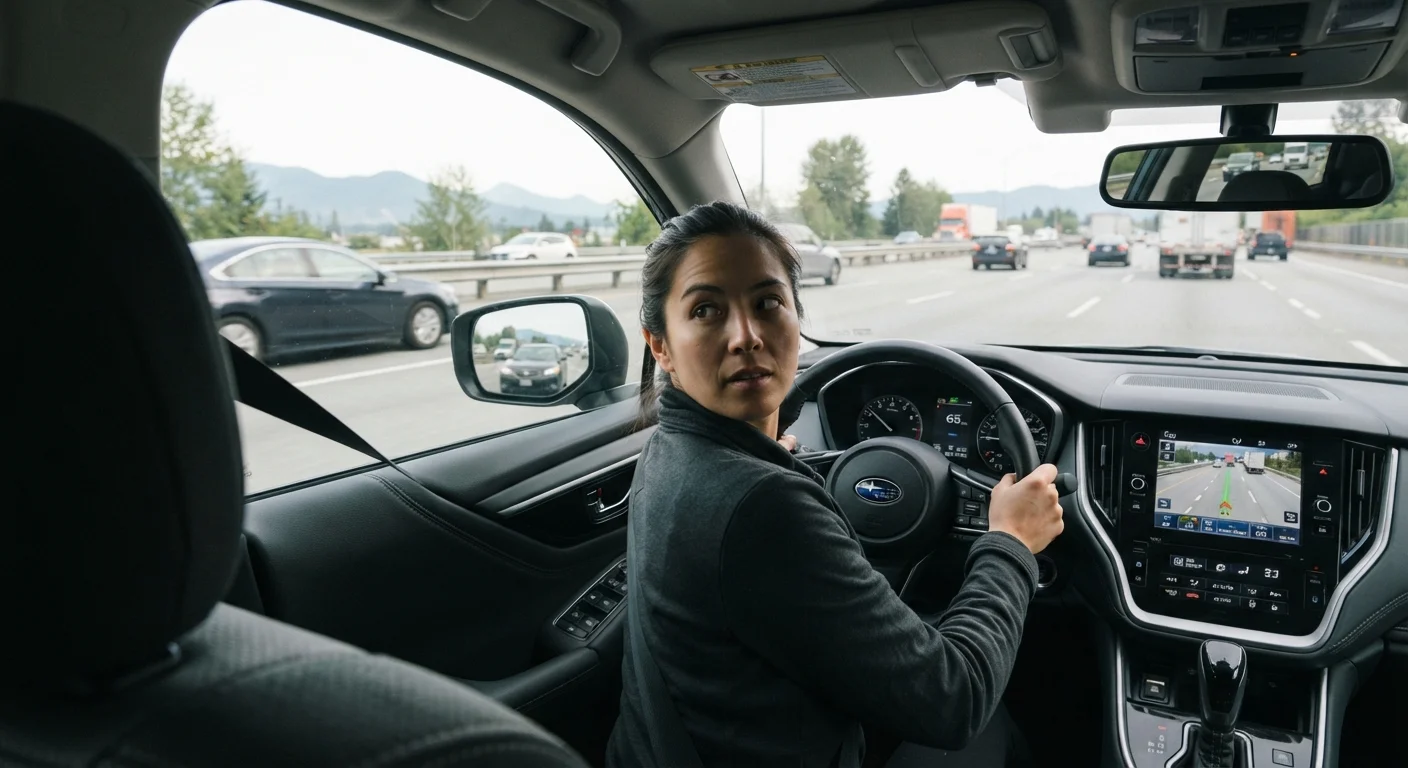
Before initiating any lane change or merge - including freeway on-ramps and highway exits - briefly turn your head toward the window on the side you're moving toward. You're looking for vehicles in the gap your mirrors don't cover. This motion should be quick (roughly one to two seconds) and should not cause you to drift in your current lane. Keep your hands steady on the wheel and maintain your current steering while you check. The sequence should be: signal, check mirrors, shoulder check, then move if clear.
Once set correctly, your three mirrors should work together: the rearview mirror covers the lane directly behind you, and the side mirrors pick up where it leaves off on each side. There will still be a gap - that's what the shoulder check is for.
Before every drive, spend a moment confirming your mirror positions haven't shifted, especially if other people drive your vehicle. This habit pairs well with a broader pre-trip safety check that covers mirrors alongside tires, lights, and fluids.
Convex Mirror Inserts Can Help
Small adhesive convex (wide-angle) mirror inserts are available for side mirrors and can expand your field of view in the blind spot zone. They don't replace proper mirror adjustment or shoulder checks, but many drivers find them a useful additional reference. If you use one, allow time to learn how distance appears distorted in a convex surface - objects will look farther away than they are.
Troubleshooting Common Mirror and Visibility Problems
Even well-adjusted mirrors can be compromised by real-world conditions. Glare from headlights at night is one of the most disruptive - most rearview mirrors have a manual or automatic anti-glare setting (often a small tab on the bottom of the mirror) that tilts the reflective surface to cut direct beam reflection. If you find night driving particularly challenging, night driving habits covers this and related issues in depth.
Condensation and dirt on mirror glass significantly reduce effective range. Keeping exterior mirror glass clean and clearing interior fogging before driving are minor habits with meaningful payoff. Cracked or damaged mirrors distort reflection and should be replaced - check with a qualified mechanic for assessment.
Passengers, cargo, or window coverings that block the rear window reduce the rearview mirror's usefulness to near zero. When hauling cargo that eliminates rear sightlines, you become more dependent on side mirrors and shoulder checks than usual - adjust your following distance and lane-change behavior accordingly. See how cargo and passengers affect driving safety for more on managing in-cabin factors.
Backup Cameras Don't Replace Shoulder Checks
Many newer vehicles include backup cameras and blind spot monitoring systems. These are useful tools, but they have real limitations: cameras can be obscured by dirt or glare, sensors have defined detection ranges and can miss fast-moving objects, and none replicate the full spatial awareness of a properly conducted shoulder check. Treat these systems as supplements to good habits - not substitutes for them. Overconfidence in driver-assist technology is a documented contributor to crashes; see the hidden patterns behind everyday accidents for more context.