

Key Takeaways
The Cabin Is Already a Complex Environment
Most drivers think of distracted driving as a phone problem. But well before smartphones existed, passengers were talking, children were fighting over snacks, and dogs were climbing onto laps at highway speed. The cabin of a moving vehicle is a dynamic space, and everything inside it - animate or not - competes with the driver's attention in some form.
The National Highway Traffic Safety Administration (NHTSA) identifies three categories of distraction: visual (eyes off the road), manual (hands off the wheel), and cognitive (mind off the task of driving). Passengers, pets, and unsecured cargo can trigger all three simultaneously. Understanding which hazard does what - and when - helps you build habits that address the actual risk rather than guessing.
This is especially relevant for newer drivers. Research consistently shows that crash risk rises sharply with each additional teenage passenger in the vehicle, which is one reason most state graduated licensing programs restrict peer passengers for new drivers. For a deeper look at those early-driving risk patterns, see how early habits shape driving safety.
Set passenger expectations before you move
Conversations don't carry the same risk as a phone call - your passengers can read the road and pause when things get complex. But loud arguments, urgent requests, or turning to face someone in the back seat are genuine hazards. Before a trip, especially with children, briefly set expectations: stay seated and buckled, keep voices at a reasonable level, and save non-urgent questions for when the car is stopped.
On longer trips, designated rest stops give everyone a chance to regroup. Road trips with kids offers practical structure for managing backseat dynamics over distance.
Passengers can read the road and pause - but arguments and urgent requests are still real hazards.
Restrain pets the same way you restrain people
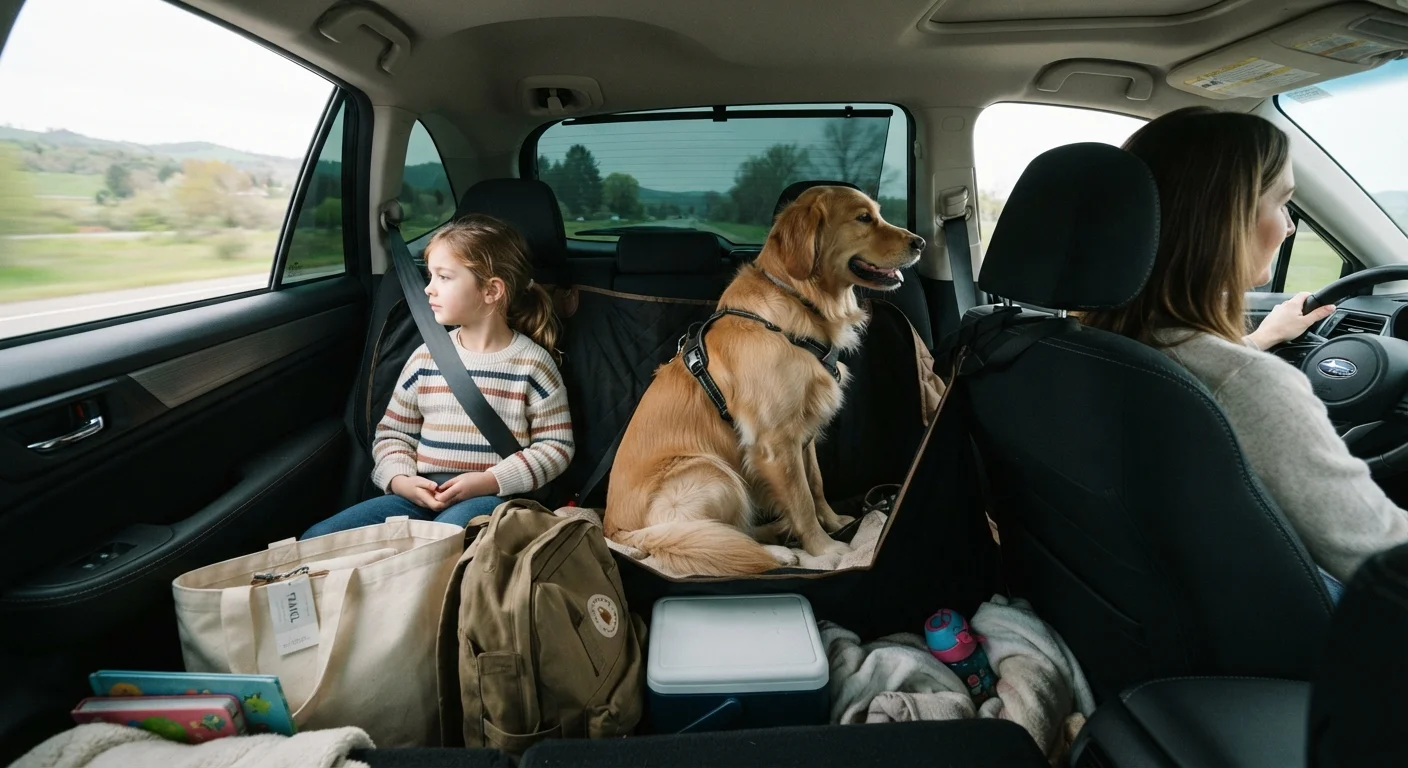
An unrestrained 10-pound dog becomes a projectile in a 30-mph collision. At 60 mph, the physics are substantially worse. Beyond the risk to the animal, a loose pet can interfere with the steering wheel, block the driver's view, or startle them at a critical moment.
Crash-tested pet harnesses, secured carriers, and vehicle barriers between the cargo area and passenger compartment are the main options. Whatever you choose, the key word is secured - a harness that clips into the seatbelt anchor but isn't rated for crash forces offers limited real protection. Look for products that have been tested under crash-simulation conditions and check your vehicle's cargo specifications for barrier compatibility.
An unrestrained dog becomes a projectile in even a moderate collision - secured restraint is non-negotiable.
Secure cargo so it can't shift or become airborne
Loose items in the cargo area - grocery bags, tools, sports equipment, luggage - shift under braking and can strike passengers or the driver in a sudden stop or rollover. Heavy items in the passenger compartment (like a toolbox on the rear seat) pose an even more direct risk.
Use the cargo net or tie-down anchor points your vehicle likely already has. Place heavier items as low and as far forward as practical. For truck beds, use ratchet straps and check that nothing extends beyond the bed without a proper flag and, where required, a permit. If your cargo demands regular trips, understanding how vehicle use affects overall ownership costs is worth a look - see managing car ownership costs for practical framing.
Loose cargo shifts under braking - use anchor points and tie-downs before every trip, not just long ones.
Limit reach-and-retrieve behavior while moving
One of the most common in-car distractions isn't a device - it's reaching for something that fell, handing food to a child, or fishing through a bag on the passenger seat. Each of these takes one or both hands off the wheel and pulls the driver's eyes downward, often for several seconds at a time.
The fix is mostly pre-trip organization. Put drinks in cup holders before departure. Place snacks where passengers can reach them independently. If something falls or is needed urgently, pull over where it's safe to do so rather than retrieving it at speed. This also applies to adjusting navigation or climate controls - many drivers underestimate how long these tasks take.
Reaching for dropped items or handing food to passengers pulls eyes and hands from the task simultaneously.
Keep sight lines clear around the vehicle
Cargo stacked too high in the rear blocks the rearview mirror. A pet kennel positioned without care can obscure a side window. Even a passenger leaning or a child's car seat positioned poorly can narrow your usable field of vision. Before you drive, confirm that your mirrors give you a clear view and that your sight lines aren't significantly compromised by what's in the cabin.
This connects directly to broader visibility habits. Understanding where your mirrors do and don't cover - and when to rely on shoulder checks - makes a real difference in complex situations like lane changes. Blind spots and mirror technique covers that ground in detail.
Cargo stacked too high or a misplaced crate can block mirrors and compress your effective field of view.
Know when to pull over rather than manage in motion
Some situations can't be resolved while driving. A dog that has escaped its harness, a child in genuine distress, or cargo that has shifted visibly are all reasons to find a safe place to stop. Attempting to manage these problems at highway speed increases risk for everyone in the vehicle and for other road users.
Identify a safe stopping point - a rest area, parking lot, or wide shoulder with good visibility - rather than braking unpredictably. Signal your intention, reduce speed gradually, and address the issue with the vehicle fully stopped and, where possible, out of the active traffic lane. Knowing your right-of-way obligations during these maneuvers matters too; lane change and merging rules explains the situations where confusion most commonly leads to crashes.
Attempting to manage a loose pet or shifting cargo at speed increases risk for everyone - pull over safely instead.
Put It Together Before You Pull Out
Most in-cabin distractions are predictable. Unlike an unexpected road hazard, you know before you start the car whether you have a restless dog, a talkative child, or a truck bed full of tools. That predictability is an advantage - use it.
Build a pre-trip checklist habit: confirm cargo is secured, pets are restrained or crated, passengers know your driving rules, and entertainment or snacks for children are within reach without requiring you to turn around. Five minutes of preparation before departure prevents fifteen minutes of dangerous improvisation at speed.
Build a Pre-Trip Cabin Check Into Your Routine
Before any trip with passengers, pets, or cargo, take 60 seconds to confirm: seatbelts buckled, pet restrained or crated, cargo secured, mirrors unobstructed. This brief pause costs almost nothing and addresses the majority of preventable in-cabin distractions before they occur.
Distraction compounds with fatigue. If you're driving tired with a full, noisy cabin, the risk multiplies. The dynamics between impairment and distraction are worth understanding - how fatigue affects driving the way alcohol does breaks down that relationship clearly. And if you're ever curious whether your confidence behind the wheel is well-founded, common distracted driving myths is worth a read.
This article is for general informational purposes only. Always follow applicable traffic laws and consult your vehicle's owner manual for cargo and restraint specifications.