

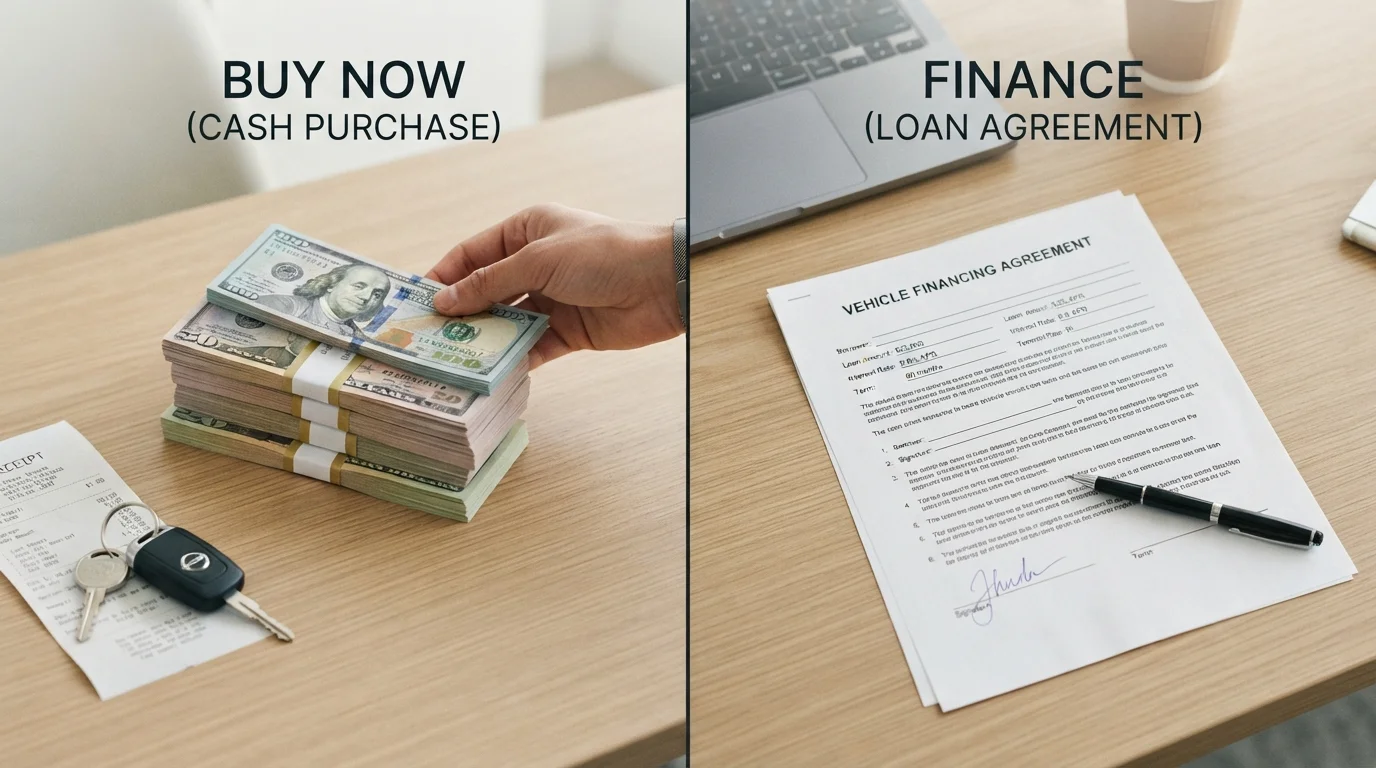
Key Takeaways
Option A
Auto Loan Financing
The structured, spread-out approach to vehicle purchasing.
Best for: Buyers who want to preserve liquid savings while acquiring a vehicle through monthly payments.
Option B
Cash Purchase
The outright, interest-free path to full ownership.
Best for: Buyers with sufficient liquid savings who want to avoid interest costs and debt obligations entirely.
If you have limited savings and need reliable transportation now
Auto Loan Financing
Financing allows you to acquire a vehicle without depleting funds needed for emergencies. Keeping a cash cushion available often outweighs the cost of loan interest.
If you have sufficient savings and want to minimize total spending on the vehicle
Cash Purchase
Paying cash eliminates interest charges entirely and simplifies ownership from day one, reducing the total amount spent on the car.
If your savings could realistically earn more than your loan interest rate
Auto Loan Financing
When a low-interest loan is available, keeping savings invested at a higher return rate may offset the interest paid - though this involves market risk and is not guaranteed.
If you want complete ownership flexibility with no monthly obligations
Cash Purchase
Owning the vehicle outright means no lender restrictions, no required lender-mandated insurance levels, and full freedom to modify or sell the vehicle at will.
What Financing Actually Costs Over Time
When you finance a vehicle, the purchase price is only the starting point. The total you repay includes the principal - the amount borrowed - plus interest calculated over the loan term. On a typical multi-year auto loan, that interest can add hundreds to several thousand dollars to the total cost, depending on the rate and term length.
For example, a $28,000 loan at a 7% annual percentage rate (APR) over 60 months results in monthly payments of roughly $554 and a total repayment of about $33,240 - meaning roughly $5,240 paid in interest alone. Extending the term to 72 months lowers the monthly payment but increases total interest paid.
Beyond the rate, your credit profile significantly influences what terms a lender offers. Borrowers with stronger credit histories typically qualify for lower APRs. Fees such as loan origination charges may also apply, depending on the lender.
| Criterion | Auto Loan Financing | Cash Purchase |
|---|---|---|
| Total amount paid | Purchase price + interest | Purchase price only |
| Monthly obligation | Fixed loan payment required | No monthly payment |
| Liquid savings impact | Savings preserved | Large savings outlay required |
| Opportunity cost | Lower (savings remain available) | Higher (funds are committed) |
| Insurance requirements | Lender may mandate full coverage | No lender requirements |
| Credit impact | On-time payments can build credit | No credit activity generated |
| Ownership flexibility | Restricted until loan is paid off | Full ownership from day one |
It's also worth noting that a financed vehicle usually requires comprehensive and collision insurance coverage until the loan is paid off - a lender requirement that can affect your monthly insurance costs. See the full picture of car ownership costs for how financing fits into your broader vehicle budget.
What Paying Cash Actually Costs - Including What You Give Up
Paying cash eliminates interest by definition. If you buy the same $28,000 vehicle outright, you spend exactly $28,000 on the purchase - no more. You also avoid mandatory lender-driven insurance requirements and carry no monthly debt obligation tied to the car.
However, using a large sum of cash has its own financial implications. The money spent on a vehicle is no longer available as an emergency fund, and it's no longer available to earn returns in savings accounts, money market accounts, or investment vehicles. Economists refer to this as opportunity cost - the potential benefit you forgo when you commit funds to one use over another.
~$40,000+
Average new vehicle transaction price in the U.S.
According to Kelley Blue Book data, average new car transaction prices have regularly exceeded $40,000 in recent years, making the cash-versus-finance decision financially significant.
60-72 months
Most common auto loan terms
Experian's automotive finance data consistently shows 60- and 72-month terms are among the most popular, extending repayment periods and increasing total interest paid.
Varies widely
APR range based on credit profile
Auto loan interest rates differ substantially by credit tier - borrowers with excellent credit may qualify for rates well below the national average, while subprime borrowers may face significantly higher rates.
The significance of opportunity cost depends heavily on your personal financial situation. If depleting your savings to buy a car leaves you without a financial buffer, that risk may outweigh the benefit of avoiding loan interest. On the other hand, if you have strong reserves and the cash purchase is a modest portion of your total savings, the opportunity cost is considerably smaller.
Cash buyers also tend to have stronger negotiating leverage at the dealership, since there's no financing contingency involved in the transaction - though the actual discount received varies widely. For a broader look at how borrowing decisions ripple outward, the hidden costs of carrying debt article illustrates similar dynamics in another context.
How to Think Through the Decision for Your Situation
The financing versus cash question doesn't have a universal answer - it depends on interest rates available to you, the size of your savings, your income stability, and your broader financial priorities.
A useful starting point is comparing the APR on any loan you qualify for against the realistic after-tax return you could expect from keeping those funds in savings or investments. If a low-rate loan is available and your savings are productively deployed, financing may carry a smaller net cost than it appears. If rates are high or your savings aren't growing meaningfully, paying cash tends to reduce total outlay.
Regardless of which path you take, the vehicle purchase price is only one layer of what you'll spend. Depreciation, maintenance, registration, and insurance all continue throughout ownership. Costs that commonly go unbudgeted are worth reviewing before committing to either approach.
If you're weighing new versus used alongside the financing question, comparing new and used vehicle ownership costs can help clarify how depreciation interacts with your purchase method. And if leasing is also on the table, what lease agreements don't show upfront is worth reading before signing anything.
This article is for general informational purposes only and does not constitute financial or legal advice. For decisions about your specific financial situation, consult a qualified financial professional.