

Key Takeaways
Why the Legend and the Reality Don't Quite Match
Route 66 occupies a uniquely powerful place in American imagination — stitched into pop songs, novels, and decades of travel marketing as the ultimate symbol of open-road freedom. That mythology is part of its enduring appeal. But it's also responsible for some persistent misconceptions that can leave unprepared travelers frustrated before they've made it out of Illinois.
The myths tend to cluster around three themes: the physical state of the road itself, the time and logistics required to drive it, and what the scenery actually looks like for most of the journey. Getting straight on all three will make the difference between a trip that delivers on its promise and one that doesn't.
Myth
Route 66 is a fully intact highway you can simply drive from Chicago to LA.
Fact
The original Route 66 was decommissioned in 1985 and replaced by interstates. What exists today is a patchwork of historic alignments maintained by individual states.
When people picture Route 66, they often imagine one continuous road with clear signage guiding them from Chicago's Lake Shore Drive all the way to the Santa Monica Pier. The reality is more complicated. After the federal government officially decertified the highway in 1985, responsibility for preserving and marking the remaining segments fell to each of the eight states it passes through. Some states, like Missouri and Oklahoma, have done extensive work to mark and restore historic alignments. Others have far less consistent signage. Travelers who don't plan ahead often find themselves defaulting to I-40 for long stretches — which technically follows the same corridor but bears none of the original road's character.
Myth
You can drive Route 66 end-to-end over a long weekend.
Fact
The full route spans roughly 2,400 miles. A realistic end-to-end drive, with stops at key towns and attractions, takes two to three weeks minimum.
The Chicago-to-Santa-Monica distance alone is around 2,400 miles — and that doesn't account for detours to notable towns, time spent at roadside attractions, or the slower pace that makes the drive worthwhile in the first place. Most experienced Route 66 travelers recommend budgeting at least 14 days, with three weeks being ideal for a relaxed, thorough experience. Those who rush it often report that they spent most of their time on the interstate and missed the very things that make the route special: places like Tucumcari, New Mexico; Galena, Kansas; and Winslow, Arizona.
Myth
Route 66 is all open desert and cowboy country.
Fact
The route begins in Chicago, winds through Missouri's Ozarks and Oklahoma's plains, and only enters the Southwest landscape in the final third.
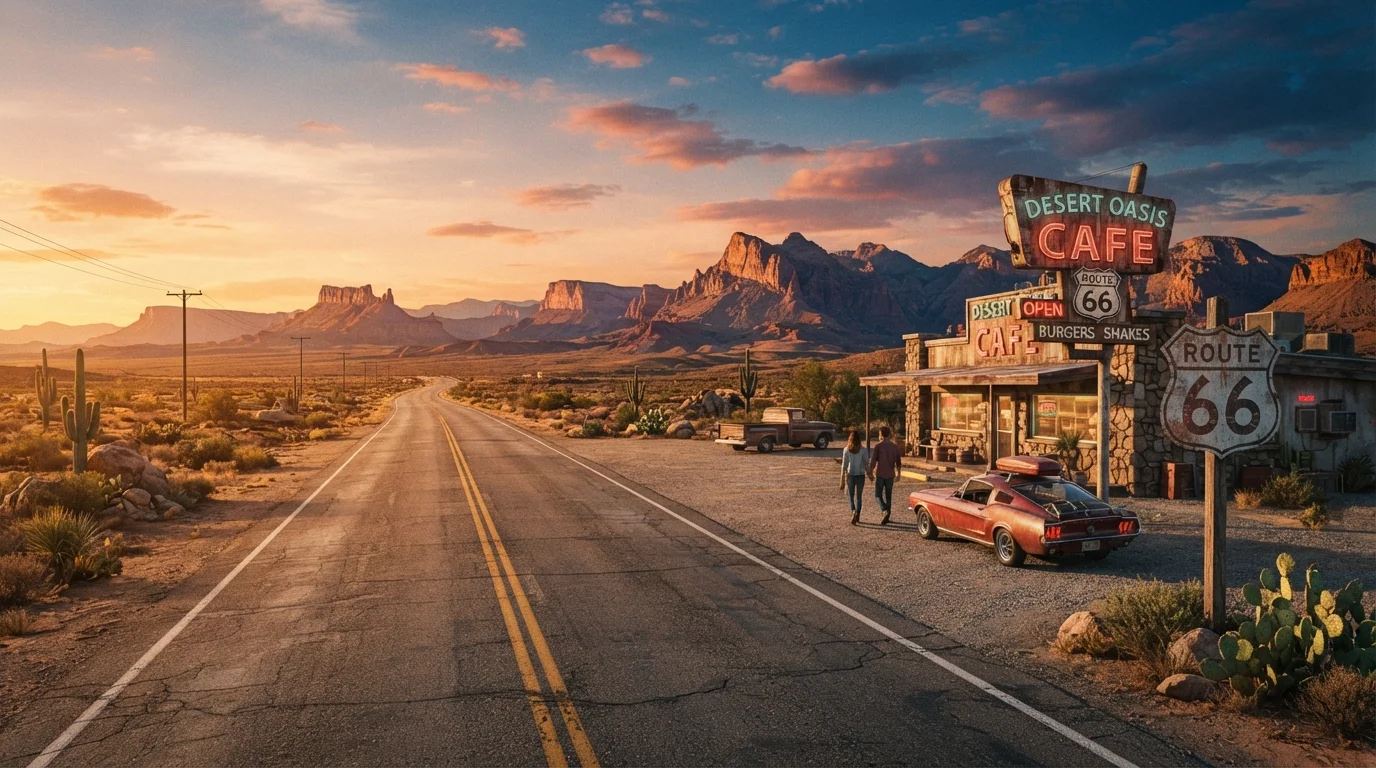
The desert imagery dominates Route 66 marketing, but the first half of the journey looks nothing like that. Chicago to St. Louis runs through Midwestern flatlands and small industrial towns. The Ozark hills of Missouri are green and hilly. Oklahoma brings wide open tallgrass prairie and Route 66's deepest cultural history, including the Dust Bowl migration stories that inspired John Steinbeck's The Grapes of Wrath. The iconic red-rock mesas and desert light only emerge in northern Arizona and the Mojave. Each geographic shift brings genuinely different food, architecture, and regional character — which is precisely what makes the full drive worth doing.
Myth
Everything worth seeing on Route 66 is on the route itself.
Fact
Many celebrated stops — national parks, historic sites, and notable towns — require short side trips off the main alignment.
Petrified Forest National Park sits just south of the route in Arizona and requires a dedicated detour. Meramec Caverns in Missouri, the Painted Desert, and several of New Mexico's most historically rich pueblos are all within striking distance but not directly on the alignment. Experienced Route 66 road trippers build flexibility into their itineraries specifically to accommodate these side excursions. See our guide to road stretches that surprise first-timers for more on managing expectations along ambitious American drives.
Myth
Route 66 is the only iconic American road trip worth taking.
Fact
The US has dozens of federally designated scenic byways with comparable beauty and far fewer crowds.
Route 66 earns its legendary status, but it's far from the only remarkable drive in the country. The Blue Ridge Parkway, the Natchez Trace, the Pacific Coast Highway, and many lesser-known corridors offer their own extraordinary experiences — often with less traffic and more accessible logistics. If the Route 66 planning complexity feels daunting, underrated American scenic byways are a compelling alternative worth exploring. And for families weighing whether a multi-week road trip is feasible, road trips with kids offers practical insight into making long drives work for all ages.
Planning a Route 66 Trip That Actually Works
The good news is that separating fact from fiction doesn't diminish the romance of Route 66 — it enhances it. Knowing what the road really is helps you prepare for the segments that are genuinely extraordinary and navigate around the ones that have been swallowed by interstate development.
Route 66 Is Not a Mapped, Signed Highway
Because Route 66 was officially decommissioned in 1985, there is no single continuous road to follow. Drivers must use a combination of state historic byway signs, dedicated guidebooks, and GPS apps designed specifically for the route. Skipping this research step is the most common mistake first-timers make — and it can lead to missed segments, wrong turns, or accidentally spending the whole trip on the interstate.
A handful of practical considerations will shape your whole experience. First, decide on your direction. Most drivers travel west (Chicago to Santa Monica), partly for the logic of finishing at the Pacific and partly because prevailing winds and sun angle tend to be more favorable. Second, pick a season thoughtfully: summer brings extreme heat through the Mojave (regularly above 110°F), while spring and fall offer milder temperatures and better light for photography. Winter is possible but cold through the higher elevations of New Mexico and Arizona.
Remote Stretches Require Real Preparation
Several segments — particularly through the Mojave Desert in California and rural New Mexico — have limited or no cell service, long gaps between gas stations, and scarce emergency services. Before driving these sections, make sure your vehicle is mechanically sound, carry extra water and fuel, and download offline maps. Do not assume modern conveniences will be readily available.
For travelers who want the Southern road trip spirit without the logistical intensity, road tripping the American South offers an excellent companion read on planning character-rich drives through storied American landscapes.
2,400 mi
Total length of the historic Route 66 corridor
The original alignment ran from Chicago, Illinois to Santa Monica, California across eight states.
1985
Year Route 66 was officially decommissioned
The American Association of State Highway and Transportation Officials removed Route 66 from the US Highway System after the Interstate Highway network was completed.
8 states
States the historic route passes through
Illinois, Missouri, Kansas, Oklahoma, Texas, New Mexico, Arizona, and California each maintain their own sections of the historic alignment.