

Key Takeaways
Why Grooming Matters Beyond Aesthetics
Regular grooming does more than keep a cat looking tidy. Brushing removes loose fur that would otherwise be ingested during self-grooming, reducing the frequency and size of hairballs. Nail maintenance prevents overgrowth that can curl back into the paw pad - a painful condition that requires veterinary treatment. Ear cleaning on an as-needed basis allows you to catch early signs of infection before they become serious.
Equally important, grooming sessions are opportunities to inspect your cat's skin, coat, ears, and paws for lumps, parasites, redness, or unusual odor. Owners who groom regularly are often the first to notice changes that prompt a timely vet visit. If you have recently adopted, our guide on bringing a cat home for the first time covers how to introduce handling and handling-adjacent routines from day one.
Use High-Value Treats Strategically
Reserve a special treat exclusively for grooming sessions so your cat develops a positive association with the routine. Offer the treat immediately after each individual task - not just at the end - to reinforce calm behavior at each stage. Consistency over several weeks yields the most reliable results.
What You'll Need Before You Start
Having the right tools ready before you bring your cat to the grooming area prevents the fumbling and delay that can raise a cat's anxiety. Gather everything in advance and keep grooming tools in a consistent location so the sight of them becomes a neutral, familiar cue rather than a trigger.
Slicker brush or fine-tooth comb
Removes loose fur, detangles, and distributes natural oils across the coat.
Cat-specific nail clippers
Designed for the curved feline nail; standard scissors can crack or split the nail.
Vet-approved ear cleaning solution
Loosens debris and wax inside the outer ear canal safely.
Cotton balls or gauze pads
Used to wipe away loosened debris after applying ear cleaner - never use cotton swabs.
Styptic powder
Stops minor bleeding quickly if a nail is accidentally trimmed too short.
Non-slip mat or towel
Gives the cat a stable, comfortable surface and reduces sliding during grooming.
What you will need
Step-by-Step Grooming Instructions
The following steps cover a full routine: coat brushing, nail trimming, and ear cleaning. You do not need to complete every task in every session - it is entirely reasonable to rotate tasks, particularly when your cat is still building tolerance for handling. Consistency and calm are more important than completeness.
Choose the right time and environment
Begin grooming only when your cat is already relaxed - ideally after play or a meal, when energy is lower. Choose a quiet room with minimal foot traffic and close the door to prevent escape attempts that can turn into a chase, which immediately raises stress levels for everyone involved.
Place a non-slip mat or folded towel on a stable surface at a comfortable working height. Avoid the bathtub or any slippery surface, which tends to make cats feel insecure.
Brush the coat thoroughly
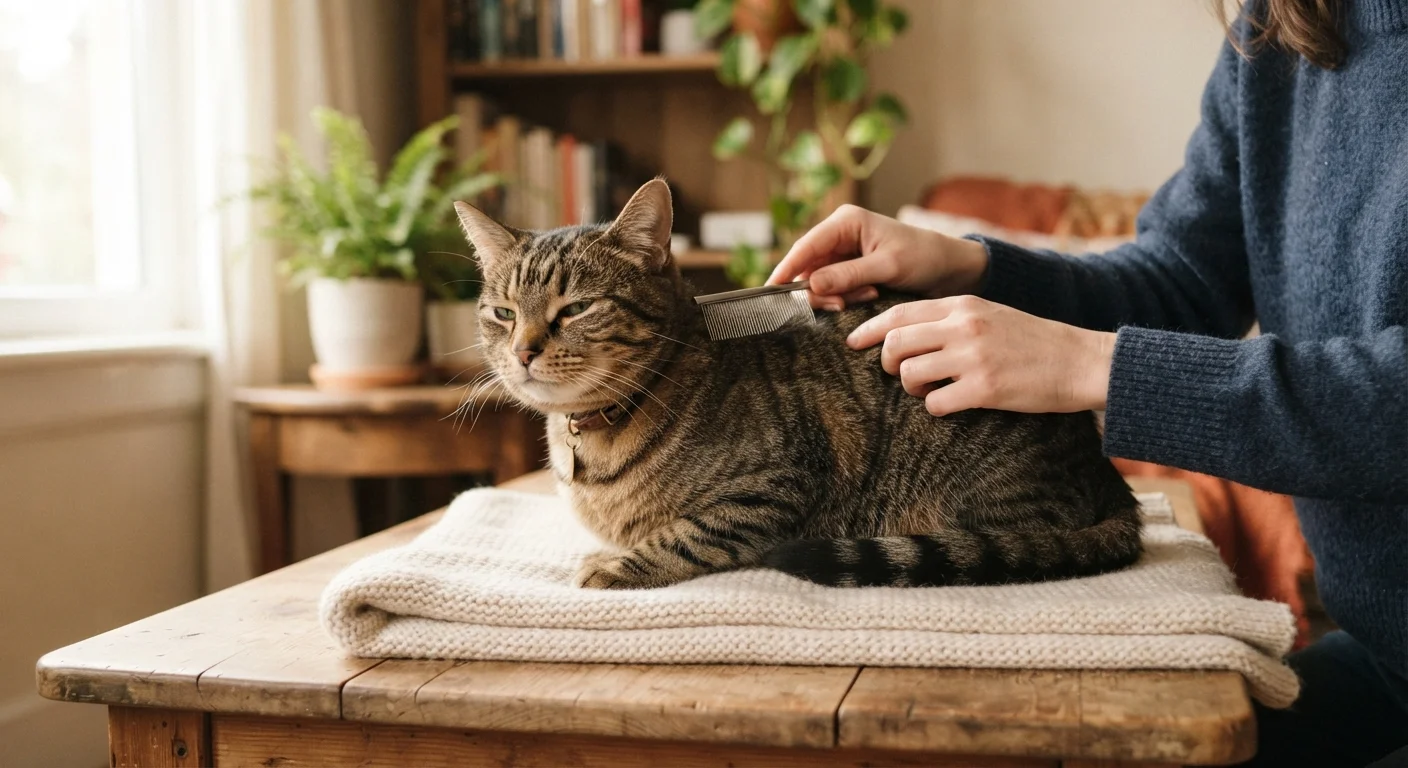
Begin brushing in the direction of fur growth, starting at the neck and working toward the tail. Apply light pressure - you should not see the cat's skin pull or hear teeth-on-comb scraping sounds. Work in small sections, especially around the belly and hindquarters where many cats are sensitive.
For cats with longer coats, hold the fur above a tangle with your fingers before brushing through it, which prevents painful tugging. Coat type significantly affects how often brushing is needed - see our coat-specific grooming guide for brushing frequency by fur category.
Trim the nails
Gently press one paw pad between your thumb and index finger to extend a single nail. Look for the pink tissue (the quick) running through the center of the nail - this contains blood vessels and nerves. Cut only the clear, curved tip, staying at least 2 mm clear of the quick.
Trim one or two nails per session if your cat is showing early resistance. You do not need to complete all nails in a single sitting, and forcing a stressed cat through all ten is counterproductive.
Clean the outer ears
Hold the ear flap gently upright and apply a few drops of vet-approved ear cleaning solution into the opening of the outer ear canal. Massage the base of the ear for about 20-30 seconds - you may hear a soft squishing sound, which is normal. Allow your cat to shake its head, then use a cotton ball or gauze pad to wipe away the loosened debris from the visible outer canal.
Inspect the ear visually: a healthy ear has light pink skin, minimal wax, and no odor. Dark discharge, strong odor, redness, or your cat shaking its head frequently outside of grooming sessions are signs that warrant a veterinary evaluation.
End the session positively
Conclude every grooming session before your cat shows significant stress - end while the cat is still tolerating handling, not after it has begun to struggle or vocalize. Offer a high-value treat immediately and follow with a few minutes of calm play or quiet companionship.
Over time, this consistent positive ending builds an association between grooming and good experiences, which makes each subsequent session progressively easier. Understanding what your cat needs to feel secure is just as important as the grooming itself - our article on feline mental health and enrichment provides useful context on reading and meeting your cat's behavioral needs.
Stop Before Your Cat Reaches Its Limit
Cats communicate discomfort through tail lashing, skin twitching, flattened ears, and low growls. Ignoring these signals and continuing to groom can cause your cat to associate handling with fear or pain, making future sessions significantly harder. Always end a session while your cat is still calm, not after a negative reaction has begun.
Troubleshooting Common Grooming Challenges
Some cats resist grooming despite patient desensitization efforts. If your cat consistently shows intense fear or aggression during grooming - hissing, biting, or becoming immobile with stress - speak with your veterinarian. In some cases, a veterinary behaviorist can help identify underlying anxiety, and for cats with severe grooming aversion, a professional groomer experienced with anxious cats may be the safest option.
For cats that resist nail trims specifically, wrapping the cat loosely in a towel (leaving one paw accessible at a time) can reduce the feeling of exposure without causing distress. Always pair this technique with treats and keep sessions brief. A cat-friendly home environment with appropriate hiding spots and vertical space also contributes to a calmer baseline temperament, which makes handling easier over time.
Never Use Human Grooming Products on Cats
Human shampoos, ear cleaners, and nail tools are not formulated for feline physiology. Many human products contain ingredients - including certain essential oils and alcohol-based compounds - that are toxic to cats. Always use products specifically labeled as safe for feline use, and consult your veterinarian if you are unsure.