

Key Takeaways
Option A
Engineered Hardwood
The dimensionally stable, moisture-resistant modern choice.
Best for: Homeowners installing flooring in basements, over radiant heat, or in climates with significant humidity swings.
Option B
Solid Hardwood
The time-tested classic with a lifetime of refinishing potential.
Best for: Above-grade installations in stable indoor environments where long-term refinishing and resale appeal are priorities.
If you're finishing a basement or installing over concrete
Engineered Hardwood
Its plywood core handles the moisture vapor that concrete slabs emit, making it far more stable and less prone to warping or cupping.
If you want a floor you can refinish repeatedly for decades
Solid Hardwood
A thicker wear layer - typically ¾ inch - means solid hardwood can be sanded and refinished many more times than most engineered products.
If you have radiant in-floor heating
Engineered Hardwood
Engineered hardwood's cross-ply construction handles the heat and humidity cycles from radiant systems without the cracking and gapping risks solid wood faces.
If resale value and traditional aesthetics are your top priority
Solid Hardwood
Solid hardwood is widely recognized by buyers and appraisers as a premium flooring material, and its refinish-ability keeps it looking fresh through multiple owners.
If you're a confident DIYer on a tighter timeline
Engineered Hardwood
Many engineered products support floating installation with click-lock profiles, requiring fewer specialized tools and no mandatory acclimatization period as long as solid hardwood needs.
How Each Floor Is Actually Built
Understanding the physical construction of each flooring type is the fastest way to predict how it will perform in your home.
Solid hardwood is exactly what the name implies - a single, continuous piece of milled timber, typically ¾ inch thick. Every plank is cut directly from a log, giving it a thick wear layer that can be sanded down and refinished repeatedly. Common species include oak, maple, hickory, and walnut. Because the board is a single piece of wood throughout, it expands and contracts as a unit in response to humidity changes - which is both its strength and its limitation.
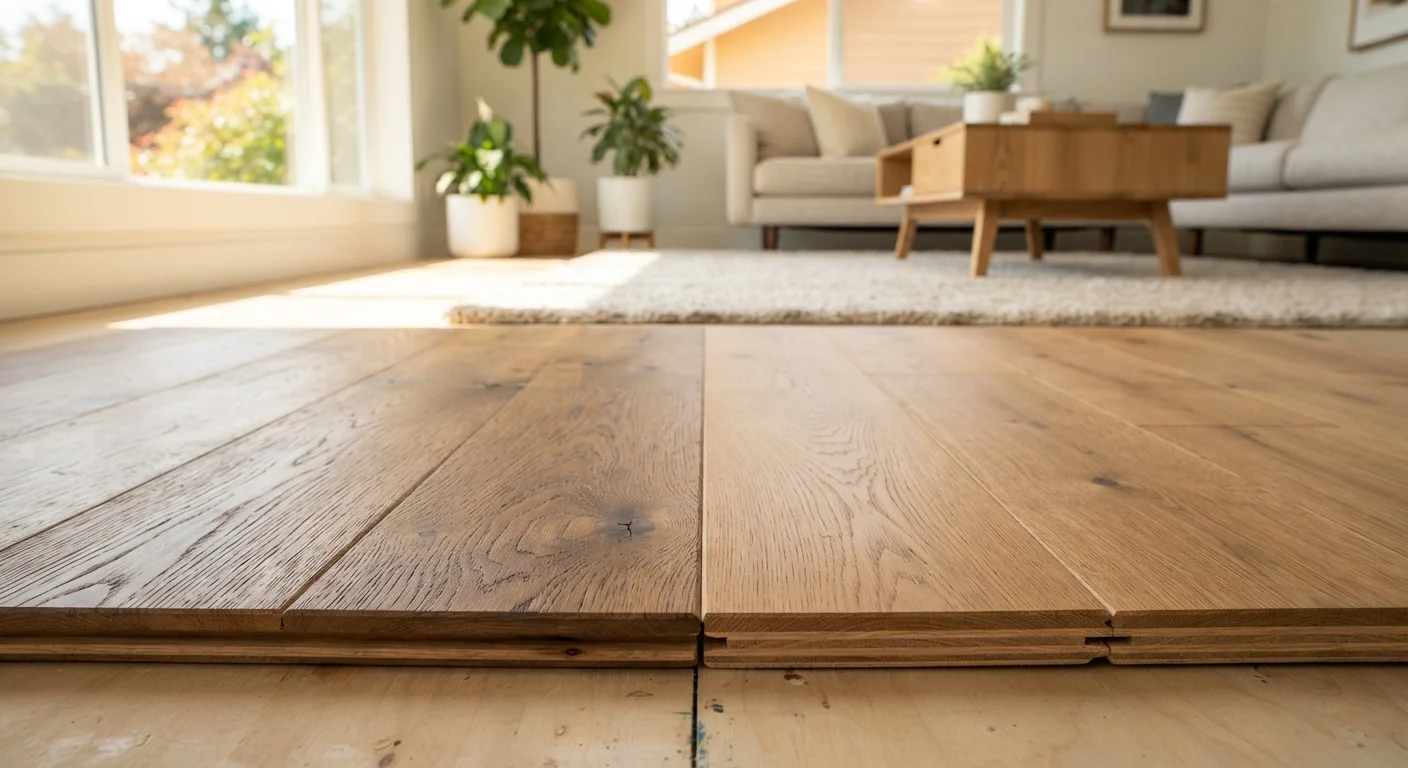
Engineered hardwood, by contrast, is a sandwich construction. A genuine hardwood veneer - the layer you actually see and walk on - is bonded to a core of cross-layered plywood or high-density fiberboard. That cross-ply structure is the key: by running the grain of each layer perpendicular to the one beneath it, manufacturers dramatically reduce the tendency of the floor to expand or contract across its width. The top veneer ranges from about 1/12 inch to 1/6 inch thick, and the quality of this layer largely determines how many times the floor can be refinished.
| Criterion | Engineered Hardwood | Solid Hardwood |
|---|---|---|
| Construction | Hardwood veneer over plywood core | Single solid timber plank |
| Typical thickness | 3/8" - 9/16" | 3/4" (standard) |
| Moisture resistance | Good - stable in humidity swings | Poor - expands and contracts significantly |
| Installation locations | Above, on, and below grade | Above grade only |
| Subfloor compatibility | Wood, concrete, or over radiant heat | Wood subfloor required |
| Installation methods | Float, glue-down, or nail/staple | Nail or staple down only |
| Refinishing potential | 1-3 times (veneer-dependent) | 5-8 times over lifespan |
| Acclimation required | Varies by product | 3-5 days typically required |
This structural difference explains nearly every performance gap between the two products - from where you can install them to how they hold up in high-humidity rooms.
Moisture, Stability, and Where You Can Install Each
Moisture is the single most important environmental factor in any flooring decision, and it's where engineered and solid hardwood diverge most sharply.
Solid hardwood should only be installed above grade - meaning on the main floor or upper levels - and it requires a wood subfloor for nail-down installation. It is not recommended for basements, over concrete slabs, or in bathrooms. Even in appropriate rooms, solid hardwood requires careful acclimatization: planks are typically left open in the installation space for three to five days so the wood can adjust to the home's humidity levels before being fastened down. Significant humidity fluctuations after installation can cause gapping in winter (when air is dry) or cupping and buckling in summer (when air is humid).
¾"
Standard solid hardwood plank thickness
This industry-standard dimension has remained consistent for decades and governs how many times a floor can be sanded.
1/12" - 1/6"
Typical engineered veneer thickness range
Thicker veneers allow more refinishing cycles; always confirm the exact wear layer thickness in millimeters before purchasing.
5-8x
Refinishing cycles for solid hardwood
Industry estimates suggest a properly maintained solid hardwood floor can be sanded and refinished multiple times over its lifetime.
Engineered hardwood opens up a broader installation range. Its dimensionally stable core makes it suitable for basements, over concrete, and on top of radiant heating systems - provided the manufacturer's guidelines are followed for temperature and moisture thresholds. Many engineered products can be glued down, nailed down, or floated, giving installers considerably more flexibility. Some products do still require a short acclimatization period, so check the manufacturer's specifications before scheduling your installation day.
Just as exterior building materials must contend with moisture and climate - as explored in our look at how different cladding materials hold up over time - interior flooring materials each have their own tolerance limits that directly affect longevity.
Durability, Refinishing, and Long-Term Value
Both flooring types are genuine wood products and can last for many decades with proper care. Their long-term trajectories do differ, however.
Solid hardwood's thick profile is its long-term advantage. A ¾-inch plank can typically be sanded and refinished five to eight times over its lifetime, allowing homeowners to remove scratches, change stain colors, or restore a worn surface without replacing the floor entirely. In homes where the flooring is already 30 or 40 years old, refinishing can extend its useful life another generation.
Engineered hardwood's refinishing potential depends almost entirely on the veneer thickness. Budget-grade products with a 1/12-inch veneer may only tolerate one light sanding. Mid-to-premium products with a thicker veneer - closer to 1/6 inch - can typically be refinished two or three times. Ask specifically about the wear layer thickness, measured in millimeters, before purchasing.
For surface hardness and scratch resistance, both types depend on the wood species chosen. Harder species like hickory and white oak outperform softer options like pine regardless of whether the plank is engineered or solid. In households with large dogs or very heavy foot traffic, species selection often matters more than the engineered-versus-solid distinction.
From a resale perspective, solid hardwood carries a strong reputation with buyers and real estate professionals. Engineered hardwood from a reputable manufacturer is increasingly well-regarded, particularly in markets where it's commonly installed. Neither choice is objectively wrong - the installed quality and species tend to matter more than construction type in most buyer perceptions.