

Key Takeaways
Why upfront decisions matter more than in-season fixes
Most gardening frustration doesn't come from bad luck - it comes from planning gaps that create problems no amount of summer effort can fully reverse. Plants placed in the wrong light, soil that drains poorly, beds positioned too far from water, or seedlings spaced without room to grow: these aren't failures of green thumbs, they're the predictable result of skipping a few key decisions at the start.
The good news is that none of these decisions are complicated. They don't require expensive tools or professional expertise. They require a bit of observation, some honest assessment of your yard, and the discipline to plan before you plant. If you're just getting started, our beginner's guide to starting a vegetable garden covers the fundamentals in plain language.
The six decisions below have a disproportionate impact on how your garden performs - not just this season, but across the years ahead.
Start with a simple garden journal
A basic notebook dedicated to your garden - dates planted, what worked, what didn't, where the sun hits - becomes one of the most useful planning tools you own after just one season. You don't need a formal system; even rough notes with dates and sketched layouts help you make smarter decisions the following year without relying on memory.
Six planning decisions that pay compounding returns
Map your sun before you plant anything
Sunlight is the single variable most gardeners underestimate - and the one that's hardest to correct after the fact. Spend a full day observing your yard in early spring and note which areas receive full sun (six or more hours of direct light), partial sun, and shade at different times of day. Do this across multiple days if your schedule allows.
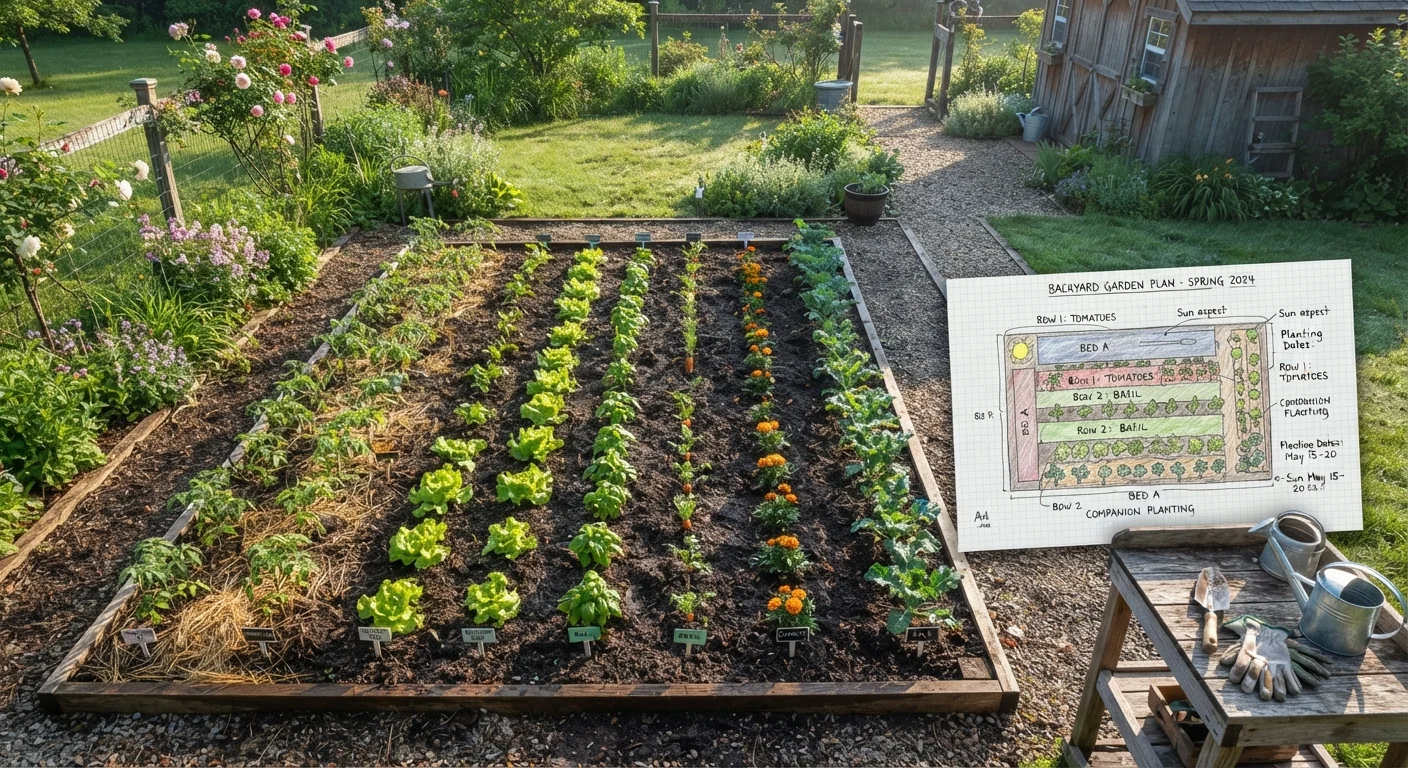
A spot that looks bright at 9 a.m. may be in deep shade by 2 p.m. thanks to a fence, house eave, or neighboring tree. Planting sun-loving vegetables like tomatoes or peppers in a spot that only gets four hours of direct light leads to poor yields and frustrated gardeners. Recording your observations on a simple sketch - even a hand-drawn grid - gives you a reference point you'll use for years.
A single day of sun-tracking saves an entire season of misplaced plants.
Invest in soil before you invest in plants
Healthy soil is the foundation every other gardening decision rests on, yet it's common for first-time gardeners to spend heavily on plants while skimping on soil preparation. Amending your soil with compost, aged manure, or other organic matter before planting improves drainage, aeration, and nutrient availability in ways that benefit your garden for multiple seasons.
Before amending, consider getting a basic soil test - many county cooperative extension offices offer them at low cost. A test tells you your soil's pH level and key nutrient levels, so you're correcting real deficiencies rather than guessing. See our guide to soil pH to understand how this invisible factor affects everything from leaf color to fruit production.
Compost invested before planting pays compounding dividends across every future season.
Plan your water access from the start
Walking 80 feet back and forth with a watering can isn't a minor inconvenience - it's the kind of friction that leads people to skip watering days, then overcompensate, then give up. Plan your garden's location with proximity to an outdoor spigot in mind, and if you're choosing between two otherwise similar sites, favor the one closer to your water source.
Even a basic soaker hose or drip irrigation setup laid at planting time costs relatively little and dramatically reduces the time and effort of keeping plants watered consistently. Consistent moisture, especially during establishment, is more important than any fertilizer you'll apply. For a deeper look at how water mistakes happen, our article on overwatering versus underwatering covers what to watch for when plants start struggling.
Locating your garden near a water source is a planning decision, not an afterthought.
Respect spacing recommendations at planting time
Seed packets and plant tags include spacing guidelines for a reason. Crowded plants compete for water, light, and nutrients, and they're significantly more prone to fungal diseases due to restricted airflow. It's tempting to pack in more plants when beds look bare in spring, but by midsummer, the consequences become obvious.
A useful mental shift: think of spacing as protecting each plant's future canopy, not just its current footprint. If you're working with a raised bed setup, square-foot gardening guidelines can help you maximize production without overcrowding - see our raised bed versus in-ground comparison for layout considerations that apply to both approaches.
Correct spacing at planting is cheaper than replanting after overcrowding causes disease.
Build a perennial backbone before filling with annuals
Perennials - plants that return year after year - do the structural heavy lifting in a mature garden. Establishing a framework of perennial shrubs, herbs, and flowering plants before filling in with annuals means your garden gets more stable and easier to manage over time rather than requiring a full rebuild each spring.
This doesn't mean avoiding annuals; they add seasonal color and flexibility that perennials can't always match. But knowing which beds are permanent and which are rotational lets you plan more intentionally and spend your time and money more strategically. Our article on balancing perennials and annuals walks through how experienced gardeners layer both for year-round appeal.
A perennial backbone means your garden gains value each year rather than starting over.
Decide on your garden structure before buying materials
Whether you're growing in raised beds, in-ground rows, or containers, the choice of garden structure shapes every downstream decision - from soil volume and drainage to pest management and access. Making this choice deliberately, rather than defaulting to whatever's most popular, helps you match the method to your actual yard conditions and physical needs.
Raised beds, for example, warm up faster in spring and offer better drainage control, but they require more upfront material investment and more frequent watering. In-ground plots can handle larger plantings more economically but require more soil preparation work. If your outdoor space is limited, container gardening can be a practical alternative - our guide on container gardening for patios and balconies shows how much is possible even in very small spaces.
Choosing your garden structure first prevents wasted materials and mismatched expectations.
Local conditions always override general advice
Gardening guidance is necessarily generalized, but your local climate, soil type, and USDA hardiness zone can significantly affect which decisions matter most. Your county's cooperative extension service - typically affiliated with a state land-grant university - offers region-specific guidance that's more reliable than any single article. It's a free resource worth using before you invest heavily in any one approach.
The patience built into good planning
None of these decisions are urgent in the way that pest outbreaks or drought stress feel urgent. That's precisely why they get skipped. But the gardeners who build productive, lower-maintenance yards over time tend to have one thing in common: they invested in thinking before they invested in planting.
A garden that has good bones - appropriate structure, healthy soil, sensible layout - becomes easier to manage each year rather than harder. That compounding ease is the real payoff of decisions that seem slow or administrative at the start. You don't need to implement all of these at once. Addressing one or two per season moves you steadily toward a yard that works with you rather than against you.