
Public School, Private School, or Charter School: What Each One Actually Means

Key Takeaways
K-12 School Types
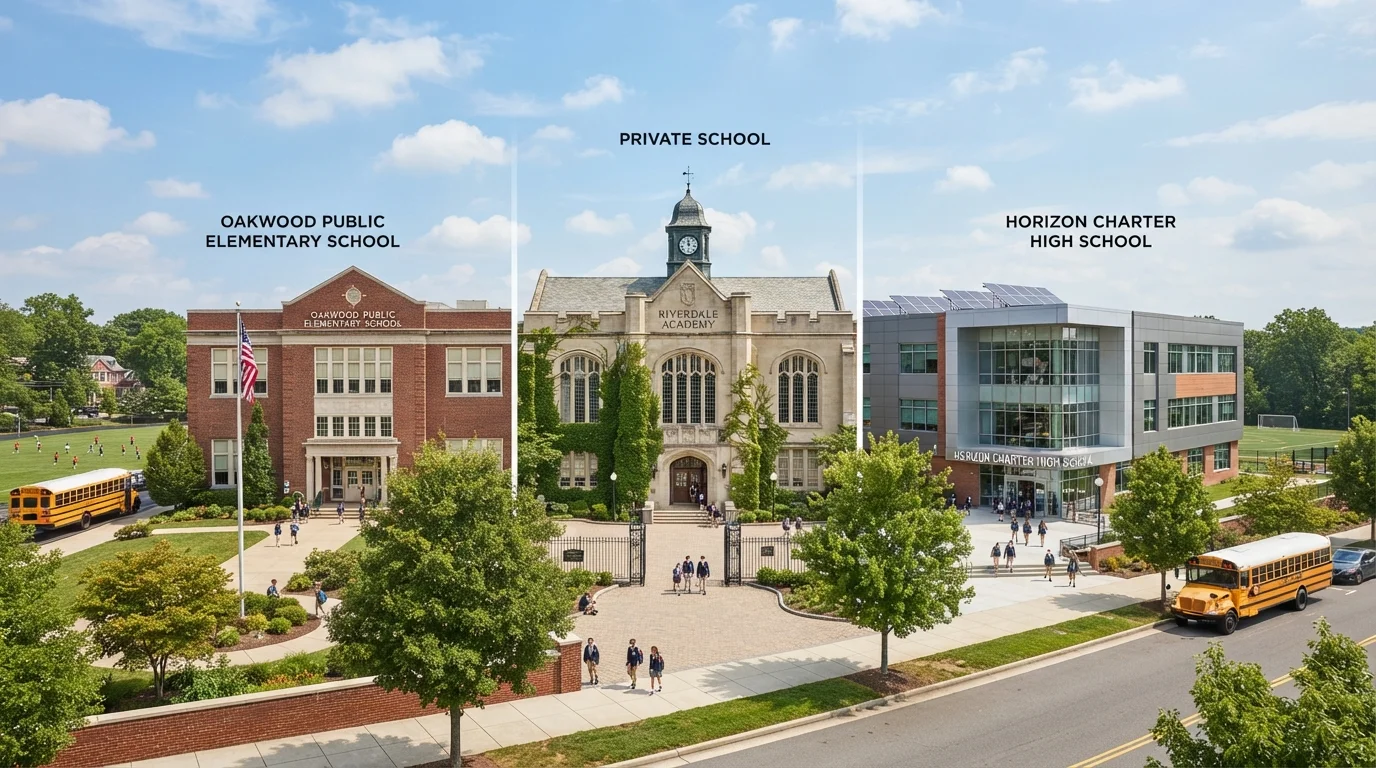
In the United States, K-12 schools fall into three main categories: public schools, private schools, and charter schools. Each type differs in how it is funded, who governs it, who may attend, and what rules it must follow. Understanding these differences helps parents identify which environment may be the right fit for their child.
Magnet schools and virtual schools are additional variations that often overlap with public or charter frameworks; this article focuses on the three primary categories.
Public Schools: The Default Option for Most Families
Public schools are operated by local government entities - usually a school district - and are funded through a combination of local property taxes, state appropriations, and federal dollars. Because they are publicly funded, they are tuition-free and legally required to accept all students who live within their attendance zone.
Curriculum standards, teacher certification requirements, and standardized testing are set or heavily influenced by state education agencies. This means a public school in Ohio and one in Texas may have noticeably different academic expectations, even though both are "public."
Public schools must also comply with federal education law, including provisions for students with disabilities under the Individuals with Disabilities Education Act (IDEA), which guarantees access to a free appropriate public education. This legal framework provides important protections that families should be aware of when comparing options.
State Rules Vary Significantly
Charter school laws, private school regulations, and public school funding formulas differ substantially from state to state. What applies in California may not apply in Texas or Florida. Always verify specific rules and rights with your state's Department of Education or a local school district office.
For a broader look at how public schools fit within the overall structure of American education, see our first-time parent's K-12 overview.
Private Schools: Independence Comes With a Price Tag
Private schools are independently operated and funded primarily through tuition, donations, and - in some cases - endowments. Because they do not receive direct government funding, they have considerably more freedom to set their own curriculum, admissions criteria, disciplinary policies, and teaching standards.
Private schools span a wide range, from religiously affiliated schools to college-preparatory institutions to schools built around specific educational philosophies such as Montessori or Waldorf. This diversity means that "private school" is not a single uniform experience.
~50 million
Students enrolled in U.S. public schools
According to the National Center for Education Statistics, public schools serve the vast majority of K-12 students in the United States.
~5.8 million
Students enrolled in private schools
The National Center for Education Statistics estimates that private schools enroll roughly 10% of all K-12 students nationally.
~3.7 million
Students enrolled in charter schools
The National Alliance for Public Charter Schools tracks charter enrollment growth across participating states, reflecting steady expansion since the 1990s.
Because private schools are not bound by the same federal accountability requirements as public schools, families bear more responsibility for evaluating quality independently. Accreditation through a recognized body can be one useful indicator, though standards differ across accrediting organizations. For context on how to interpret school performance data more broadly, the parent's guide to school report cards offers practical decoding strategies.
Tuition costs vary widely, from a few thousand dollars per year at smaller religious schools to over $50,000 annually at elite independent schools. Financial aid is available at many institutions, though it is not universally standardized.
Charter Schools: Public Funding, Private-Style Flexibility
Charter schools occupy a middle ground. They are publicly funded - meaning free to attend - but operate under a charter, which is a contract between the school's governing organization and an authorizing body such as a school district, a state agency, or a university. This contract grants them more operational flexibility than a traditional public school in exchange for meeting specific performance benchmarks.
In practice, this flexibility can mean a longer school day, a distinctive instructional model, or a curriculum emphasis that traditional district schools don't offer. However, charter schools must still comply with core state education laws and, because they receive federal funding, with federal civil rights protections.
Enrollment is typically open to any student in the state, but because demand often exceeds capacity, many charter schools use a lottery system. It's worth researching how a specific charter school's lottery works and what its track record looks like before making decisions.
Visit Before You Decide
If you have the option to tour multiple school types, do so with a prepared list of questions: How are students grouped? What support exists for struggling learners? How does the school communicate with families? Answers to these practical questions often reveal more than category labels alone.
To understand how charter schools relate to broader school choice programs - including vouchers and open enrollment - see our explanation of school choice programs.
How to Think About These Differences as a Parent
The school type itself does not determine quality. Research consistently shows variation within each category - high-performing and low-performing schools exist across public, private, and charter sectors. What matters most is how well a school's environment, culture, and resources match a child's particular learning needs.
When comparing options, it helps to look at measurable indicators - attendance rates, teacher retention, special education services, extracurricular offerings - alongside less quantifiable factors like classroom culture and parental involvement expectations. The same comparison logic that applies to K-12 schools applies further up the education ladder; our public vs. private college breakdown explores how these distinctions play out at the postsecondary level.
Understanding the structural differences between school types is a starting point, not a verdict. Visiting schools, reviewing available performance data, and talking with other families in your community will give you a more complete picture than any category label alone.