

Key Takeaways
Start here
How the K-12 System Is Structured
Next
Elementary School: Grades K-5
Then
Middle School: Grades 6-8
Continue
High School: Grades 9-12
When you're ready
School Choice and Finding the Right Fit
How the K-12 System Is Structured
The term K-12 refers to the full span of American primary and secondary education, from kindergarten through 12th grade - roughly ages five to eighteen. These 13 years are publicly funded and free for most families, administered mainly at the state and local district level rather than by the federal government.
Because individual states set most of the rules, the details vary widely. Grade configurations, compulsory attendance ages, graduation requirements, and even the school calendar differ from one state to the next. What stays consistent is the broad three-tier structure: elementary, middle, and high school.
K-12
The full span of American public education from kindergarten through 12th grade, covering approximately 13 years of schooling.
School district
A local government body that oversees public schools in a defined geographic area, responsible for enrollment, staffing, and curriculum within state guidelines.
IEP (Individualized Education Program)
A legally binding written plan developed for a student with a qualifying disability, outlining specific educational goals and the support services the school will provide.
Compulsory attendance age
The age range during which a child is legally required to attend school, set by each state and typically spanning from ages five to sixteen or eighteen.
Dual enrollment
A program that allows high school students to take college-level courses and earn credit at both the high school and college level simultaneously.
CTE (Career and Technical Education)
High school programs that provide hands-on training in specific career fields such as healthcare, construction, information technology, or culinary arts.
Understanding this architecture helps parents ask better questions at enrollment, anticipate transitions, and plan ahead rather than react to surprises.
Elementary School: Grades K-5
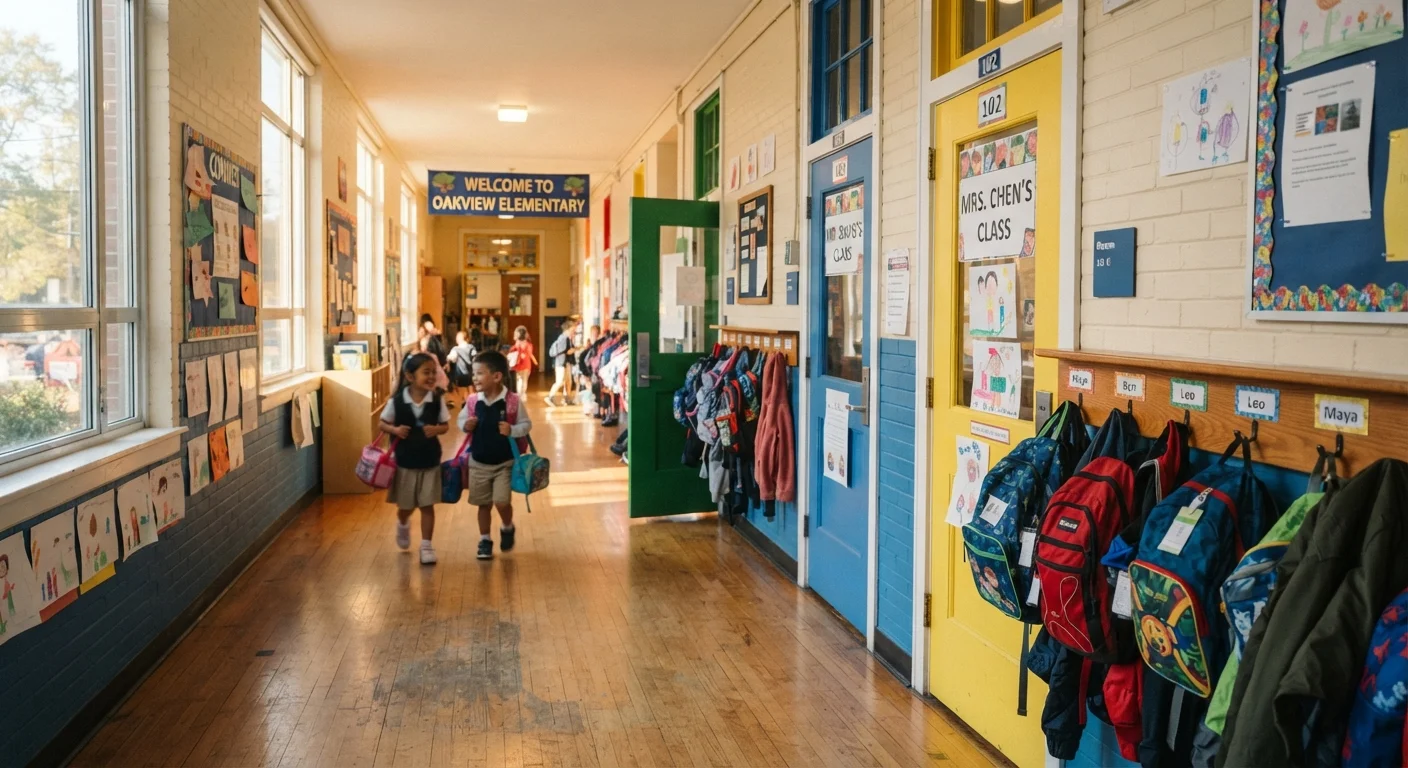
Elementary school (sometimes called grammar or primary school) typically covers kindergarten through fifth grade, roughly ages five to eleven. Some districts run K-6 configurations, so check what your local schools use.
This stage focuses on foundational literacy and numeracy - reading, writing, and basic mathematics. Children also receive instruction in science, social studies, and the arts. Most learning happens in a single self-contained classroom with one primary teacher, which gives parents a clear point of contact.
Key parent responsibilities during elementary years include:
- Completing enrollment paperwork and submitting immunization records on time - see our enrollment checklist guide for what to prepare.
- Attending parent-teacher conferences, typically held in fall and spring.
- Monitoring homework habits and reading progress.
- Communicating early if your child shows signs of a learning difference, so the school can evaluate appropriately.
Middle School: Grades 6-8
Middle school (also called junior high in some districts) bridges the gap between elementary and high school. Students move between subject-specific classrooms and teachers, building independence and organizational skills.
Academically, this is when coursework becomes more rigorous and begins to matter for future opportunities. Elective choices may include a second language, music, or technology. Some districts allow academically advanced students to access algebra or high-school-credit courses in 8th grade, which can affect their high school trajectory.
Keep a Simple School Records Folder
From the first day of kindergarten, maintain a folder - physical or digital - with your child's report cards, immunization records, IEP documents (if applicable), and test score reports. When your family moves or your child transitions schools, having these on hand prevents delays and ensures continuity of services.
Socially, middle school can be a challenging transition. Staying connected without hovering - attending school events, asking open-ended questions at home, and knowing your child's teachers - tends to support both wellbeing and performance during this period.
High School: Grades 9-12
High school runs from 9th grade (freshman year) through 12th grade (senior year). Students must meet state- and district-specified graduation requirements in core subjects - typically English, math, science, and social studies - plus elective credits.
This stage introduces higher-stakes decision-making: course selection shapes transcripts, standardized tests such as the SAT or ACT become relevant for college-bound students, and career and technical education (CTE) pathways open up for those pursuing trades or workforce entry. Advanced Placement (AP) and dual-enrollment courses can allow students to earn college credit while still in high school.
For families thinking ahead, students who plan to pursue higher education after graduation will benefit from starting college planning early, ideally by 10th grade.
School Choice and Finding the Right Fit
Most families are assigned to a public school based on their home address. But in many parts of the country, additional options exist - and knowing about them lets parents make an informed decision rather than simply accepting a default.
Common alternatives to the assigned neighborhood school include:
- Charter schools
- Publicly funded, independently operated, tuition-free schools that may have a distinctive instructional model. Admission is often by lottery.
- Magnet schools
- District-run public schools organized around a theme (STEM, arts, language immersion). Usually open to any student in the district, subject to space and sometimes a screening process.
- Open enrollment
- Policies in many states that allow families to apply to a public school outside their assigned zone, space permitting.
- Virtual public schools
- State- or district-authorized online programs that are publicly funded. Research consistently shows that outcomes vary significantly by student and program; our guide to K-12 online learning covers what the evidence says.
For a deeper look at vouchers, magnet programs, and open enrollment, the school choice programs overview explains how each type works and what families typically need to qualify.
National Center for Education Statistics (NCES)
A federal agency that publishes comprehensive, publicly accessible data on K-12 schools nationwide, including enrollment figures, graduation rates, and school locator tools.
Your State Department of Education Website
Each state's education department publishes official rules on enrollment ages, graduation requirements, and school choice programs - the authoritative source for local requirements.
Parent Teacher Association (PTA) / Parent Teacher Organization (PTO)
Joining your school's parent organization is one of the most practical ways to stay informed about school decisions, meet teachers, and engage with the broader school community.