

Key Takeaways
Our Verdict
Neither EVs nor gas cars are universally cheaper - total cost of ownership depends on how much you drive, where you live, and how long you keep the vehicle. EVs offer real long-term savings on fuel and maintenance, but those savings take time to offset a higher purchase price. Gas vehicles remain more affordable upfront and may suit drivers with lower annual mileage or limited access to home charging.
| Best for | Recommended |
|---|---|
| High-mileage commuters with home charging access | Electric Vehicle |
| Drivers prioritizing lower upfront cost | Gas Car |
| Those in areas with low electricity rates | Electric Vehicle |
| Drivers in rural areas with limited charging infrastructure | Gas Car |
Purchase Price and Incentives
The sticker price gap between EVs and comparable gas vehicles has narrowed in recent years, but a meaningful difference remains. On average, EVs carry a higher purchase price than equivalent internal combustion engine (ICE) vehicles in the same segment. However, federal incentives can reduce that gap significantly for buyers who qualify.
The federal Inflation Reduction Act established a clean vehicle tax credit of up to $7,500 for new EVs meeting specific assembly and income requirements. Used EVs may qualify for a separate credit of up to $4,000. Eligibility depends on the buyer's income, the vehicle's price cap, and where key components are manufactured - so it's worth verifying current rules with a tax professional before assuming a credit applies to your situation.
For a fuller picture of every cost layer involved in vehicle ownership beyond the sticker price, see our breakdown of the full price of owning a car.
| Electric Vehicle | Gas Car | |
|---|---|---|
| Typical purchase price | Higher (before incentives) | Lower on average |
| Federal tax incentives | Up to $7,500 (if eligible) | Generally none |
| Fuel/energy cost per mile | Lower (home charging) | Higher at current gas prices |
| Routine maintenance cost | Lower - fewer fluid changes | Predictable but recurring |
| Insurance premiums | Often higher | Typically lower |
| Charging/fueling infrastructure | Growing but uneven | Widely available nationwide |
| Depreciation pattern | Less predictable currently | Well-established patterns |
| Long-term savings potential | Strong for high-mileage drivers | Better for low-mileage drivers |
Fuel and Energy Costs
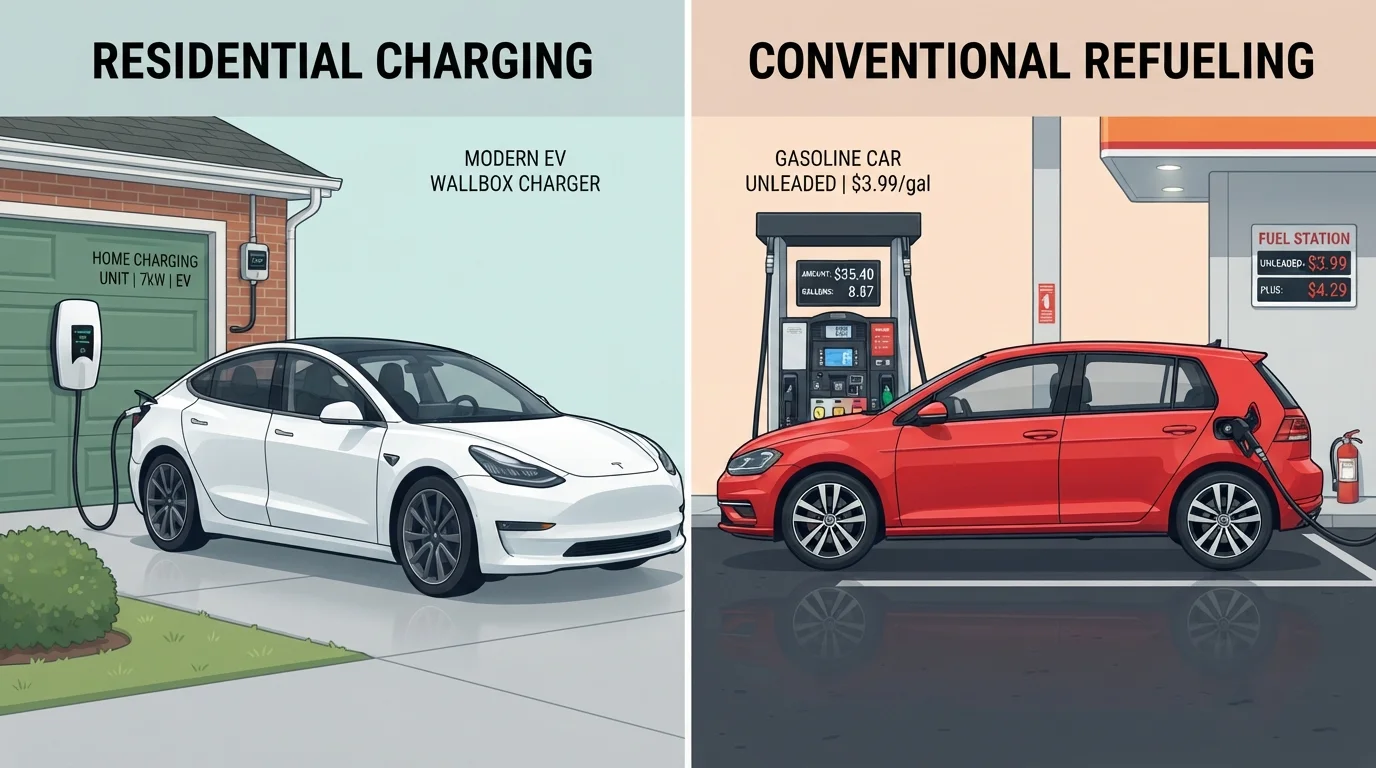
Fueling an EV with electricity is generally cheaper per mile than fueling a gas car, though the actual difference varies by region. The U.S. Energy Information Administration tracks average electricity and gasoline prices, both of which fluctuate considerably. A useful rough comparison: charging at home during off-peak hours tends to cost significantly less per mile than filling a tank at current retail gas prices.
The exact savings depend on your vehicle's efficiency rating, local utility rates, and whether you charge at home or rely on public fast-chargers - which typically cost more per kilowatt-hour. Drivers who can charge overnight at home capture the most benefit. Those relying primarily on public charging networks may find the fuel cost advantage shrinks considerably.
Estimating your lifetime fuel costs using your actual mileage and local rates is the most reliable way to project real-world savings.
~$0.03-$0.05
Estimated EV fuel cost per mile (home charging)
Based on U.S. average residential electricity rates; actual costs vary significantly by region and utility provider.
~$0.10-$0.15
Estimated gas vehicle fuel cost per mile
Calculated using average U.S. gas prices and a mid-range fuel efficiency of 28-32 MPG; varies by vehicle and driving conditions.
8 years / 100K mi
Standard federal EV battery warranty minimum
Federal law requires EV manufacturers to warranty the battery pack for at least 8 years or 100,000 miles, whichever comes first.
Maintenance and Repair Expenses
EVs have fewer moving parts than gas vehicles - no oil changes, no transmission fluid, no spark plugs, and generally less brake wear due to regenerative braking. Consumer-facing data from organizations like AAA consistently show that EV maintenance costs run lower on average than those for comparable gas vehicles over a multi-year ownership period.
That said, EVs are not maintenance-free. Tires, cabin air filters, brake fluid, and coolant still require attention. Battery replacement is a low-probability but high-cost event; most EV manufacturers provide battery warranties covering eight years or 100,000 miles, which limits financial exposure during that window. Repair costs when something does go wrong can be higher due to specialized parts and technician requirements.
Gas vehicles have well-understood, widely available service infrastructure. Routine costs - oil changes, air filters, spark plugs - are predictable and often inexpensive, though they accumulate steadily across years of ownership.
Insurance, Depreciation, and Other Ownership Factors
Insurance premiums for EVs tend to run higher than for comparable gas vehicles, partly because repair costs and parts prices are elevated. Actual rates vary by insurer, driver history, location, and vehicle model, so comparing quotes is essential before drawing conclusions about your specific situation.
Depreciation affects both vehicle types, but EVs have historically depreciated faster in some segments - though this pattern is shifting as the market matures and buyer demand grows. The used EV market is developing rapidly, making depreciation harder to predict than for established gas models.
Registration fees, which vary by state, sometimes factor in vehicle weight or value - both of which may be higher for EVs. Some states also charge annual EV fees to offset the loss of gas-tax revenue that funds road maintenance.
For context on how these costs compare across different vehicle classes, ownership costs by vehicle type provides a useful reference point. And if you want to avoid common financial blind spots, common car ownership cost myths is worth reviewing before making a final decision.