

| Primary communication mode | Body language (posture, gesture, expression) (American Veterinary Medical Association) |
| Tail wag height significance | Higher tail = higher arousal; lower tail = submission or anxiety (Applied Animal Behaviour Science research) |
| Whale eye indicates | Stress or discomfort - give the dog space |
| Play bow meaning | Reliable invitation to play; signals friendly intent |
| Calming signals concept | Identified and described by trainer Turid Rugaas (On Talking Terms With Dogs, Turid Rugaas) |
| Key reading principle | Always read signals in clusters, not individually |
Why Body Language Is Your Dog's First Language
Dogs communicate almost entirely through body language - posture, tail carriage, ear position, facial tension, and eye contact all work together as a single system. Misreading one signal in isolation can lead to misunderstandings that erode trust or, in stress situations, contribute to preventable bites.
The key principle trained behaviorists rely on is cluster reading: never judge a dog's emotional state from a single cue. A wagging tail does not automatically signal friendliness; a high, stiff wag paired with a tense body can signal arousal or agitation. Reading the full picture is what separates confident interpretation from guesswork.
Many popular beliefs about dog signaling don't hold up to current research. For a closer look at those, see common myths about dog behavior that science has since revised.
Calming signal
A behavioral gesture dogs use to communicate peaceful intent or reduce tension, such as yawning, head-turning, or moving in a curved path. These are social communication tools, not signs of boredom or inattention.
Whale eye
A stress indicator in which a dog shows the whites (sclera) of its eyes by turning its head away while keeping its gaze fixed. It often signals discomfort and is a warning sign to respect the dog's space.
Hackles
The hairs along a dog's back and neck that can rise involuntarily in response to arousal, excitement, fear, or perceived threat. Raised hackles alone do not indicate aggression - context matters.
Play bow
A posture in which a dog lowers its front legs and chest while keeping its hindquarters raised. It is a reliable invitation to play and signals friendly, non-threatening intent.
Cluster reading
The practice of evaluating multiple body language signals together rather than in isolation to accurately assess a dog's emotional state. Relied upon by professional trainers and behaviorists.
Appeasement behavior
Actions a dog uses to signal submission or non-confrontation, such as rolling onto its back, licking a person's face, or avoiding direct eye contact. These behaviors are social, not signs of guilt.
Key Signals and What They Mean
Use the following signal clusters as a practical reference for everyday situations at home, at the park, or at the vet.
| Primary communication mode | Body language (posture, gesture, expression) (American Veterinary Medical Association) |
| Tail wag height significance | Higher tail = higher arousal; lower tail = submission or anxiety (Applied Animal Behaviour Science research) |
| Whale eye indicates | Stress or discomfort - give the dog space |
| Play bow meaning | Reliable invitation to play; signals friendly intent |
| Calming signals concept | Identified and described by trainer Turid Rugaas (On Talking Terms With Dogs, Turid Rugaas) |
| Key reading principle | Always read signals in clusters, not individually |
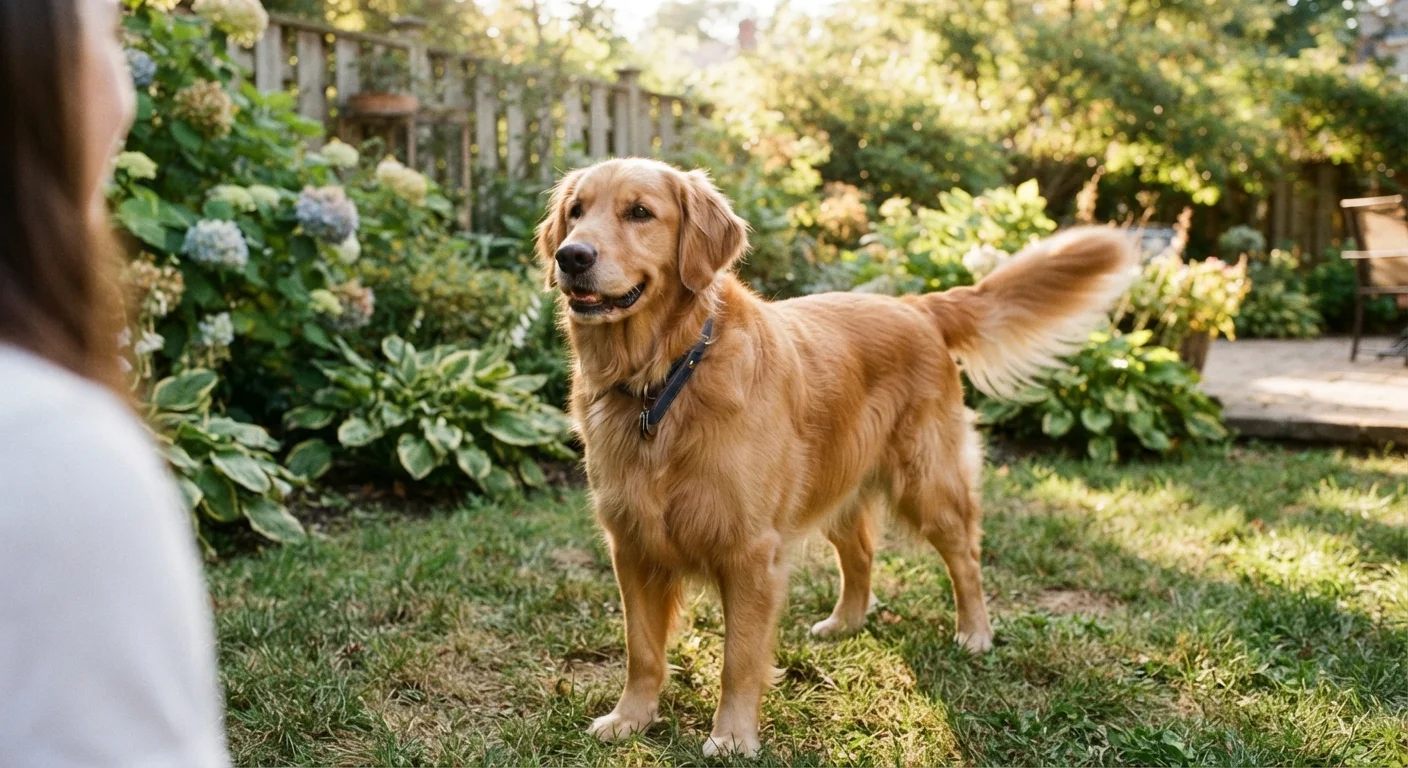
Relaxed and Happy
- Ears: Held in natural position for the breed - not pinned back or rigidly forward
- Tail: Loose, flowing wag at mid-height; broad, sweeping movement
- Body: Soft, wiggly posture; weight distributed evenly
- Eyes: Soft, almond-shaped; occasional slow blink
- Mouth: Slightly open or gently closed; relaxed lips
Anxious or Uncomfortable
- Ears: Pulled flat against the head or rotated sideways
- Tail: Tucked between the legs or held very low with minimal movement
- Body: Crouched or leaning away; whale eye (showing whites of eyes)
- Mouth: Lip licking, yawning, or repeated swallowing unrelated to food
- Posture: Weight shifted backward; may turn head away to avoid eye contact
Alert or Aroused
- Ears: Pricked forward, oriented toward a stimulus
- Tail: Raised and held still or vibrating rapidly
- Body: Weight shifted forward; hackles may rise along the spine
- Eyes: Wide and fixed, hard stare
Playful
- Posture: Play bow - front end lowered, rear end elevated, tail wagging
- Movement: Bouncy, exaggerated; may include brief mock retreats to invite chase
- Mouth: Open, relaxed, panting lightly
Dogs who are well-socialized tend to display more nuanced, readable signals. If your dog struggles with social situations, socializing an adult dog outlines realistic expectations and helpful approaches.
Calming Signals and Stress Indicators to Know
Norwegian dog trainer and researcher Turid Rugaas identified a category of behaviors she called calming signals - actions dogs use to de-escalate tension with other dogs or people. These include yawning, turning the head or body sideways, sniffing the ground, blinking, and moving in a curved arc rather than a direct approach. These signals are not signs of disobedience or distraction; they indicate your dog is working to manage stress or communicate non-threat.
Chronic stress signals - persistent panting without heat or exercise, excessive shedding during an interaction, tucked tail lasting beyond a stressful moment - may warrant a conversation with your veterinarian to rule out underlying health or anxiety issues. General health and behavioral wellbeing are closely linked; even something as routine as what your dog eats can affect mood and energy. If you're evaluating your dog's overall care, common feeding mistakes is a worthwhile reference.
This article provides general educational information about dog behavior and is not a substitute for professional veterinary or certified animal behaviorist guidance. If your dog displays persistent fear, aggression, or sudden behavioral changes, consult a qualified professional.