

Key Takeaways
Dog Food Label
A dog food label is the regulated set of information printed on every commercial pet food package, including the ingredient list, guaranteed analysis, and a nutritional adequacy statement. Each section is governed by guidelines set by the Association of American Feed Control Officials (AAFCO) and, in many states, enforced at the state level. Reading these sections together - not in isolation - gives you a complete picture of what you're actually feeding your dog.
AAFCO does not directly regulate or approve pet foods; it establishes model regulations and nutrient profiles that individual states may adopt and enforce through their own feed laws.
The Ingredient List: Order, Weight, and What It Really Signals
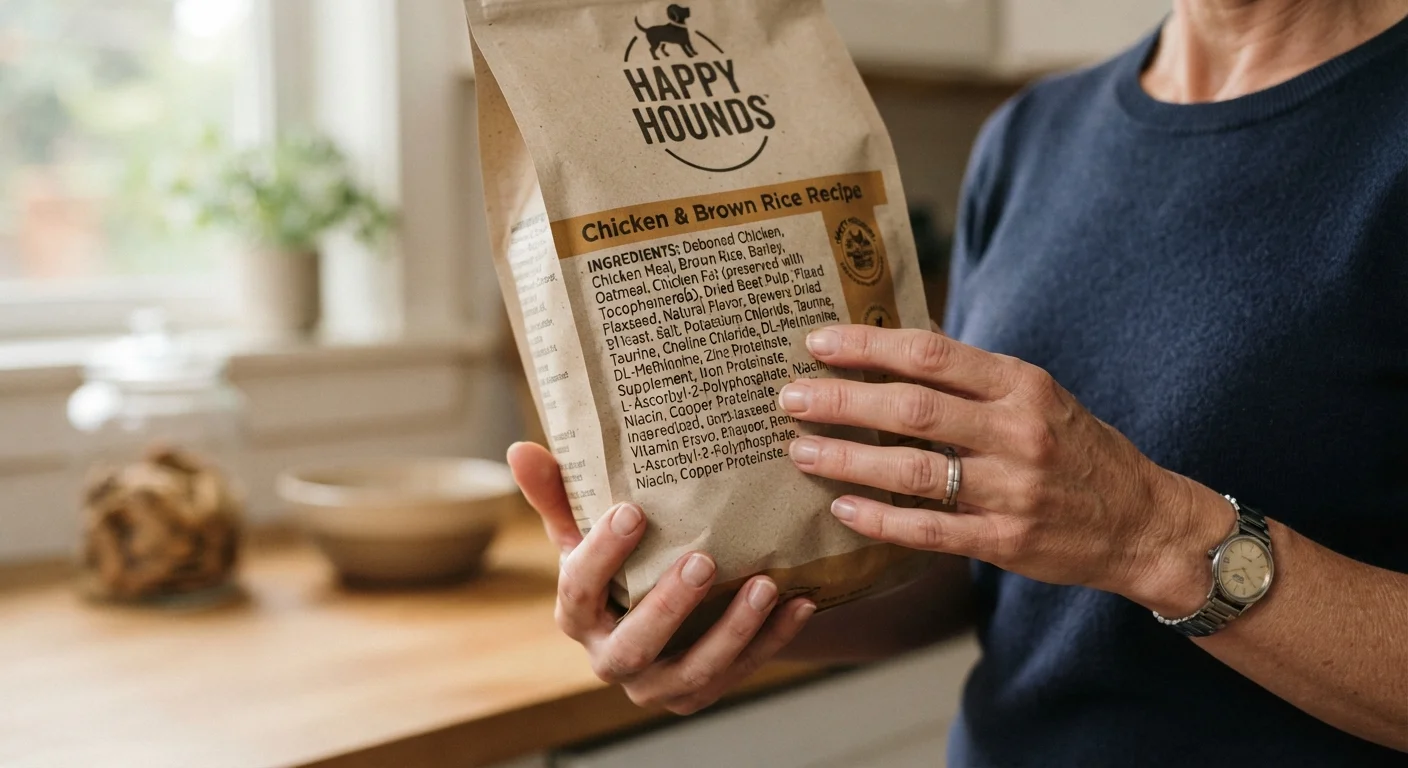
Federal law requires that dog food ingredients be listed in descending order by pre-processing weight. That means a food listing 'deboned chicken' first contained more chicken by weight than any other single ingredient - before cooking. After moisture evaporates during processing, the proportion shifts considerably.
This is why ingredient splitting matters. A manufacturer can list 'chicken,' 'chicken meal,' and 'chicken by-product meal' separately, each lower on the list, while collectively they represent a substantial protein source. Conversely, a single grain like 'ground corn' listed second may outweigh the meat ingredients combined once everything is dry.
For a deeper look at how ingredient list order translates to nutritional reality, see our guide to reading ingredient lists which covers packaged food labeling broadly.
Look for Named Protein Sources
Ingredients labeled with specific names - 'deboned salmon' rather than 'fish,' 'chicken meal' rather than 'poultry meal' - indicate a named, single-species source. Named ingredients allow for more consistent quality control and easier identification of potential allergens. If your dog has a known food sensitivity, named proteins make it much easier to avoid triggers.
Ingredients labeled with specific names - 'deboned salmon' rather than 'fish,' 'chicken meal' rather than 'poultry meal' - indicate a named, single-species source. Named ingredients allow for more consistent quality control and easier identification of potential allergens.
The Guaranteed Analysis: Reading Between the Percentages
The guaranteed analysis panel lists crude protein (minimum), crude fat (minimum), crude fiber (maximum), and moisture (maximum). 'Crude' refers to the testing method used, not the quality of the nutrient. These numbers represent regulatory boundaries, not exact amounts - actual protein content could be higher than the stated minimum.
The most practical challenge is comparing wet and dry foods. A canned food might show 10% protein while a kibble shows 28%, yet the canned food could be nutritionally denser once you account for moisture. Converting to a dry-matter basis - dividing the nutrient percentage by the percentage of dry matter (100 minus moisture content) - allows a fair comparison. Your veterinarian or a board-certified veterinary nutritionist can help you interpret these numbers in the context of your dog's health needs.
Dry-Matter Conversion: A Quick How-To
To convert crude protein to a dry-matter basis, subtract the moisture percentage from 100 to get the dry-matter percentage. Then divide the nutrient value by that number and multiply by 100. For example, a wet food with 78% moisture and 10% crude protein: 100 − 78 = 22% dry matter; 10 ÷ 22 × 100 = 45.5% protein on a dry-matter basis. This lets you compare that food directly against a dry kibble.
The AAFCO Statement: The Most Important Line on the Bag
The nutritional adequacy statement - sometimes called the AAFCO statement - tells you whether a food is formulated to meet established nutrient profiles or has been tested through feeding trials. It also specifies the intended life stage.
- Formulated to meet: The food's recipe was calculated to meet AAFCO nutrient profiles, but it was not necessarily fed to dogs in a controlled trial.
- Animal feeding tests using AAFCO procedures: The food was fed to real dogs over a defined period and met survival and basic health criteria. This is a higher bar, though the trials have limitations.
- All life stages: Must meet the more demanding requirements for growth and reproduction, making these foods suitable for puppies and pregnant or nursing dogs.
A food labeled 'for supplemental or intermittent feeding only' lacks an AAFCO adequacy statement entirely and should not serve as your dog's primary diet.
95%
Minimum meat content for a single-named-protein food
Per AAFCO model regulations, a product named 'Beef Dog Food' must contain at least 95% of that named ingredient by weight, excluding added water.
25%
Minimum content for 'dinner,' 'entrée,' or 'platter' labels
AAFCO's '25% rule' applies when a product name uses terms like dinner, entrée, formula, or platter - the named ingredient must comprise at least 25% of the total product weight.
2
Life stages with distinct AAFCO nutrient profiles
AAFCO publishes separate nutrient profiles for growth/reproduction and adult maintenance; there is no separate AAFCO nutrient profile category for senior dogs.
Marketing Language vs. Regulated Terms
Words like 'premium,' 'holistic,' and 'human-grade' carry no standardized regulatory definition in pet food. They are marketing descriptors, not quality guarantees. By contrast, a few terms are regulated:
- 'Natural'
- AAFCO defines this as a feed or ingredient derived solely from plant, animal, or mined sources - not produced by or subjected to a chemically synthetic process. Exceptions apply to added vitamins and minerals.
- Flavor rules
- A food named 'Beef Flavor Dog Food' may contain very little actual beef - just enough to be detectable. A food called 'Beef Dog Food' must contain at least 95% beef by weight (excluding water). 'Beef Dinner' or 'Beef Entrée' requires at least 25%.
Understanding these distinctions helps you see past front-of-bag claims and focus on the regulated content found on the back panel.