

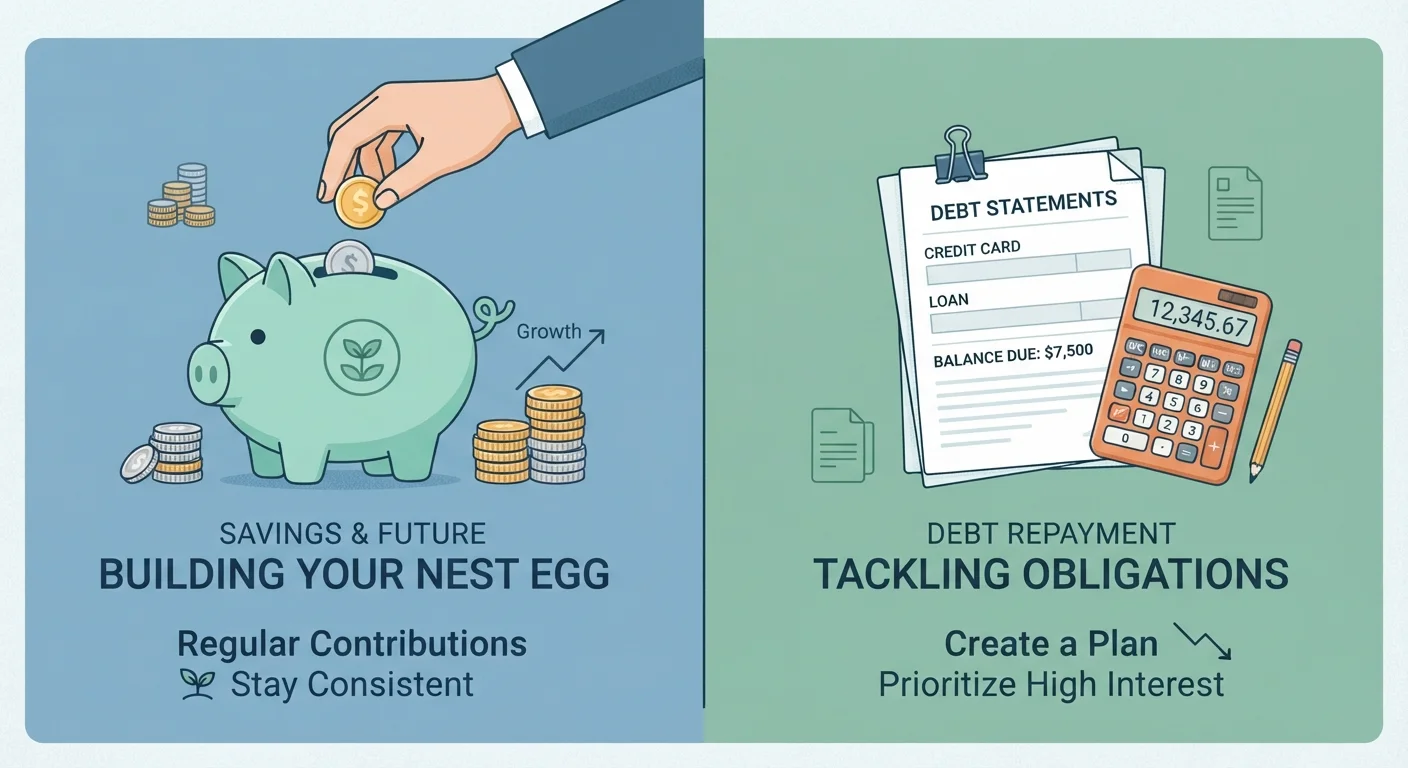
Key Takeaways
Option A
Emergency Fund
The financial cushion that keeps setbacks from becoming disasters.
Best for: Anyone without reliable access to cash reserves when unexpected expenses strike.
Option B
Paying Off Debt
The aggressive strategy to eliminate interest drag and free up monthly cash flow.
Best for: Those carrying high-interest debt where the cost of delay outweighs the benefit of holding savings.
If you have no savings buffer at all
Emergency Fund
Even a small cash cushion prevents you from adding new high-interest debt every time an unexpected expense arises. Build a starter fund first.
If you carry high-interest credit card debt
Paying Off Debt
Interest rates on revolving credit card balances can run well above typical savings yields. Every month you carry the balance, the cost compounds.
If your debt is low-interest and your income is unstable
Emergency Fund
When job security is uncertain, liquid savings matter more. Losing income with no cushion can accelerate the debt spiral you're trying to escape.
If you have dependents and variable household expenses
Emergency Fund
Households with children or irregular costs face unpredictable expenses more often, making a three-to-six month reserve worth prioritizing.
If you have stable income and only moderate-interest debt
Paying Off Debt
With a reliable paycheck and a small starter fund already in place, redirecting extra cash toward debt payoff shrinks your total interest cost faster.
Why This Trade-Off Feels So Hard
If you have a little breathing room in your budget - a tax refund, a side gig payment, a modest raise - the question hits immediately: should this go toward debt, or into savings? The honest answer is that there's no single right move for everyone. The right choice depends on your interest rates, income stability, household situation, and how much of a safety net you currently have.
What makes this genuinely difficult is that both goals are legitimate. Carrying debt is expensive. But having zero savings means any car repair, medical bill, or job disruption forces you to borrow again - often at high interest. You can end up running in place, paying off debt only to take on new debt when life happens.
For a structured approach to managing both at once, see this practical framework for saving while in debt.
| Criterion | Emergency Fund | Paying Off Debt |
|---|---|---|
| Primary benefit | Protects against new debt from surprises | Eliminates ongoing interest costs |
| Best interest rate context | Always useful; critical when rates are low | Most impactful with high-interest balances |
| Income stability needed | More important when income is variable | Safer to prioritize with stable income |
| Risk of not acting | One setback can trigger new debt | Compounding interest grows total owed |
| Recommended starting size | Small buffer first; grow over time | Focus on highest-rate balance first |
| Liquidity | Immediately accessible cash | Frees up future monthly cash flow |
The Case for Building an Emergency Fund First
Many financial planners suggest that before aggressively attacking debt, you build a modest starter emergency fund - commonly cited in a range around $500 to $1,000. The logic is straightforward: without any liquid reserves, you're one unexpected expense away from adding more debt, which defeats the purpose of the payoff effort.
Think of a small emergency fund as a circuit breaker. It doesn't need to cover six months of expenses right away. It just needs to be enough to handle a car repair or a medical co-pay without reaching for a credit card.
If your income is unpredictable, you're self-employed, or you support dependents, the case for a larger cushion grows stronger. Once high-interest debt is cleared, building toward the traditional three-to-six month reserve becomes more achievable. For guidance on getting started when cash is tight, see building a starter emergency fund on a tight budget.
~40%
Americans who couldn't cover a $400 emergency with savings
According to Federal Reserve surveys on household economic well-being, a significant share of U.S. adults report difficulty covering an unexpected $400 expense without borrowing.
20%+
Typical annual interest rate on credit card balances
Federal Reserve data on consumer credit regularly tracks average credit card interest rates, which have frequently exceeded 20% APR in recent years.
3-6 months
Commonly recommended emergency fund target
Most mainstream personal finance guidance, including from consumer financial agencies, cites three to six months of essential expenses as a sound savings target.
The Case for Prioritizing Debt Payoff
The mathematical argument for attacking debt first is compelling when interest rates are high. If a credit card is charging you 20% annually and a savings account is yielding a fraction of that, every dollar sitting in savings is effectively costing you money. Paying off that balance produces a guaranteed, risk-free return equal to your interest rate - something no savings account reliably matches.
The debt avalanche method - targeting the highest-interest balance first - minimizes total interest paid over time. The debt snowball method - knocking out the smallest balance first - can build motivation. Both are valid depending on your personality and situation. You can explore how they compare in The Debt Avalanche and Debt Snowball, Explained.
It's also worth understanding common missteps: things people get wrong about paying off debt early can derail otherwise solid plans.
How to Think Through Your Own Situation
Rather than treating this as an either/or decision, consider a tiered approach:
- Step 1: Build a small starter emergency fund before making extra debt payments.
- Step 2: Direct extra dollars toward high-interest debt while making minimum payments on everything else.
- Step 3: Once high-interest debt is cleared, grow your emergency fund toward three to six months of essential expenses.
Your debt's interest rate is a key variable. Low-rate debt - such as certain student loans or mortgages - may not warrant the same urgency as revolving credit card balances. Where your emergency fund sits also matters: high-yield savings accounts vs. traditional accounts can affect how much your savings actually earn while you carry low-rate debt.
For broader day-to-day budgeting habits that support both goals, the Budgeting Basics hub offers a useful starting point.
This article is for general informational and educational purposes only and does not constitute personalized financial advice. Consult a licensed financial professional for guidance specific to your circumstances.