

Key Takeaways
Our Verdict
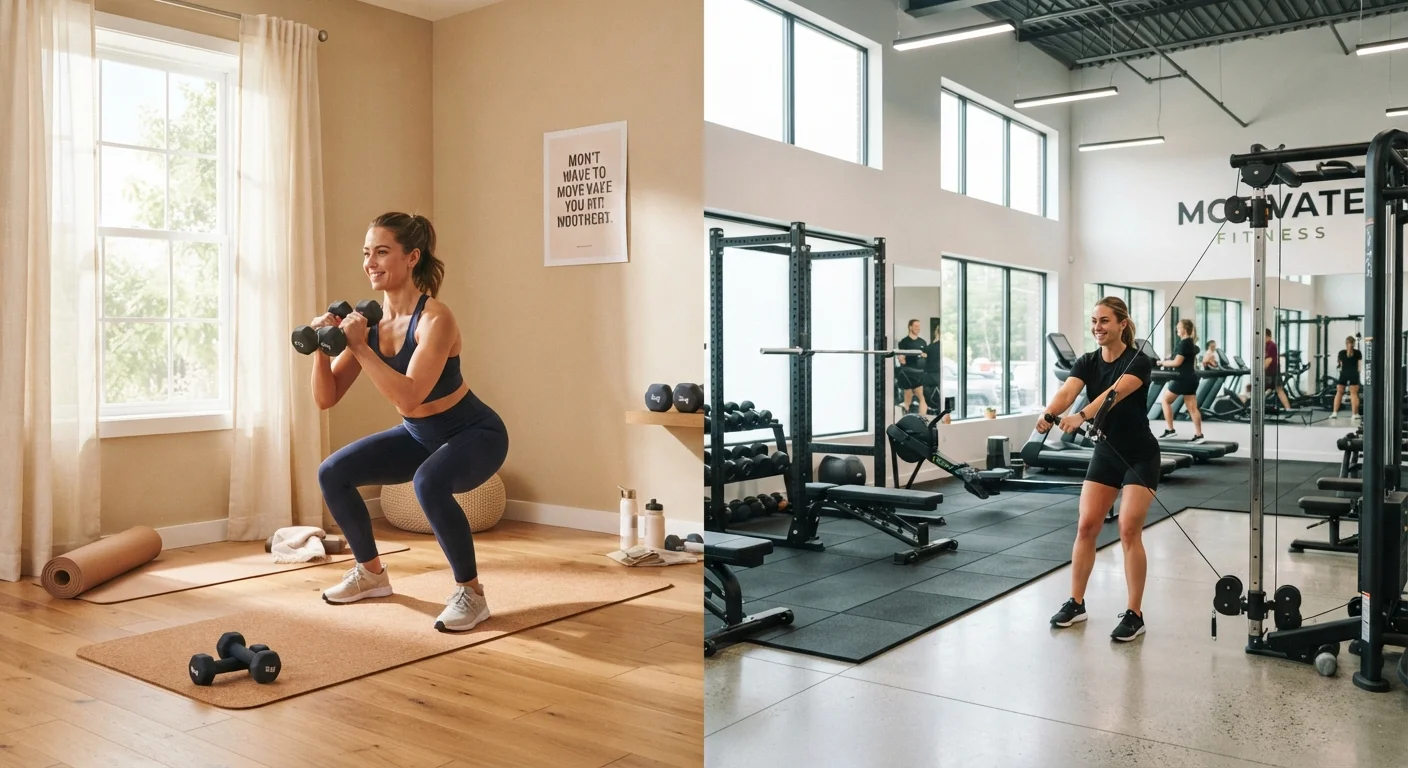
Home and gym workouts are both capable of producing meaningful fitness results when done consistently. The deciding factor isn't which setting is objectively better - it's which one you'll actually show up for, week after week. If cost and convenience are your biggest barriers, a well-structured home routine can match gym results for most fitness goals. If equipment variety, structure, or social accountability keep you engaged, a gym membership may be worth every dollar.
| Best for | Recommended |
|---|---|
| Those with tight schedules or limited budgets | Home Workouts |
| Those who need equipment variety or external motivation | Gym Workouts |
| Beginners who want a low-pressure environment | Home Workouts |
| Those training for specific athletic or strength goals | Gym Workouts |
The Real Question: What Will You Actually Stick With?
The fitness industry tends to frame the home-vs-gym debate around equipment and programming. But the more honest question is simpler: which setting makes it easiest to show up consistently? Research on exercise adherence consistently points to convenience and enjoyment as stronger predictors of long-term success than the sophistication of any given workout. Consistency tends to outperform intensity for most everyday exercisers - and your environment plays a significant role in sustaining it.
That means personal variables - your commute, your home space, whether you find crowds motivating or draining - deserve as much weight as any objective comparison of facilities. This breakdown covers the key dimensions most adults care about so you can make a grounded, realistic call.
| Home Workouts | Gym Workouts | |
|---|---|---|
| Monthly Cost | Low after initial setup | Ongoing membership fee required |
| Convenience | No commute, start anytime | Commute and schedule required |
| Equipment Access | Limited by home setup | Wide range available |
| Privacy | Fully private | Shared public space |
| Social Motivation | Minimal unless virtual | Built-in community and classes |
| Best Suited For | Flexibility, budget-conscious goals | Variety, performance, structure |
Cost: Upfront vs. Ongoing
Gym memberships in the United States typically run anywhere from roughly $25 to $80 per month for standard commercial gyms, with premium or specialty facilities costing considerably more. Over several years, that adds up. Home workouts, by contrast, can require a meaningful upfront investment in equipment - though basic setups with resistance bands, a mat, and a set of adjustable dumbbells can be assembled for a few hundred dollars. After that initial cost, ongoing expenses are minimal.
If you're weighing equipment options for a home setup, the resistance bands vs. free weights comparison is a useful starting point for understanding what delivers the most value per dollar at home.
Start With What You'll Actually Use
If you're new to working out, don't over-invest in either direction right away. A trial gym membership or a modest set of home equipment lets you discover which environment you actually prefer before committing significant money. Many gyms offer short-term or month-to-month memberships specifically for this reason.
Convenience and Time
One of the most underestimated factors in any workout routine is the time cost of getting there. A gym session that takes 45 minutes of actual exercise can easily consume 90 minutes once you add commute, parking, changing, and travel back. For people with demanding jobs, caregiving responsibilities, or irregular schedules, that friction is real - and it's one of the most commonly cited reasons people quit gym memberships.
Home workouts eliminate that friction entirely. A 30-minute session can begin within seconds of deciding to move. This is particularly relevant when you're just starting to build an exercise habit, when lowering barriers matters most. On the other hand, the gym's physical separation from home can itself be a motivating cue for some people - getting there signals a mental shift into workout mode.
Equipment, Programming, and Goals
Gyms provide access to a range of equipment that is genuinely difficult to replicate at home without significant expense: cable machines, barbells with heavy plate stacks, specialty cardio equipment, and more. For those pursuing specific strength benchmarks, training for athletic performance, or working toward goals that require progressive overload beyond what lighter home equipment allows, a gym offers a real advantage.
Home workouts are more than capable of supporting general fitness, weight management, cardiovascular health, and moderate strength development - particularly when combined with a structured plan. Learning how to build a weekly exercise schedule matters equally whether you train at home or in a gym. You'll also want to consider the role of different training types: what strength training and cardio each do for your body can help clarify what kind of equipment you actually need to meet your goals.
Motivation, Accountability, and Environment
Motivation is highly individual. Some people thrive in the social energy of a gym - seeing others working hard, having access to group fitness classes, or simply being somewhere dedicated to exercise. Others find that environment intimidating, distracting, or socially draining, and perform far better in the quiet of their own space.
Home workouts place the full responsibility of accountability on you. Without a class time to honor or a trainer watching, it's easy to shorten sessions or skip them. Strategies like scheduled workout times, virtual classes, or workout partners (even remote ones) can help offset this. For gym-goers, accountability is more built-in - but it's also contingent on getting out the door in the first place.
Neither approach is inherently more motivating. The question is which accountability structure fits your personality. Many adults find that a hybrid approach - gym sessions two or three days a week supplemented by home workouts - provides both structure and flexibility without over-relying on either.
This article is for general informational and educational purposes only. It is not a substitute for personalized advice from a qualified fitness professional or healthcare provider. Consult a professional before starting any new exercise program, particularly if you have an existing health condition or injury.