
Self-Paced vs. Scheduled Online Courses: What the Difference Actually Means for Your Learning

Key Takeaways
Option A
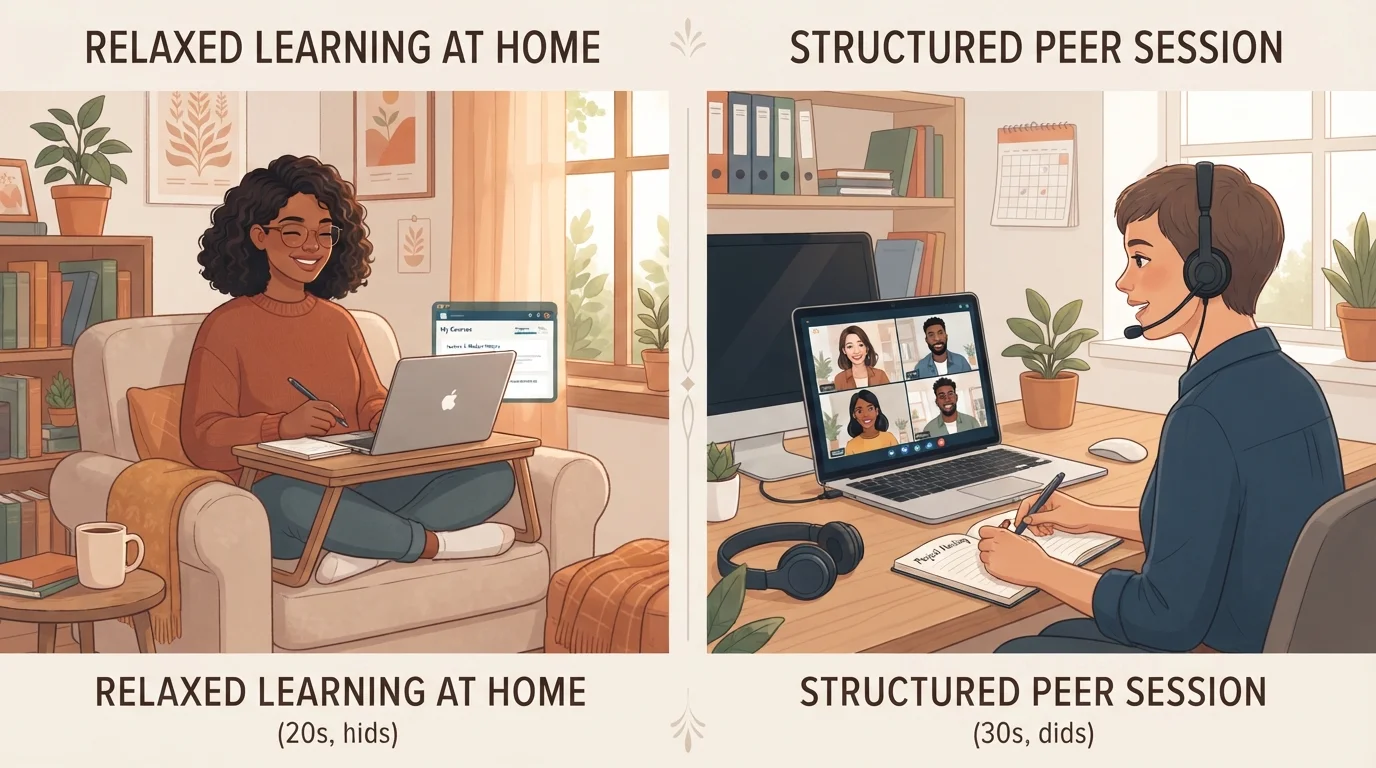
Self-Paced Online Courses
The flexible, on-your-own-schedule format.
Best for: Adults with unpredictable schedules, caregiving responsibilities, or existing expertise who want to move through material at their own speed.
Option B
Scheduled (Cohort-Based) Online Courses
The structured, community-driven format.
Best for: Learners who thrive on deadlines, peer interaction, and live instructor feedback to stay accountable and engaged.
If your schedule changes week to week
Self-Paced Online Courses
Self-paced formats let you study during windows that actually open up, without the penalty of missing a live session or falling behind a cohort.
If you need accountability to follow through
Scheduled (Cohort-Based) Online Courses
External deadlines and classmates who notice your absence are powerful motivators - cohort structures build that accountability in by design.
If real-time feedback from instructors is important to you
Scheduled (Cohort-Based) Online Courses
Cohort courses typically include live sessions, office hours, and discussion boards where instructors respond actively - far more interactive than most self-paced formats.
If you are revisiting familiar material or filling specific skill gaps
Self-Paced Online Courses
When you already have background knowledge, you can skip what you know and focus only on what you need - self-paced formats make that efficient.
If professional networking is part of your learning goal
Scheduled (Cohort-Based) Online Courses
Moving through a program alongside peers creates natural networking opportunities that self-paced courses, taken in isolation, cannot replicate.
What Each Format Actually Looks Like
The term self-paced means you access recorded lectures, readings, and assignments on your own schedule, with no fixed start date and no live sessions. You move as fast or as slowly as your life allows. Many platforms allow perpetual or long-window access - sometimes 90 days, sometimes a year or more.
Scheduled, or cohort-based, courses operate more like a traditional class. Everyone enrolls at the same time, progresses through the same material on the same weekly timeline, and often participates in live video sessions, graded discussions, or peer-reviewed assignments. Deadlines are real, and missing them typically has consequences.
These structural differences ripple through every part of the learning experience - from how often you log in to whether you ever interact with another student. For a broader view of how course delivery models vary across platforms, see how online learning platforms differ from each other.
| Criterion | Self-Paced | Scheduled / Cohort-Based |
|---|---|---|
| Start date | Enroll anytime | Fixed enrollment windows |
| Deadlines | None or soft access expiry | Weekly or module-based deadlines |
| Live interaction | Rare or none | Common - live sessions, office hours |
| Peer community | Minimal; asynchronous forums only | Active; shared timeline builds cohesion |
| Instructor feedback | Automated or delayed | Direct and timely |
| Completion rates | Typically lower | Typically higher |
| Schedule flexibility | High - study any time | Low to moderate - fixed calendar |
| Best credential weight | Certificates of completion | Graded credentials, formal credit |
The Completion Rate Gap - and Why It Matters
One of the most documented patterns in online education is that self-paced courses have significantly lower completion rates than cohort-based ones. Studies of massive open online courses (MOOCs), which are typically self-paced, have found completion rates often below 15%. Cohort-based programs, especially those with tuition costs or formal credentials attached, tend to see far higher follow-through.
<15%
Typical MOOC completion rate
Research on massive open online courses consistently finds that fewer than 15% of enrolled learners complete self-paced courses.
~50%+
Cohort course completion (paid programs)
Paid, cohort-based programs with formal credentials tend to see substantially higher completion, often exceeding half of enrolled learners.
3 in 10
Adults who cite flexibility as top need
Surveys of adult learners routinely find schedule flexibility is among the most frequently cited reasons for choosing online over in-person education.
This is not a judgment about learners - it reflects what behavioral science tells us about motivation. Deadlines, peer presence, and social commitment are among the strongest drivers of task completion. Self-paced formats remove all three by default.
That said, completion rate is not the only measure of value. An adult who dips into a self-paced course to learn one specific skill they needed - and stops there - may have gotten exactly what they came for.
How to Match the Format to Your Situation
Before choosing, answer three practical questions honestly:
- How predictable is my schedule? If your work hours shift, you care for dependents, or you travel frequently, a cohort format may create friction every week. Self-paced removes that friction.
- Do I finish things without external pressure? Look at your track record. If you've abandoned gym memberships, unread books, or half-finished projects, self-paced learning may replay that pattern. A cohort structure counteracts it.
- What do I need from this course beyond content? If you want a credential that carries weight, peer connections, or direct instructor feedback, cohort formats typically deliver more on those fronts.
The Adult Learner's Roadmap to Online Education covers how to evaluate these questions as part of a full course-selection process. And before you pay for anything, review the questions to ask before enrolling in any online course - format is just one variable among several worth checking.
Cost and Format Often Travel Together
Free and low-cost courses are overwhelmingly self-paced, while cohort-based programs tend to carry higher price tags. This cost difference can feel like it settles the question for budget-conscious learners, but it's worth separating the format decision from the cost decision. Some institutions offer cohort-based courses at modest prices, and some self-paced courses are expensive. Evaluate format and cost as distinct variables so one doesn't automatically override the other.
A Note on Hybrid and Asynchronous Formats
Not every course falls cleanly into one of these two categories. Some programs run on a cohort schedule but use only pre-recorded video and discussion boards - no live sessions required. Others are self-paced in content delivery but include optional live Q&A calls. These asynchronous cohort formats try to blend flexibility with accountability.
Reading course descriptions carefully matters here. Look for specific language: are there live sessions, and are they required? Are deadlines per-week or per-module? Is there a defined start date? The answers tell you far more than a marketing label like "flexible" or "interactive." For a side-by-side look at how learning formats affect working adults specifically, learning online as a working adult goes deeper on real trade-offs.