

Key Takeaways
Option A
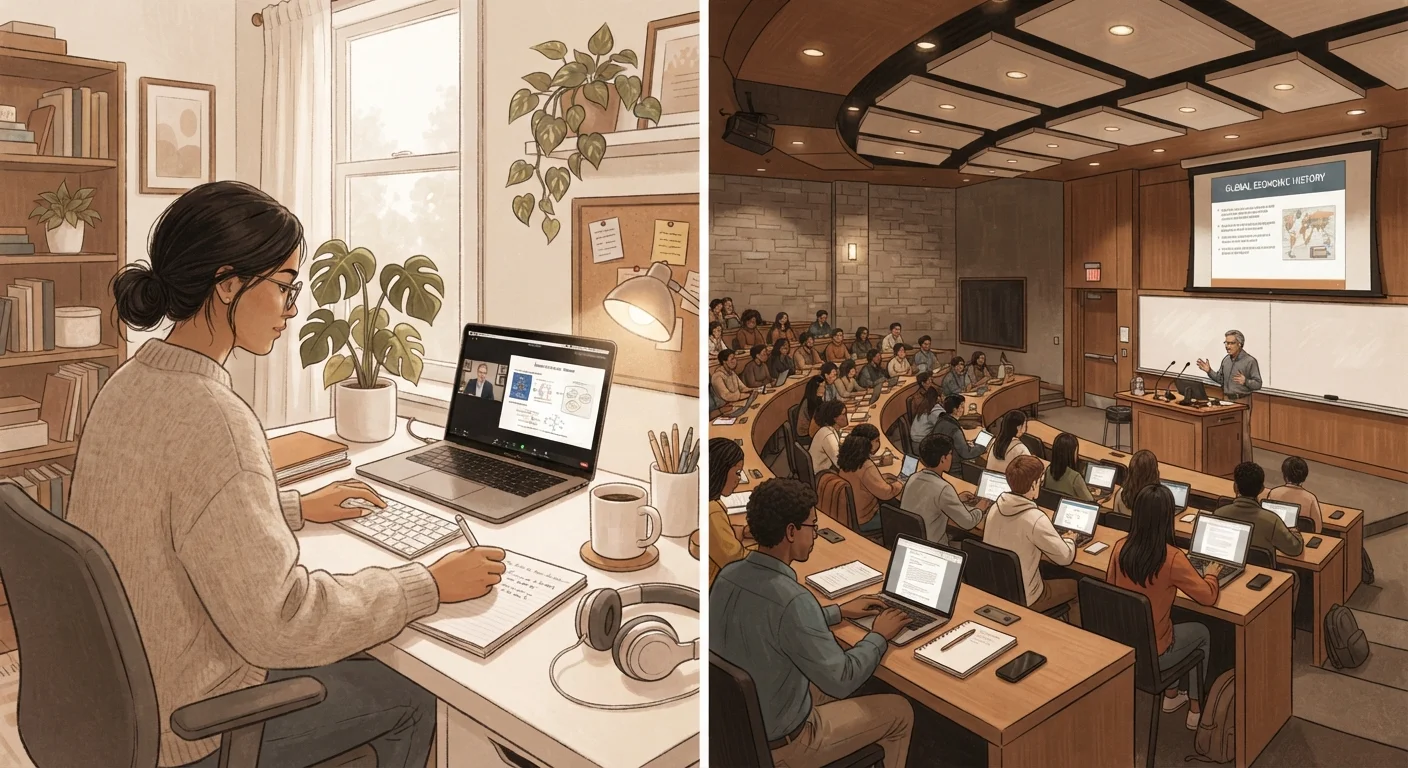
Online Degree
The flexible, location-independent path to a credential.
Best for: Working adults, caregivers, and learners in areas with limited campus access who need to study around existing commitments.
Option B
On-Campus Degree
The traditional, immersive college experience.
Best for: Students who thrive with face-to-face instruction, structured schedules, and direct access to campus resources and social networks.
If you're balancing a job or family responsibilities
Online Degree
Asynchronous coursework lets you complete readings and assignments around work shifts and caregiving duties without relocating or commuting.
If you're a recent high school graduate seeking the full college experience
On-Campus Degree
Campus life builds social capital, professional networks, and independence in ways that are difficult to replicate through a screen.
If cost is your primary concern
Online Degree
Eliminating room, board, and commuting costs can meaningfully reduce total debt load, though tuition rates vary widely by institution.
If your field requires hands-on labs, clinical hours, or studio work
On-Campus Degree
Nursing, engineering, and fine arts disciplines depend on physical equipment, supervised practice, and in-person critique sessions that online formats cannot fully replicate.
If you live far from accredited institutions in your field
Online Degree
Online programs remove geographic barriers entirely, opening access to institutions and specializations unavailable locally.
What Actually Differs Between the Two Formats
The most consequential differences between online and on-campus study aren't about prestige - they're about how learning is structured day to day. On-campus students attend scheduled classes, interact with instructors in real time, and participate in a physical campus ecosystem. Online students, by contrast, typically access recorded lectures, discussion boards, and digital assignments on their own timetables.
That flexibility cuts both ways. Without a fixed class schedule, online learners must supply their own structure. Research consistently shows that self-discipline and time management are stronger predictors of online student success than academic ability alone. For some learners that independence is freeing; for others it creates drift.
Social environment is another genuine difference. Campus life delivers organic networking - study groups form in hallways, professors are available after class, internship leads come through campus career fairs. Online programs increasingly replicate some of these touchpoints through virtual office hours and alumni networks, but the spontaneous connections of a physical campus are harder to engineer.
| Criterion | Online Degree | On-Campus Degree |
|---|---|---|
| Schedule flexibility | High - mostly asynchronous | Low - fixed class times |
| Social networking | Limited; requires deliberate effort | Organic and ongoing |
| Total cost of attendance | Generally lower (no housing/commute) | Generally higher overall |
| Hands-on lab or clinical access | Limited or arranged locally | Fully available on campus |
| Degree recognition (accredited) | Equal to on-campus | Equal to online |
| Federal financial aid eligibility | Available (if program qualifies) | Available |
| Self-discipline required | Higher - self-managed schedule | Moderate - structured externally |
For a closer look at how different online formats - live sessions versus asynchronous video - affect the experience, see Learning Online as a Working Adult.
What Stays the Same Regardless of Format
Accreditation is the most important constant. A degree from a regionally accredited institution holds the same academic recognition whether courses were taken on a quad or on a laptop. Employers and graduate schools evaluate the accrediting body and institution name, not the delivery method - provided the school itself is legitimate. If you're uncertain, the U.S. Department of Education's database of accredited institutions is the authoritative place to verify a school's standing.
Academic rigor, when the institution is equivalent, also remains consistent. Professors set the same learning outcomes for both cohorts; exams and papers carry the same weight. The common assumption that online coursework is less demanding has been widely challenged by educators and does not hold as a general rule. Online Learning Myths That Keep Adults from Getting Started examines this and other misconceptions in detail.
Financial aid eligibility is another area of parity. Federal student loans, Pell Grants, and many institutional scholarships apply equally to online and on-campus enrollment, as long as the program meets federal eligibility criteria. The total cost of attendance - factoring in housing and transportation savings - often differs substantially, but aid access itself does not.
43%
U.S. undergraduates enrolled in distance education
According to National Center for Education Statistics data, roughly four in ten undergraduates were taking at least some distance education courses in recent years.
~$12,000
Average annual room and board cost (public 4-year)
The College Board's Trends in College Pricing reports average on-campus room and board costs that online-only students can largely avoid.
Equal
Employer acceptance of accredited online degrees
Surveys conducted by Gallup and other researchers have found that employer concern about online degrees has declined substantially as online enrollment has grown.
Making the Decision That Fits Your Life
Neither format is universally superior. The right choice depends on three overlapping factors: your learning preferences, your life circumstances, and your field of study.
Field requirements matter more than many prospective students realize. Clinical nursing programs, laboratory science degrees, and architecture curricula have hands-on components that accreditors require to be completed in person, regardless of how the rest of the program is delivered. Verify what your intended program actually mandates before assuming full online completion is possible.
Life circumstances - employment status, family obligations, geographic location - often narrow the realistic options before academic preference enters the picture. For many adult learners, the question isn't which format is ideal in the abstract; it's which one is actually compatible with their existing life. The Online Learning hub covers a range of formats and platforms to help you think through what fits.
If you're weighing credentials below the degree level, Online Certificates, Diplomas, and Degrees: A Plain-Language Guide can help clarify what each credential type actually signals to employers and graduate programs.
Hybrid Programs: A Middle Path
Many institutions now offer hybrid or blended programs that combine online coursework with periodic in-person residencies or lab sessions. These formats can preserve scheduling flexibility while still providing face-to-face instruction for the components that benefit most from it. If neither fully online nor fully on-campus study feels right, ask admissions offices whether a hybrid track is available in your program of interest.